Battery Powered Food Trailer vs Generator: Which Is Better in 2026?
A practical guide for food trailer buyers comparing lithium battery systems and generators by power, cost, noise, maintenance, and real operating scenarios.
“Can we run the whole food trailer on batteries?” It is one of the first questions buyers ask when they want a quieter, cleaner-looking setup. The honest answer is: sometimes. A lithium battery system can be a great fit for a coffee trailer, an ice cream trailer, a short event shift, or a site with strict noise rules. But a generator still makes sense when your kitchen has a heavy electrical load, long operating hours, or no reliable charging plan.
The best choice is not about chasing the newest technology. It is about matching your power system to the way you actually work. Picture two owners at the same weekend market. One sells espresso and pastries for four hours. The other runs fryers, refrigeration, a hood fan, and a grill for ten hours. Giving them the same power package would be a mistake.
At ZZKNOWN, we help buyers think through a mobile kitchen as a complete operating system: layout, equipment, serving flow, electrical supply, and local requirements. This friendly guide will help you ask better questions before you decide between a battery-powered food trailer and a generator.
How does a battery-powered food trailer work?
A battery-powered food trailer stores electricity in a battery bank—usually lithium iron phosphate (LiFePO4) for modern mobile applications. An inverter changes stored DC power into the AC power used by outlets and equipment. The system is then recharged from shore power, solar panels, a generator, or a combination of those sources.
Think of it like a large, carefully managed power bank. It can run lights, POS devices, a water pump, small refrigeration loads, coffee equipment, and other appliances within its rated capacity. The key words are rated capacity and runtime. A battery may handle a momentary surge, but that does not mean it can run every appliance all day.
How does a generator-powered food trailer work?
A generator turns fuel into electricity while it runs. It can deliver substantial power for as long as you have fuel and the unit is maintained. For many high-output food businesses, that makes it a familiar and practical answer.
Generators are not automatically noisy, unreliable, or old-fashioned. Modern inverter generators can be much quieter and produce cleaner power than basic conventional units. The trade-off is ongoing fuel, exhaust management, refueling, service, and event rules about where the generator can sit.
What is the real difference between batteries and generators?
| Question | Battery system | Generator |
|---|---|---|
| Noise at the trailer | Nearly silent | Depends on model, placement, and load |
| Runtime | Limited by stored energy and load | Extended with safe refueling and maintenance |
| Best for heavy cooking loads | Often needs a large, costly bank or backup | Usually the more direct choice |
| Daily operating cost | Low after installation when charging is available | Fuel cost varies with load and local prices |
| Up-front investment | Typically higher for a meaningful capacity | Often lower for comparable high output |
| Maintenance | Fewer routine mechanical tasks, but professional electrical care matters | Fuel, oil, filters, exercise, and service schedule matter |
The right question is not “Which is better?” It is “Which limitation can my business live with?” A quiet battery system has a finite energy budget. A generator has fuel, noise, and service requirements. Neither is a shortcut around good planning.
When is a battery-powered food trailer the better choice?
Batteries shine when the experience matters as much as the electrical load. Think of wedding venues, hotel courtyards, office campuses, premium markets, museums, or evening events where guests are standing close to the trailer. Silence helps your menu board, music, customer conversations, and brand feel more polished.
- Coffee, beverage, bakery, and dessert concepts with manageable loads and shorter service windows.
- Sites with shore power where the battery can recharge before or during the event.
- Noise-sensitive locations that restrict generators or expect a quieter setup.
- Operators who want a cleaner service area without a generator beside the customer queue.
- Low-load overnight needs such as lighting, security, or small refrigeration, depending on capacity.
Here is the practical lesson we share with buyers: a battery system works best when you can name every significant load. “We only need some power” is not enough. A commercial espresso machine, electric water heater, induction cooker, air conditioner, or fryer can change the calculation dramatically.
When is a generator the smarter choice?
A generator remains a strong option when you need high wattage, long service hours, or the ability to work far from reliable grid power. It is often the practical backbone for a busy fully equipped food trailer with electric cooking equipment.
- High-output menus: fried food, grilled food, electric ovens, large refrigeration loads, or heavy ventilation.
- Long festivals and remote events: especially when shore power is uncertain or unavailable.
- Rapid refueling needs: where swapping or refilling fuel is simpler than arranging a long recharge.
- Budget-led launches: when a smaller battery package cannot cover the real load.
Choose a generator thoughtfully. Look at continuous output—not just a large peak number—plus fuel consumption, noise rating, outlet type, certification, ventilation, and safe external placement. A cheap unit that is too small will be expensive in stress, downtime, and damaged customer trust.
How do you calculate the power your food trailer really needs?
Start with an equipment list. For every item, record rated watts or amps, voltage, and whether it runs continuously or only in short bursts. Then separate the loads into three groups:
- Always on: refrigerators, freezers, POS, lights, water pump, and network equipment.
- Often on: coffee machines, hood fans, warmers, and ice makers.
- High-demand or intermittent: fryers, grills, water heaters, air conditioning, and induction equipment.
Expected running load + reasonable simultaneous equipment load + a safety margin = your starting power target.
Then calculate energy use over time. Power (kW) tells you how much your system must deliver at a moment. Energy (kWh) tells you how long a battery can last.
Do not rely on generic internet tables alone. Appliance ratings vary by model, voltage, climate, and duty cycle. Have a qualified electrician or experienced equipment professional validate the final design. Electrical safety and local regulations are not places to guess.
How much does a battery system cost compared with a generator?
A fair comparison includes more than the purchase price. A battery system may require the battery bank, inverter, charger, monitoring, wiring, protection devices, labor, and possibly solar. A generator package may require the generator, connections, cable management, weather protection, fuel, regular service, and a safe operating location.
Over time, batteries can be attractive for owners who recharge from affordable shore power and use moderate daily loads. Generators can be cost-effective when they prevent you from buying a very large battery bank just to cover a few high-load appliances. Ask your supplier for a written load calculation and quote the system as part of the trailer—not as an afterthought.
Could a hybrid battery-and-generator setup be the best answer?
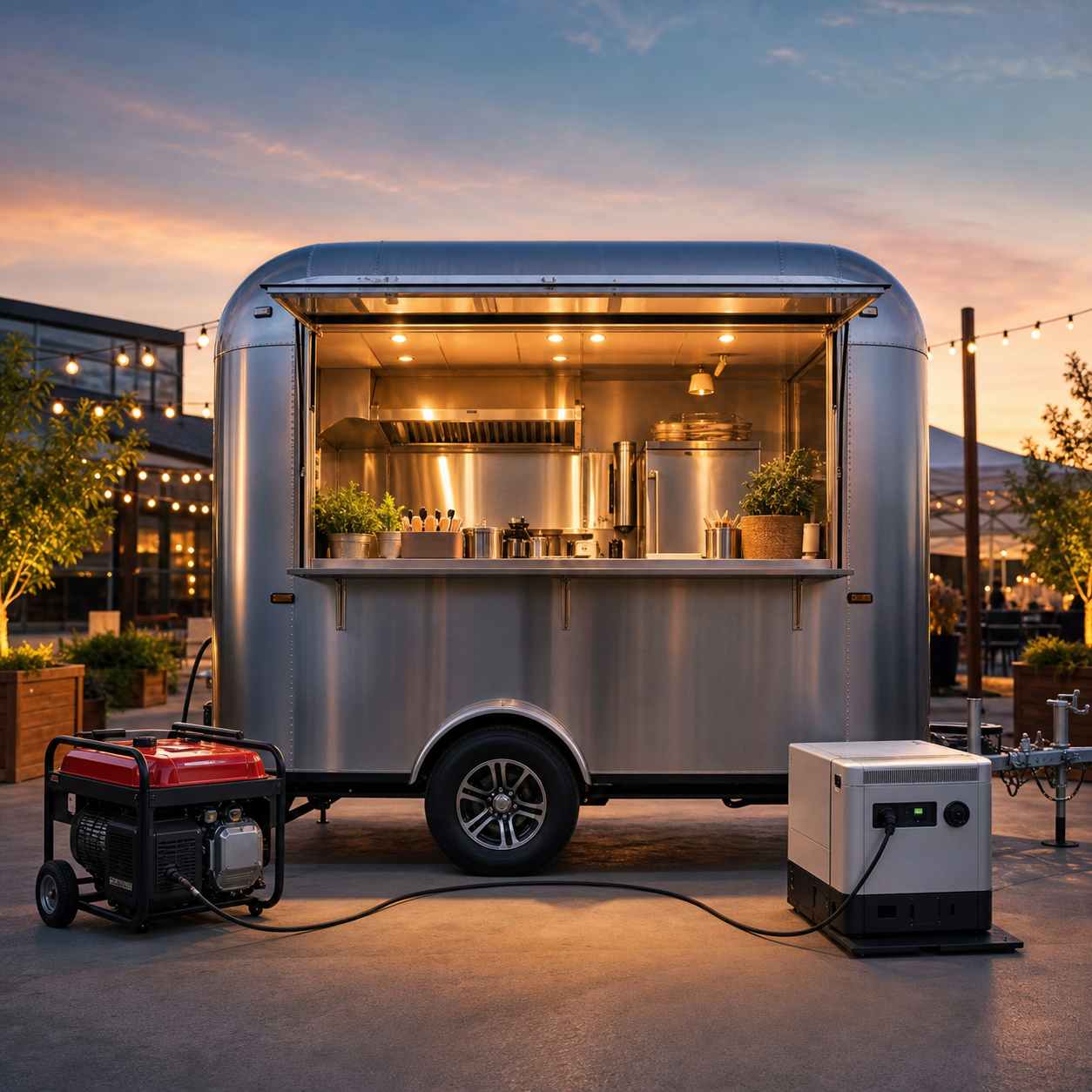
For many operators, yes. A hybrid system uses batteries for quiet light-load periods and a generator only when required. That can reduce noise and fuel use without asking the battery bank to do the impossible.
For example, a coffee trailer may use batteries while guests arrive and order, then start a generator only during a sustained peak period. A festival trailer may use batteries overnight for essential loads, while the generator carries the heavy cooking service. The exact control strategy should be designed safely by professionals.
What should you ask before ordering a power-ready food trailer?
Bring these questions to your manufacturer and electrical professional:
- What are my actual peak and continuous loads?
- How many service hours do I need without shore power?
- Which equipment can be propane or gas instead of electric?
- Where will the generator sit, and how will exhaust be kept away from customers?
- What voltage, plugs, breaker panel, and local standards apply in my market?
- Can the trailer accept shore power, solar, a battery system, and a generator in a safe coordinated design?
- How will I monitor state of charge, fuel, and load during service?
ZZKNOWN’s custom food trailer process starts with the operating reality: menu, equipment, service volume, destination market, and your preferred power sources. That is how a power package becomes useful rather than just impressive on a quote sheet.
What is the bottom line?
Choose batteries when quiet operation, a refined customer experience, and predictable moderate loads are central to your business. Choose a generator when you need robust power, long runtime, and flexibility in remote locations. Choose a hybrid system when you want both quiet periods and heavy-duty capability.
Most importantly, size the system around your real equipment and real hours. A power system should let your team focus on food and customers—not on wondering what will trip next.
Frequently Asked Questions
Can a food trailer run entirely on batteries?
Yes, some can. It depends on the equipment load, desired runtime, battery capacity, charging plan, and local electrical design. High-load all-electric cooking can require a very large system or a backup generator.
Are lithium batteries safe for food trailers?
They can be safe when properly specified, installed, protected, ventilated where required, and maintained according to applicable standards. Use qualified professionals for the final electrical design and installation.
Can solar panels power a food trailer?
Solar can help recharge batteries and support lower loads, but roof area, weather, season, and energy demand limit what it can do. Treat solar as part of a system, not an automatic replacement for every other power source.
What size generator do I need for a food trailer?
It depends on the continuous and simultaneous load of your exact appliances. Build a load list, include startup demand and a safety margin, then have the system validated by a qualified professional.
Should I choose an electric or gas cooking line?
That choice affects power sizing, ventilation, fuel logistics, local codes, and how you cook. Discuss the menu and destination market before finalizing the equipment layout.