
What Can You Do With a Custom Trailer Besides Serve Food?
Direct answer: A custom trailer can become a mobile retail shop, flower stand, barber studio, pet-grooming workspace, gaming lounge, ticket booth, brand-activation unit, photo studio, classroom, field office, repair workshop or regulated health-service space. The best use is the one whose customer flow, utilities, payload, accessibility and local approvals fit a towable footprint—not simply the idea that looks most exciting in a rendering.
What should you remember before choosing a concept?
- A trailer is a platform, not a business model; demand, site permission and operating costs decide whether the idea works.
- Retail and event uses often need less plumbing than grooming, barbering or health services, but may still need electrical, accessibility and fire review.
- Never order around a generic “DOT/CE approved” statement. Vehicle compliance and business permits are different questions.
- Put your largest item, busiest customer hour and most demanding utility on the drawing before you choose the size.
- ZZKNOWN’s existing KN-FS800 gaming trailer and KN-OT450 office unit illustrate different real product platforms; the 12 ideas below are planning concepts, not claims that each has already been built.
Who is this guide for, and how current is the information?
This guide is for international buyers evaluating a towable business trailer for the United States, Canada, the European Union, United Kingdom, Australia or another market. Product specifications and the primary U.S. sources linked below were checked on September 16, 2026. Other countries have different vehicle, trading, workplace, professional-license and accessibility rules. The design comparisons are qualitative engineering guidance, not a market survey or a quotation. A local approval body, landlord, organizer or licensing agency must review the actual use and site.
Why might a trailer beat a permanent storefront?
Imagine a florist testing a weekend market. She needs refrigerated storage for arrangements, a clean display and enough room to take payments. Renting a permanent shop before learning which neighborhood buys flowers would lock her into a location. A towable pop-up can test sites, but it does not remove the hard parts: a suitable tow vehicle, secure parking, setup labor, insurance, weather exposure, permitted selling locations and a clear storage plan overnight. That is the useful comparison. A trailer can reduce dependence on one fixed address and support events, yet mobility itself has a cost.
According to ZZKNOWN’s production experience, the first drawing is most effective when it begins with the customer journey: where a customer approaches, what they see, where they pay, where staff retrieve stock and how the trailer closes for towing. A pretty exterior does not fix an aisle that blocks the staff or a shelf that overloads one axle. We have treated the examples below as design briefs you could hand to an engineer, not as promises of profit.
How do 12 non-food trailer businesses compare at a glance?
| Idea | Critical layout need | Utility intensity | Main question before ordering |
|---|---|---|---|
| 1. Mobile retail | Display, secure stock, checkout | Low–medium | Where can you trade? |
| 2. Flower shop | Cool storage, water-resistant worktop | Medium | How long can stock stay fresh? |
| 3. Barber or beauty studio | Chair clearance, sanitation, privacy | Medium–high | What professional licenses apply? |
| 4. Pet grooming | Animal restraint, wash/dry, drainage | High | How will wastewater be managed? |
| 5. Gaming lounge | Seating, screens, ventilation | High electrical | How many guests can the layout safely host? |
| 6. Ticket or information booth | Protected window, queue, visibility | Low | Does the organizer allow the setup? |
| 7. Brand-activation unit | Openable façade, adaptable graphics | Medium | How quickly can a campaign be reset? |
| 8. Photo/video studio | Lighting control, equipment storage | Medium–high | How will you protect gear while towing? |
| 9. Pop-up classroom | Seating, sight lines, accessible entry | Medium | Will learners enter the trailer? |
| 10. Field office | Desk, data, climate control | Medium | How long will it stay on one site? |
| 11. Repair workshop | Tool restraint, workbench, ventilation | Medium–high | What hazardous work or waste occurs? |
| 12. Health-service space | Privacy, clean/dirty separation | High and regulated | Which licensed provider and authority approve it? |
“Utility intensity” is a relative design ranking, not a measured power, water or price value. It assumes the service described in each row and changes with the equipment list.
Which ideas make sense for selling products?
1. Could a mobile retail trailer test a neighborhood before you sign a lease?
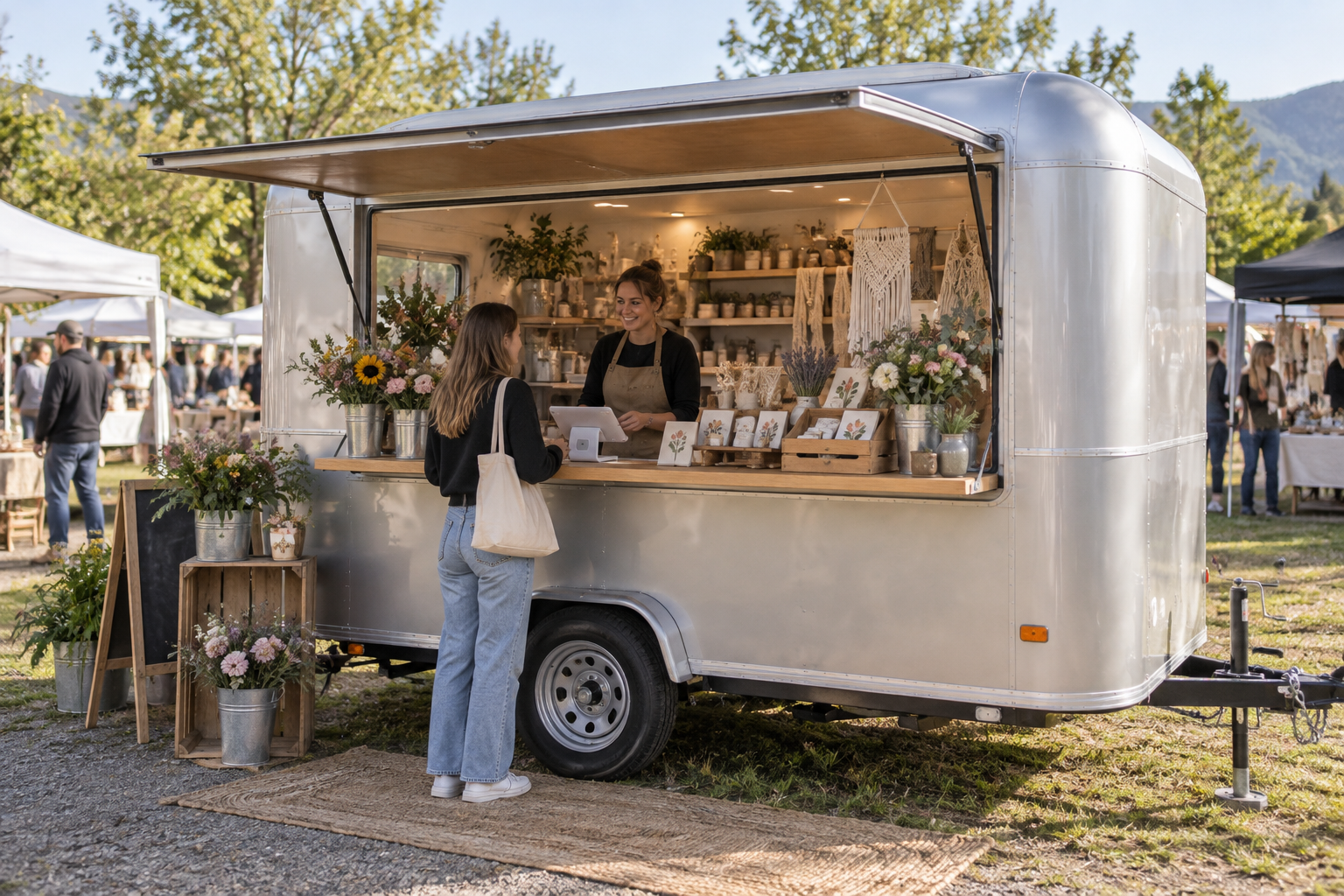
Yes, especially when your goods can be displayed compactly: apparel, books, handcrafted items, sports accessories or local souvenirs. Start with how many customers can browse without stepping into the trailer. A wide serving window and exterior display can keep the interior for staff and secure stock; a walk-in showroom needs an entrance, aisle, lighting and accessibility review. Use locked cabinets, positive latches and shelving sized for your actual packages, not empty presentation shelves. A point-of-sale counter should be visible before the customer asks where to pay.
The easy mistake is carrying too many SKUs. Heavy merchandise affects payload and axle loading, while weak inventory rotation ties up cash. Ask the market organizer and local authority about temporary trading, signage and site power. If you are evaluating exterior formats, browse ZZKNOWN’s OEM and custom trailer product categories as starting points, then specify a retail—not kitchen—interior.
2. Would a flower trailer work better as a window shop or a walk-in shop?
For weekend markets, a window-shop design is often easier to operate: people see bouquets, order at the counter and staff work inside. A walk-in layout can feel immersive, but it consumes space that could be used for cool storage and wrapping. Flowers need shade, appropriate cooling and a plan for stems, water and discarded plant material. A floor that looks beautiful in a rendering may be slippery or hard to clean after buckets spill. Give the engineer the largest bouquet bucket, anticipated stem deliveries and realistic daily inventory before picking shelf heights.
Do not assume a domestic refrigerator will keep a trailer cool in direct sun. Calculate the equipment load and heat gain for the actual climate, verify the chosen unit’s commercial suitability, and keep the refrigeration vents clear. The relevant question is not “Can a trailer sell flowers?” It is “Can it preserve the stock and make the handoff pleasant?”
Which ideas are really service businesses?
3. What changes if the trailer is a mobile barber or beauty studio?
The customer spends time inside, so comfort and privacy matter far more than on a retail trailer. Mark the chair’s full working radius, the stylist’s movement and the position of a client waiting to enter. Plan washable surfaces, tool sanitation, hot and cold water when required, hair collection, mirrors, task lighting and climate control. A product list may look small, yet one chair, sink, storage cabinet and accessible circulation can consume most of a compact trailer.
Licensing is not portable in the same way the trailer is. State, provincial or national professional boards may set rules for salons, mobile service and sanitation; some locations may not allow the proposed setup at all. Ask the licensing board and the site owner before freezing the layout. Never label the concept “licensed” merely because its fixtures resemble a salon.
4. Why is pet grooming a much more demanding conversion than it first appears?
A grooming trailer is a small wet workshop that also carries living animals. The floor needs secure footing, the dog needs safe restraint, staff need access around the tub, and the blower needs a place where heat, noise and moisture can be managed. A bath, fresh-water tank, water heater and wastewater tank all add weight. Build in protected storage for disinfectants and tools, and make it easy to clean hair from screens and drains. Think about how the groomer exits quickly with a frightened animal.
Ask for the largest breed served, expected baths per day and whether animals enter by ramp. A tiny vanity sink is not a substitute for a workable bathing station. Local animal-care rules, business licensing, wastewater disposal, parking and customer access may apply. If you want this use, send the groomer’s workflow and real tub dimensions to ZZKNOWN before asking for a trailer length.
Which concepts are strongest for events and entertainment?
5. Could a gaming trailer earn its space at birthdays or corporate events?
It can be a useful event product when the layout supports guests rather than just screens. ZZKNOWN’s real KN-FS800 custom gaming trailer is published as an 8 m × 2.1 m × 2.3 m platform. Its product page shows why gaming is its own engineering brief: seating, screen mounting, cable protection, cooling, power distribution, lighting and exterior branding all interact. The published model dimensions are evidence of a real product; they are not a universal capacity, licensing or earnings figure.
Define the game systems, simultaneous players, standing staff, accessible guest experience and planned power source. Screens and consoles produce heat, and poor ventilation makes a full session uncomfortable. A buyer should also check venue rules, insurance, local amusement or event requirements where relevant, and safe ingress and egress. If guests cannot comfortably enter and leave, more screens will not solve the business problem.
6. When does a ticket booth need more than a simple serving hatch?
A ticket or tourism-information unit can be compact, but queue design is critical. The window should be visible, sheltered and positioned so the line does not block pedestrian traffic. Staff need a counter, secure drawer, network connection, lighting and a place for signs or maps. If the use involves cash, equipment security and clear sightlines matter. If visitors can enter, review aisle and entrance dimensions rather than copying a vending trailer design.
Public events may have organizer rules for trailer placement, emergency access, electrical hookup and trading rights. The site plan is as important as the vehicle drawing. Ask for a map of the actual event footprint before choosing which side the window opens on.
7. How can one trailer support several brand-activation campaigns?
Build for reset, not just for the first campaign. A promotional trailer may be a sampling window one month, a product-launch stage the next and an information counter after that. Removable graphics, modular mounting rails, adaptable lighting and protected cable routes make those changes easier. A large opening adds visual impact, but its structure, hinges, weather sealing and setup procedure require deliberate engineering.
Make a campaign kit list: display weight, packaging size, staff positions, customer interaction, audio, lighting and power. A brand wants a clean visual, but the operating team needs fast load-in and a reliable close-up routine. The trailer should not need a day of improvisation every time it moves.
8. What would make a photo or video trailer useful rather than cramped?
It depends on whether clients enter. An exterior photo booth may need a protected camera, background mount, screen and printer. A walk-in portrait studio needs enough distance between subject and camera, controlled light, privacy and climate comfort. Equipment must be restrained for towing; loose tripods and lights are a payload and damage problem. Cable routes should stay out of walking paths, especially in low light.
A trailer can bring a creative experience to festivals or private events, but site permissions, media consent, data storage and power quality should be reviewed by the operator. The vehicle manufacturer can design mounting points and circuits; it cannot grant permission to photograph attendees or solve the client’s privacy process.
Which concepts support work and learning?
9. Could a trailer become a pop-up classroom or demonstration lab?
Yes, if the lesson itself fits the space. A compact trailer is better for small workshops, product demonstrations or a teaching counter than for copying a full classroom. Put the instructor’s sightline, learner seating, screen visibility and storage on the plan. If students enter, plan the entry and circulation for the actual group. If the lesson happens outside, a side opening, awning and power connection may be more valuable than extra interior seats.
Any education provider should confirm venue rules, child safeguarding where applicable, accessibility and fire capacity with the relevant authority. This guide is about the platform and workflow, not accreditation or permission to run a school. Mobile learning works when the service is clearly scoped.
10. Why might a field office be the simplest real-world benchmark?
A field office has a familiar brief: staff need desks, light, heating or cooling, data, storage and perhaps a restroom. ZZKNOWN lists a real KN-OT450 portable construction office unit at 4.5 m × 2.15 m × 2.5 m, with worktable, cabinets, windows and an air-conditioning outlet among the published options. That is a useful reference model for site offices, not a guarantee that it suits every jurisdiction or crew size.
On a long project, stable leveling, weather sealing, site-power protection, communications and day-to-day comfort become more important than how often the trailer can move. Define the staff count, workstation equipment and duration on site. Also clarify whether a restroom is needed on board or available nearby. A dry office usually has an easier utility brief than a wet grooming or clinical service, but a site still has rules.
11. Could a mobile repair workshop save customers a trip?
That depends on what is repaired. A bicycle-service unit may need a secure bike stand, parts bins and hand-tool storage. An electronics repair trailer may need dust control, stable power, ESD-aware work surfaces and secure devices. A small equipment workshop may need a stronger bench, tool restraint and ventilation. These are very different payloads. Put the heaviest tool and longest workpiece in the CAD drawing, and ask where a customer hands over an item without crossing the technician’s work zone.
Do not assume every process is suitable inside a trailer. Welding, solvents, batteries or other hazardous work can trigger specialist fire, ventilation, waste and workplace requirements. A general-purpose mobile retail trailer is not automatically a safe repair shop. Use a task-by-task process list and ask local reviewers about the risky steps.
Which idea needs the most careful regulatory review?
12. Can a trailer be a health-service space without becoming a licensed clinic?
A trailer can physically host some outreach, screening, consultation or service functions, but the permitted clinical scope depends on the provider, destination and jurisdiction. That distinction is essential. A private consultation room, cleanable finishes, handwashing, privacy, temperature control, safe entry, secure record systems and accessible service may be needed. Some services require medical-grade equipment, infection-control planning, regulated waste handling, licensed practitioners and a specific facility approval. None of that is created by installing cabinets and a sink.
Start by asking the healthcare operator exactly which services will be offered and which authority licenses them. Then involve a healthcare-facility designer and the relevant public-health regulator. ZZKNOWN can discuss the trailer envelope and fabrication options, but it should not represent an ordinary OEM unit as a certified clinic. This concept is included because buyers ask about it—not because it is a quick conversion.
What do real ZZKNOWN product models tell us about flexibility?
| Published product | Verified published size | What it illustrates | What it does not prove |
|---|---|---|---|
| KN-FS800 gaming trailer | 8 m × 2.1 m × 2.3 m | Entertainment-focused interior and high electrical planning | Revenue, legal guest capacity or blanket national approval |
| KN-OT450 office unit | 4.5 m × 2.15 m × 2.5 m | Worktable, cabinet, windows and climate-control provision | Permission for every site or crew size |
| KN-580CS restroom trailer | 5.8 m × 2.1 m × 2.55 m | How specialized wet-service layouts change tanks, partitions and utility needs | That a retail or clinical conversion can reuse its plumbing unchanged |


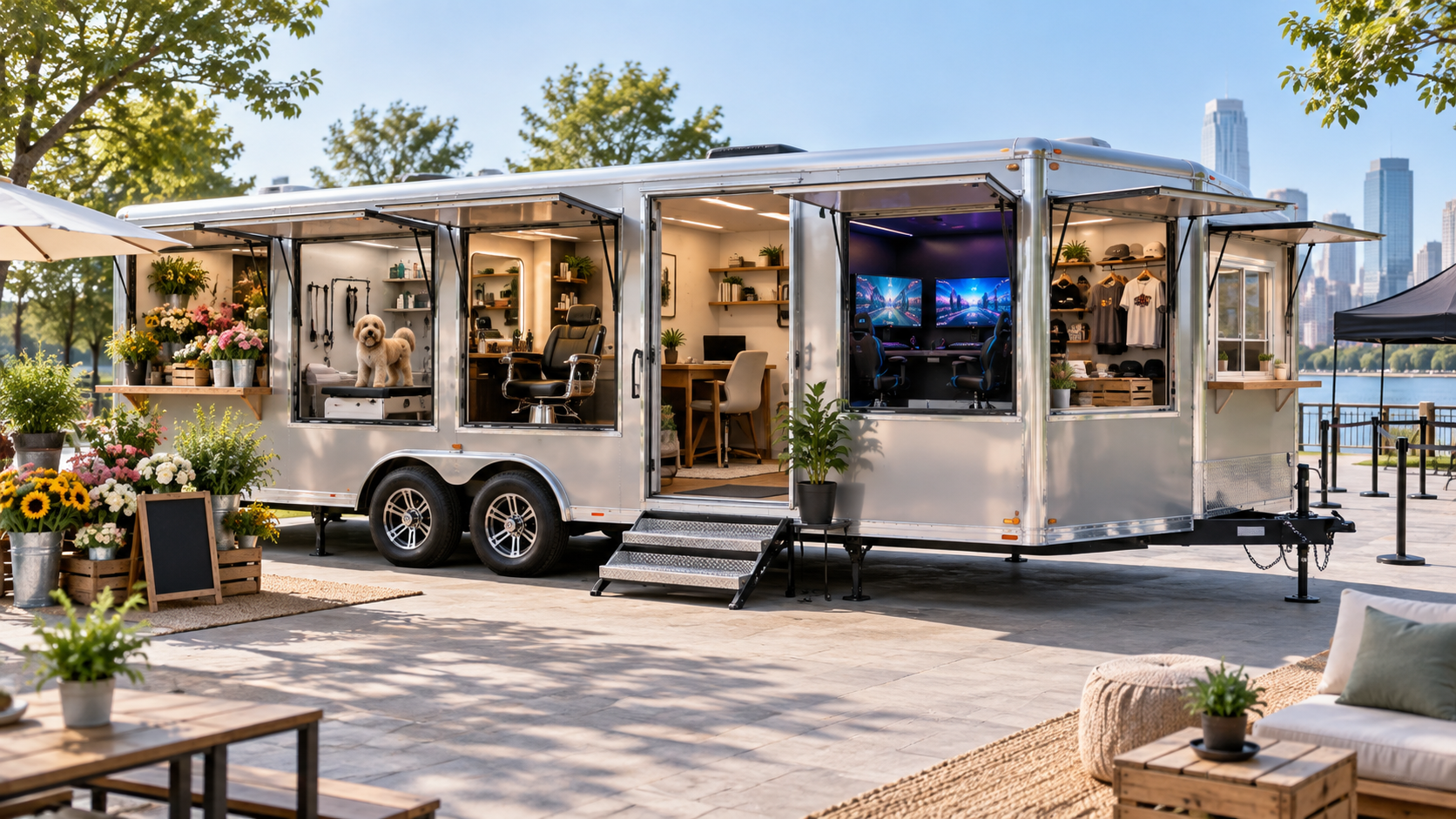
Those are existing ZZKNOWN product pages and their published images, not invented case studies. The concept image above is a generated visualization. Buyers should ask ZZKNOWN for current project photos and exact unit records before using any picture as proof of a delivered configuration.
What should an engineer ask before recommending a trailer size?
A useful first-stage package contains a menu of tasks (even for a non-food trailer), furniture or equipment model numbers, workflow sketch, electrical list, storage plan, site map, vehicle category and photos of the customer interaction you want to create. This allows the factory to prepare a two-dimensional layout for review. It does not make ZZKNOWN the authority for local licenses, accessibility determinations or clinical permissions.
How should global buyers check road safety and customer access?
In the United States, the National Highway Traffic Safety Administration warns trailer buyers that imported towable trailers must meet applicable federal safety standards and carry the manufacturer’s certification label. A VIN or sales-page badge alone is not a substitute for the right vehicle documentation. Other markets use different approval paths; review ZZKNOWN’s global trailer-certification guide and confirm the route with the destination’s registration or approval body before deposit.
Customer access is a separate design question. The U.S. Department of Justice explains that businesses open to the public—including retail shops and service establishments—must provide equal access to goods and services; its ADA Title III guidance points to accessible routes and sales/service provisions where applicable. Trailer-specific implementation can depend on site, use and jurisdiction. Ask a qualified local accessibility reviewer how customers will be served, especially if entering the trailer is part of the experience. In other countries, consult local accessibility law rather than assuming the U.S. ADA applies worldwide.
Which costs should you compare before asking for a price?
A factory quotation covers only part of the business. Compare trailer fabrication, interior fit-out, equipment, shipping/import, towing vehicle, insurance, storage, site fees, utilities, professional licensing, testing, marketing, staffing and ongoing maintenance. Do not copy a generic food-trailer price onto a gaming, grooming or clinical unit: screens, tubs, tanks, ventilation, doors and special finishes change the bill of materials. We did not insert a dollar range because no common specification was collected for the 12 concepts and cross-country figures would mislead buyers.
Which concepts are typically simpler to quote?
Exterior-facing retail, flower display and ticket booths can often be described with a shorter equipment list. Their costs can still rise with climate control, secure stock, custom façades and permits.
Which concepts need a detailed utility schedule?
Pet grooming, barbering, gaming, workshops and health services need model-specific water, wastewater, power, heat, ventilation or safety information before a meaningful quotation.
How did we gather and compare the information?
We identified the 12 applications from buyer-facing design possibilities, then compared each by customer entry, utility intensity, wet or dry workflow, equipment restraint and approval complexity. We checked real model names and dimensions against ZZKNOWN’s published product pages on September 16, 2026. For the U.S. regulatory context, we used primary NHTSA and U.S. Department of Justice guidance rather than third-party “all-purpose certification” articles. The descriptions are qualitative design analysis, not measured market demand, conversion rates, earnings claims or inspected client outcomes. The 12 ideas are original concept briefs; only the three linked product platforms are described as existing ZZKNOWN models.
What do buyers usually ask before ordering a non-food trailer?
Can I buy a food trailer and simply remove the kitchen?
Sometimes a shell or chassis can be adapted, but review the doors, windows, floor, utilities, weight balance and approval scope. Removing appliances does not automatically create a safe retail, grooming or studio layout.
Which use needs the least water?
An exterior-facing ticket booth or dry retail counter may need little or no on-board water, depending on the operator’s tasks and local rules. A grooming or barber service usually needs a more detailed water and wastewater plan.
Can customers walk inside any custom trailer?
No. The design must account for entrance, circulation, exit, floor load, customer capacity, accessibility, ventilation and site approval. Some compact concepts work better as exterior-window service.
Will a gaming trailer need a generator?
Not always. It may use approved site power, a generator or another appropriately designed system. Add up the actual equipment loads, startup demands, cooling and lighting before selecting an electrical package.
Is a mobile pet-grooming trailer the same as a restroom trailer?
No. Both are wet-service designs, but animal handling, tub dimensions, hair removal, restraints and wastewater arrangements differ. Reusing a tank specification without a workflow review is risky.
Can ZZKNOWN guarantee a business license in my country?
No manufacturer can issue every local trading, salon, clinical, event or site license. ZZKNOWN can prepare a configuration and documentation package for local review; the authority and operator decide the permitted use.
What photos should I ask to see?
Ask for current real-unit photos of the body, chassis, utilities and interior details for the model being quoted, plus the model number and final equipment list. Do not treat a generated hero visualization as a delivery record.
What should I send for a custom layout recommendation?
Send your business concept, destination and operating city, proposed site, largest equipment sizes, staff/customer count, required power and water, inventory weight, tow vehicle and any local approval checklist.
Which related product, case and guide pages should you read next?
- Real KN-FS800 gaming trailer product and gallery
- Real KN-OT450 field-office product and gallery
- ZZKNOWN mobile-office application page
- Global trailer-certification buying guide
- ZZKNOWN trailer catalogs and downloads
Which official sources support the key safety and access points?
- NHTSA: Consumer Alert on Trailer Federal Safety Regulations.
- U.S. Department of Justice: Businesses Open to the Public under ADA Title III.
- U.S. Department of Justice: Guidance on Web Accessibility and the ADA (relevant if appointments, ticketing or commerce are offered online).
Would you like a layout for your non-food business trailer?
Tell ZZKNOWN what you will sell or do, where the trailer will operate, who enters it, what equipment and stock you carry, and how you will provide power and water. Ask for a concept CAD layout and a model-specific quotation that you can take to the relevant local reviewers.
Request a Custom Business Trailer LayoutExplore Real ZZKNOWN Trailer Models
Editorial note: This guide is educational. It does not replace vehicle approval, accessible-design, professional-licensing, fire, workplace, medical, insurance or site advice. Verify the final use with the competent authorities for your destination and operating location.


