






How Do You Protect a Coastal Container Restaurant From Corrosion?
What should you remember first?
- Corrosion protection begins with the site brief and structure design, not the final paint color.
- ISO 12944 classifies environments and helps select protective paint systems; it is not a blanket certificate for a finished restaurant.
- Coastal exposure varies sharply with sea spray, wind, shelter, condensation, drainage and cleaning, so a distance-from-water rule alone is unreliable.
- Welds, cut edges, door frames, roof joints, underside details and fasteners deserve extra design and inspection attention.
- Ask for measurable surface-preparation, coating-thickness and inspection records rather than a vague “marine-grade” promise.
- Plan access for washing, inspection and repair before the kitchen equipment, signage and decking make steelwork hard to reach.
Why does a beachside cafe expose steel differently from an inland kiosk?
Picture a compact cafe opening on a seaside promenade. The front counter gets the attention: the espresso machine, menu board and view of the water. Six months later, a brown stain appears below a hinge. Another shows up where the roof trim meets the wall. The painted side panels still look fine. That pattern is common in principle because corrosion usually announces itself first at details that hold water, collect deposits or lose coating coverage—not on the easiest flat panel to spray.
Salt deposits attract and retain moisture. Wind-driven spray reaches edges and undersides that ordinary rain does not rinse. Warm, humid air can condense on cool steel overnight. A covered facade may be more exposed than an open wall if deposits accumulate but rainfall never washes them away. Food-service operations add their own wet cleaning, grease, chemicals and abrasion. The result is a series of local micro-environments on one small building.
That is why the right starting question is not “How many miles from the beach?” It is “Where can chloride, moisture and dirt sit on this particular unit, and how will we inspect those spots after opening?” ISO 12944-2 classifies the principal atmospheric environments and stresses that environmental conditions are one factor in system selection. The site engineer should evaluate the real exposure, not select a category from a vacation photo.
What does ISO 12944 actually tell a container restaurant buyer?
ISO 12944-2 is the environmental-classification part of a series about corrosion protection of steel structures by protective paint systems. Buyers often see C3, C4, C5 and CX on a quotation. These labels are corrosivity categories, not a universal material grade or a promise that a finished cafe will last a fixed number of years without maintenance. The actual system also depends on design, preparation, application, inspection and use.
ISO 12944-5:2019 gives guidance on selecting protective paint systems for many environments, but its scope excludes CX and Im4. Where an engineer genuinely identifies extreme offshore-type exposure, the relevant published ISO 12944-9:2018 addresses offshore and related structures in CX and Im4. A container cafe a short walk from a beach is not automatically an offshore structure. Conversely, a unit repeatedly hit by sea spray may need more than a generic exterior powder coat. The project brief must resolve that difference.
How should you compare C3, C4, C5 and CX without guessing?
| Category in ISO 12944-2 | Practical buyer interpretation | Evidence to request | Common mistake |
|---|---|---|---|
| C3 | Moderate atmospheric corrosivity; may describe some sheltered or less aggressive sites. | Site location, observed moisture, pollutants, rainfall and relevant local exposure evidence. | Assuming every location outside a major city is C3. |
| C4 | High corrosivity; can be relevant to more demanding coastal or industrial exposure. | Salt deposition or comparable site assessment; details of shelter, cleaning and water traps. | Using C4 as an automatic “coastal” label without checking microclimates. |
| C5 | Very high atmospheric corrosivity; requires a correspondingly documented design and coating plan. | Engineer-selected category and system; surface preparation, nominal dry-film thickness and inspection criteria. | Writing “C5 paint” without stating substrate, preparation, coats and acceptance tests. |
| CX | Extreme exposure, associated with offshore and related environments under the appropriate ISO part. | A specific justification for CX plus the correct standard part and qualified system. | Specifying CX for every cafe with an ocean view—or ignoring it where severe spray truly warrants review. |
This table is a buying conversation aid, not a substitute for classification under the standard. Seasonal wind, the position of the unit, washdown, condensation and nearby industry can move the decision. If two surfaces of one restaurant see very different conditions, ask the designer whether they need different treatment or a single system designed for the more demanding location.
Should you protect only the visible walls, or the whole steel structure?
The whole structure needs a strategy. A brightly colored topcoat on corrugated wall panels can make a unit look complete while hidden structural members, welded connections or the underside remain vulnerable. The roof, base rails, lifting or towing points, equipment supports and service-window frame should be part of the coating schedule. So should later site-installed signs, awnings, decking brackets and conduit penetrations.
ISO 12944-3 covers design considerations that help avoid premature corrosion. For a food-service unit, that means asking whether water drains instead of pooling, whether crevices can be sealed or cleaned, and whether an inspector can reach both sides of a joint. A concealed underside pocket that traps salt can defeat an otherwise good paint specification. From ZZKNOWN's production perspective, service openings and attachments should be settled on the drawing before the coating sequence; a late field cut exposes fresh steel and creates an avoidable repair point.
A new container-style restaurant is not necessarily a reused intermodal cargo container. ZZKNOWN's container restaurant range includes custom-built structures. Ask which structural steel, panel steel and connection details are actually used in your contracted model. Do not assume a coating associated with a freight container applies to a newly fabricated cafe, or vice versa.
What surface preparation belongs in the specification?
Paint adheres to the surface it meets, not to the promise on the paint label. Rust, mill scale, grease, dust and soluble salts left under a coating can lead to early failure. ISO 12944-4 discusses steel surface types and preparation, including uncoated, galvanized and previously painted surfaces. The appropriate procedure depends on which of those the factory is actually treating.
Ask for a documented sequence: fabrication and weld cleanup; edge preparation; degreasing; assessment of soluble contamination; specified mechanical or blast preparation where appropriate; removal of dust; and prompt coating under suitable conditions. If soluble salts are a concern, ISO 8502-9 provides a field method for estimating water-soluble salt density on steel. The measurement method, limit and sampling locations should be agreed in the project inspection plan. A photo of freshly painted steel cannot tell you whether the surface beneath it was clean.
How do primer, intermediate coat and topcoat work together?
Think of a coating system as layers with different jobs. The primer must bond to the prepared substrate and contribute corrosion protection. An intermediate coat can build barrier thickness. The topcoat provides weathering, UV resistance, cleanability and the appearance the customer sees. Product chemistry, number of coats, nominal dry-film thickness and recoat windows must be specified as a compatible system—not assembled from attractive catalog descriptions.
For a cafe, color and branding matter, but they belong late in the decision. Two identical dark-blue units may have very different protection if one has properly prepared steel and a verified multi-coat schedule, while the other only has a decorative finish. Ask the supplier to identify the coating manufacturer and data sheets in the project quotation, the surface preparation, coat sequence, target and tolerance for dry-film thickness, cure conditions, and touch-up material for transport or installation damage. The design team should select a compatible system for the destination and exposure.
Do not equate laboratory performance with guaranteed field life. ISO 12944-6 describes laboratory performance-test methods that can help choose a system, but actual service depends on fabrication quality, application, handling and maintenance. A durability range in a technical specification is a planning parameter, not the same thing as a no-maintenance warranty.
Is hot-dip galvanizing better than paint for a seaside unit?
It is a different protection route, not an automatic winner. Hot-dip galvanizing applies a zinc coating to suitable fabricated steel. ISO 1461:2022 specifies requirements and test methods for hot-dip galvanized coatings on fabricated iron and steel articles within its scope. Galvanizing can offer useful sacrificial protection at exposed steel, but the design needs drainage and venting for the process, compatible fabrication, attention to deformation risk, and a plan for any later coating over zinc.
A paint-only design may offer simpler color control and repairs, but it relies heavily on surface preparation and inspection. A duplex approach—galvanizing plus a suitable coating—may be worth evaluating for some components, yet it adds process and interface questions. Small fasteners, pre-coated sheet and complex kitchen assemblies may fall under different product standards or methods. The buyer should not write “galvanize everything” without an engineer checking what can actually be dipped, what will be installed afterward and how connections will be protected.
| Protection route | Potential benefit | Cost or delivery driver | Ask before ordering |
|---|---|---|---|
| Protective paint system | Wide finish choices and accessible touch-up. | Preparation, number of coats, labor, controlled application and inspection. | What substrate, preparation, coating schedule, DFT and repair kit are included? |
| Hot-dip galvanized components | Zinc protection on suitable fabricated steel, including some difficult-to-paint geometry. | Part design, transport to galvanizer, size constraints and post-treatment. | Which parts are within ISO 1461 scope, and how are cut or welded areas repaired? |
| Duplex system on selected parts | Combines zinc coating with decorative or additional barrier coating where designed correctly. | Compatibility, pretreatment, extra production stages and quality control. | Who owns surface preparation over zinc and the complete inspection record? |
These are qualitative cost drivers, not universal prices. A valid budget comparison needs the same unit drawings, exposure brief, target service interval, destination and inspection scope. Upfront coating cost is only part of ownership cost; shipping damage, closure for repairs and hard-to-access steel can be more expensive later.
Why do welds, cut edges and roof details deserve special attention?
A sharp edge often receives less coating thickness than a flat face. Welding can leave spatter, roughness and heat-affected areas that need cleanup and re-preparation. A field-drilled sign bracket breaks the original protective film. These are predictable weak points, so the fabrication drawing and inspection plan should call them out before painting.
For a restaurant, pay attention to the serving-window opening, door hinges, roof canopy connections, exterior light fittings, water and electrical penetrations, corner posts and base-to-deck interfaces. Prefer details that shed water and are reachable for cleaning. Specify edge rounding, weld finishing, stripe coating or other system-approved treatment where the coating designer requires it. Where a joint cannot be inspected later, ask why it is designed that way.
Transport and installation are part of the corrosion story. A lift chain, forklift contact or scratched trim can expose bare steel after the factory inspection. Require a delivery inspection and a coating-compatible repair procedure. Record damage before accessories cover it. The fix must match the coating system; a quick spray from an unlabeled can is not an adequate project specification.
What about stainless steel, fasteners and mixed metals?
Stainless worktops are useful for food-service hygiene, but they do not protect the outside carbon-steel frame. Conversely, a stainless fastener is not automatically the right solution for every connection. Dissimilar metals in a wet, salty joint can create galvanic corrosion if the combination, relative area and electrical contact are unfavorable. Water trapped under a washer can also attack the surrounding coating.
Ask the engineer to specify fastener grade and finish for the exposure, isolation or sealing details where needed, and how the joint can be inspected or replaced. Check hinges, handles, latches, canopy brackets, menu-board mounts, cable glands and plumbing supports—not just the main wall sheets. For a coastal kitchen, the interior cleaning regime and exterior salt exposure are different environments. Each deserves a material and maintenance choice that fits its job.
How can you tell whether the coating was actually applied as specified?
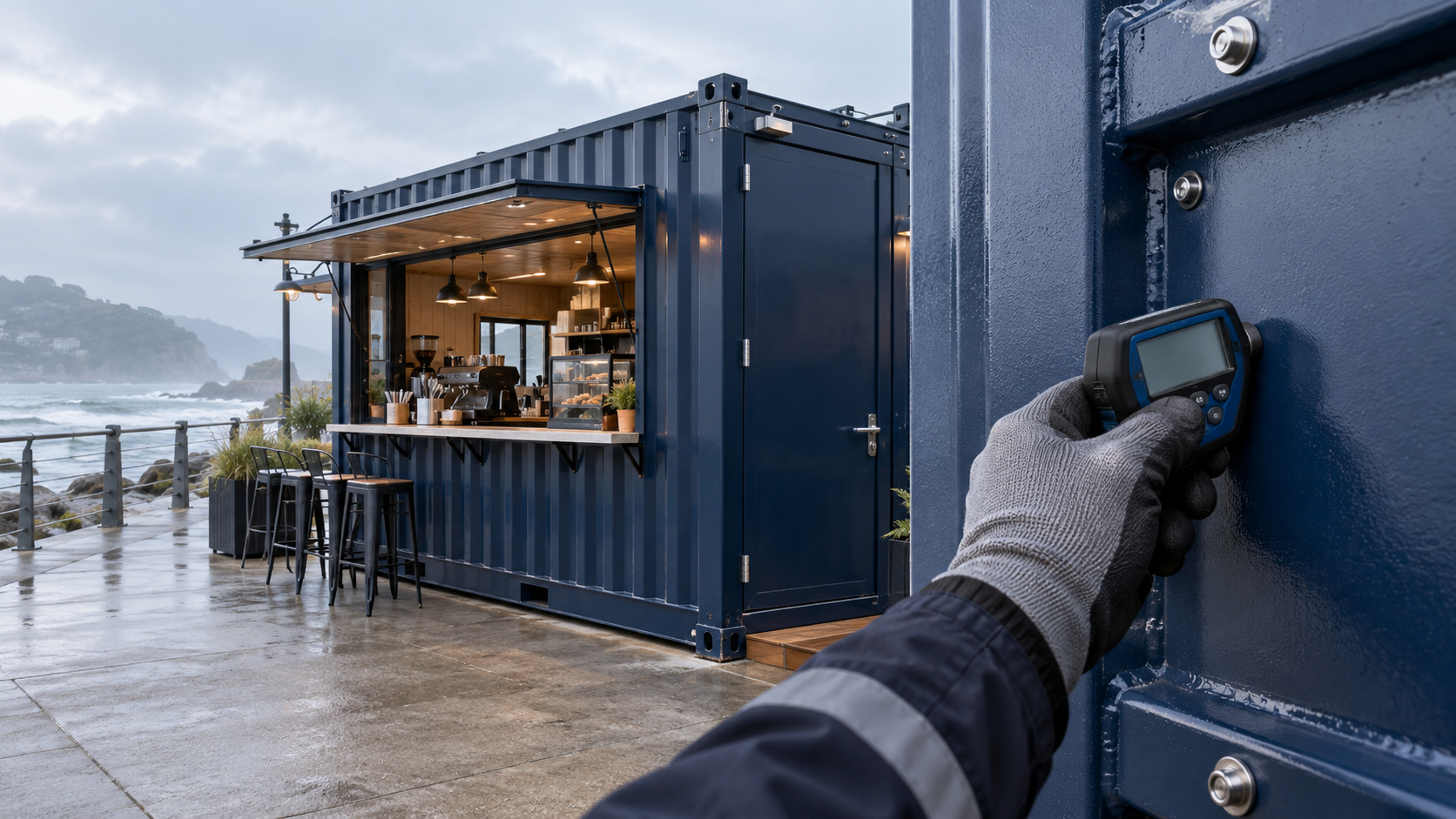
Ask for inspection checkpoints rather than only a final photo. A useful record identifies the steel or component, preparation method, environmental conditions during application where relevant, coating batch, coat sequence, measured dry-film thickness and repair locations. ISO 19840 describes a method to verify dry-film thickness of protective paint systems on rough steel surfaces, including sampling and gauge adjustment. The standard has scope limits, so the inspector must use a method appropriate to the coating and substrate.
One thickness reading in the middle of a panel does not represent every edge, weld or hidden joint. Agree on sampling locations and acceptance criteria before fabrication. If coating is applied over galvanized steel, the measurement and preparation plan must account for the zinc layer and topcoat. If the supplier cannot explain what was measured and where, “marine grade” is too vague to evaluate.
What can a real ZZKNOWN model show you—and what can it not prove?
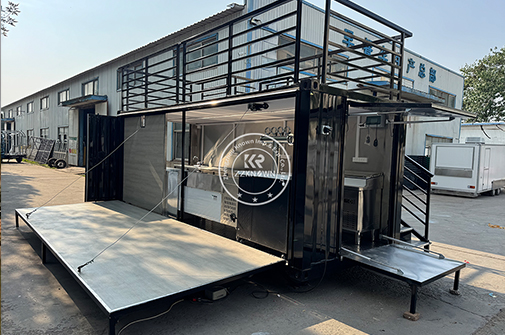
The real ZZKNOWN KN-DZ5 mobile restaurant container is a useful planning reference. Its published page lists a 5.7 m × 2.1 m × 2.15 m unit with four heavy-duty wheels and a configurable restaurant layout. At that scale, a serving window, doors, roof edge, wheel or base assembly and multiple equipment penetrations all become part of the corrosion discussion. The page is not a project-specific ISO 12944 coating certificate, and it does not establish that every KN-DZ5 has the same steel, coating system or coastal approval. Those items belong in the signed project schedule.

For a different real layout reference, see ZZKNOWN's 5.8 m container bar with rooftop lounge. The photos illustrate how stairs, upper decks and rails multiply exposed connections. A matte-black finish by itself says nothing about salt resistance. If your project has roof access, the engineer must also address structure, fall protection, drainage and local approvals alongside corrosion protection.
What maintenance plan should be handed to the operator?
Even a well-specified coating will eventually need cleaning, inspection and repair. Agree on a simple baseline: photos at delivery, a map of high-risk joints, coating identification, touch-up material and a log for defects. In service, inspect after storms and at intervals matched to site severity. Look for blistering, rust staining, loose sealant, standing water, scratched edges, failed fasteners and corrosion under attachments. Wash salt deposits using a procedure compatible with the coating and local water rules; do not assume a pressure washer is safe for every seal or electrical fitting.
When a defect appears, record where it is and how far it has spread. Repair promptly according to the coating-system instructions. Do not paint over active corrosion or salt. At the same time, find the cause: poor drainage, a damaged bracket or a leak may recreate the defect. The maintenance schedule should be realistic for the business. A finish that requires inaccessible underside work every season is a poor match for a cafe built tightly into a deck.
What should you send a supplier before asking for a price?
- Site and exposure: country, city, precise location, distance and orientation to the shoreline, sea-spray history, shelter, rainfall, humidity and any industrial pollutants.
- Operating plan: year-round or seasonal opening, cleaning chemicals, pressure washing, water supply, roof access, signage, awning and outdoor seating.
- Unit drawing: footprint, height, window and door openings, base and roof details, mobility or fixed installation, plus utilities and equipment penetrations.
- Protection target: engineer-selected corrosivity category, expected maintenance interval, desired appearance and project-specific warranty terms.
- Quality records: specified steel and coating materials, preparation, coat sequence, dry-film thickness, inspection method, repair instructions and delivery checks.
- Local approvals: identify the authority or consultant responsible for building, food-service, fire, electrical, accessibility, zoning and any shoreline restrictions.
Based on ZZKNOWN's production experience, drawings are most useful when they show the exact location of service windows, canopies, drainage and attachments before the steel goes through finishing. The technical team can then price and review a coherent build instead of guessing from the word “coastal.” For layout choices, start with our custom steel container restaurant design guide and small container restaurant planning guide.
How was this guide researched, and where does its evidence stop?
Applicability: The ISO documents provide an international technical framework for steel corrosion protection. Local building and food-business rules, current standard editions, coating availability and the final engineering specification must be checked for the destination. Model dimensions and photos describe the published example only; every custom order needs its own signed drawings.
What do buyers usually ask about coastal container restaurants?
1. Is a container restaurant automatically more corrosion-resistant than a conventional kiosk?
No. Its performance depends on steel grade, design details, surface preparation, coating or galvanizing, installation damage and upkeep. The label “container” does not define any of those.
2. If my cafe is one mile from the beach, do I need a C5 system?
Distance alone cannot decide. Ask a qualified project engineer to assess sea spray, prevailing wind, shelter, wetness, cleaning and local data before selecting the category and coating system.
3. Can powder coating alone protect a seaside restaurant?
It may be a component of a suitable system, but the words “powder coated” do not establish substrate preparation, film thickness, edge coverage or performance in your exposure. Request the full documented system and inspection criteria.
4. Should I choose stainless steel for the entire restaurant?
Not necessarily. Stainless grade, surface finish, joints and maintenance still matter in chloride environments, and an all-stainless structure may be unnecessary or impractical. Use the right material for each structural and food-contact function.
5. Will galvanized steel solve the problem forever?
No. It needs suitable design, correct process and maintenance. Later cuts, welds or attachments can interrupt protection, while some components are outside the scope of ISO 1461.
6. What should I inspect when the unit arrives?
Compare it with the signed drawing and coating schedule. Look at edges, welds, underside, roof, doors and penetrations; record shipping scratches, check the supplied quality records and arrange system-compatible repairs before installation hides the damage.
7. Can ZZKNOWN quote corrosion protection before I have a final layout?
ZZKNOWN can discuss a preliminary range and likely design routes, but a comparable final quote needs site exposure, structure and attachment drawings, selected system, inspection scope and local compliance requirements.
Where can you check the official technical sources?
- ISO 12944-2:2017 — classification of environments
- ISO 12944-3:2017 — design considerations
- ISO 12944-4:2017 — surface types and preparation
- ISO 12944-5:2019 — protective paint systems
- ISO 12944-6:2018 — laboratory performance tests
- ISO 12944-9:2018 — offshore and related structures
- ISO 19840:2012 — dry-film thickness measurement and acceptance
- ISO 8502-9:2020 — water-soluble salt field method
- ISO 1461:2022 — hot-dip galvanized coatings
Want a corrosion-protection review for your actual site?
Tell ZZKNOWN your project city, shoreline exposure, desired service interval and planned container layout. Share where the serving window, canopy, deck, utilities and signs will attach. We can prepare a project-specific drawing and coating-options discussion for your local engineer and approving authority to review before the build is locked in.
Request a Layout and Coating ReviewExplore the KN-DZ5See ZZKNOWN Customization