A Practical, Story-Driven Guide for Global Entrepreneurs
When momo vendors talk about success, they rarely start with dough recipes or spice blends. Instead, they talk about space, workflow, and how fast they can serve customers without compromising quality. In today’s competitive street food market, the difference between a profitable momo business and a struggling one often comes down to one decision made early on: choosing the right custom momo trailer.
This guide is written for street food entrepreneurs, food truck operators, and catering businesses around the world who are considering a custom momo trailer as their next growth step. Whether you are launching your first mobile food business or upgrading from a basic setup, this article will walk you through real-world design options, layout logic, equipment choices, and customization strategies—with insights from ZZKNOWN, a factory-direct manufacturer specializing in custom food trailers for global markets.
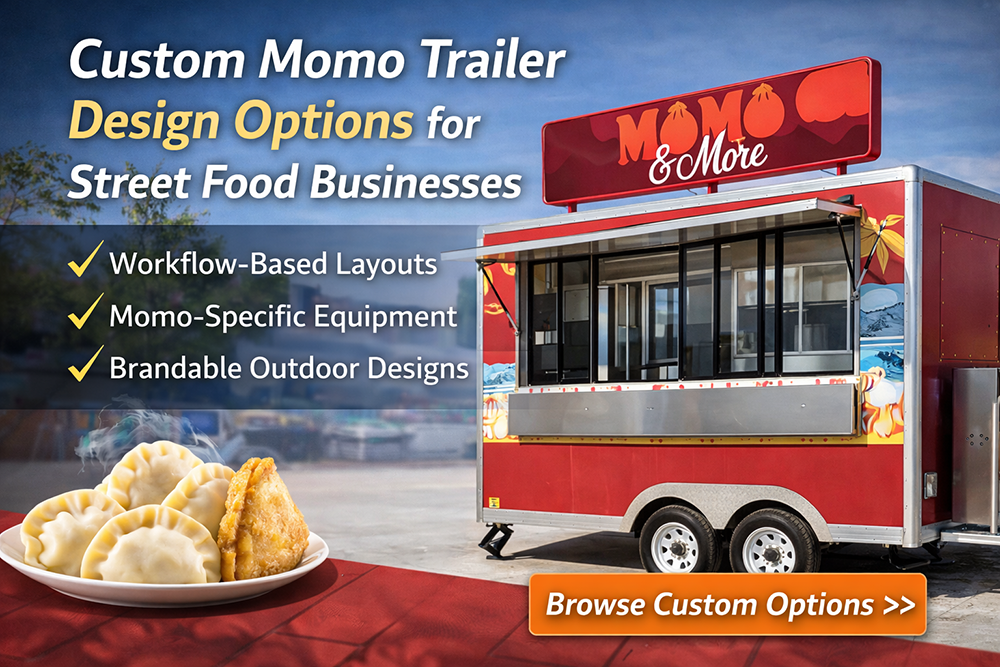
Momos are not just dumplings—they are a high-volume, fast-turnover product with massive global appeal. From Nepal and India to Europe, North America, Australia, and the Middle East, momo street food businesses are growing fast.
But momos present specific operational challenges:
Steaming requires stable power and heat
Dough prep needs clean, efficient workspace
Filling and folding demand workflow precision
Peak hours require rapid output without congestion
This is why more operators are moving away from generic food trucks and choosing custom momo trailers designed specifically around dumpling production.
A custom-built momo trailer allows you to:
Increase serving speed
Reduce staff fatigue
Meet local food safety standards
Scale from street vending to events and catering
A standard food trailer is built for flexibility. A custom momo trailer is built for efficiency and specialization.
Here is the difference in real terms:
| Feature | Standard Food Trailer | Custom Momo Trailer |
|---|---|---|
| Kitchen Layout | General-purpose | Workflow-based for dumplings |
| Equipment | Mixed-use | Steamers, prep tables, dough stations |
| Output Capacity | Medium | High-volume focused |
| Labor Efficiency | Average | Optimized for 1–3 operators |
| Long-Term ROI | Moderate | Higher for momo-focused businesses |
At ZZKNOWN, most momo trailer buyers are not first-time vendors. They are operators who already understand that layout equals profit.
.jpg)
Every successful custom momo trailer follows a four-zone layout strategy. This is where most new buyers make or break their investment.
This is where momo production begins.
Key design options include:
Stainless steel dough prep tables
Under-counter refrigeration for dough storage
Optional dough mixer space
Easy-clean wall and floor materials
Smart operators keep this zone separate from cooking to maintain hygiene and speed.
This is the heart of your momo trailer.
Customization options:
Extended stainless steel counters
Overhead shelves for ingredients
Integrated lighting for precision work
Ergonomic height design to reduce fatigue
A well-designed folding station can double output during peak hours.
Momos rely heavily on steaming, and this area requires careful planning.
Common equipment options:
Commercial momo steamers (gas or electric)
Multi-layer steam cabinets
Gas burners for pan-fried or tandoori-style momos
Heavy-duty ventilation and exhaust hoods
ZZKNOWN custom momo trailers often include dual steamer setups to support high-volume service.
This zone determines customer flow.
Popular customization choices:
Wide serving windows
LED menu boards
POS counter integration
Optional condiment stations
A smooth handover zone reduces wait times and improves customer experience.
There is no “one-size-fits-all” momo trailer.
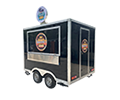
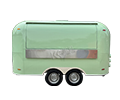
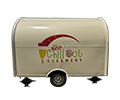
Most ZZKNOWN customers choose from these common sizes:
3–3.5 meters: Ideal for solo vendors or small teams
4–4.5 meters: Best for busy street locations and events
5 meters and above: Catering, festivals, and multi-menu operations
Larger trailers allow:
Separate prep and cooking zones
Additional refrigeration
Higher daily sales capacity
Smaller trailers offer:
Lower startup cost
Easier towing and permits
Faster setup time
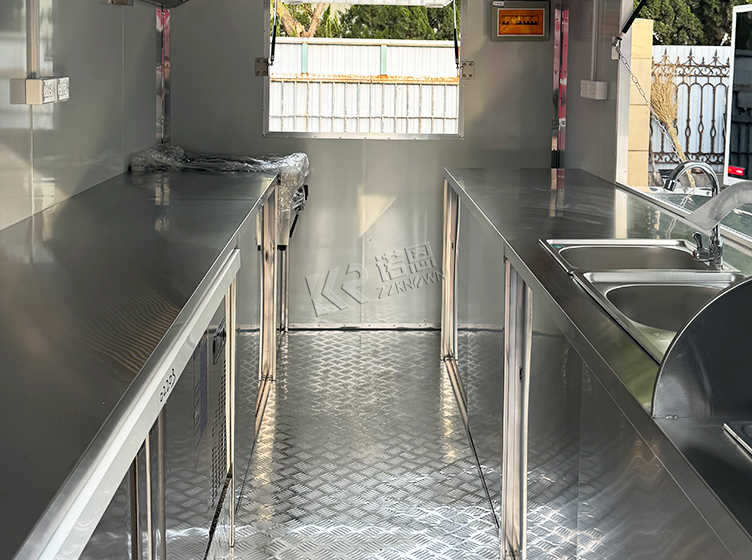
A true custom momo trailer is defined by its equipment configuration.
Stainless steel steamers
Double or triple sinks
Hot and cold water system
Commercial refrigerator or freezer
Stainless steel worktables
Automated dough mixers
Dual-fuel systems (gas + electric)
Solar-assisted power
Water heaters
Additional storage cabinets
ZZKNOWN designs equipment layouts based on your menu, not generic templates.
.jpg)
Utilities are often overlooked—until problems start.
A professional custom momo trailer includes:
External power inlet (110V / 220V)
Generator-ready wiring
Fresh water and wastewater tanks
Electrical distribution panel
LED lighting systems
For global buyers, ZZKNOWN adapts all utility systems to local regulations, whether for the USA, Europe, Australia, or the Middle East.
Your momo trailer is not just a kitchen—it is a mobile advertisement.
Exterior customization options include:
Custom color matching
Full vinyl logo wraps
Illuminated signage
Awning systems
Weather-resistant finishes
Many ZZKNOWN clients report that branding upgrades alone increased foot traffic by over 30%.
A custom momo trailer must meet local standards.
ZZKNOWN supports:
CE certification for Europe
DOT/VIN compliance for the USA
Electrical and gas standards for Australia and New Zealand
Food safety layouts for local health inspections
Factory-direct manufacturing ensures compliance is built in—not added later.
Working directly with a custom momo trailer manufacturer eliminates:
Dealer markups
Miscommunication
Limited design flexibility
ZZKNOWN provides:
2D and 3D layout drawings
Pre-production confirmations
Photo and video updates during manufacturing
Global shipping support
This factory-direct approach is why many international buyers choose ZZKNOWN for long-term scalability.
Custom momo trailers are used for:
Street vending
Night markets
Food festivals
Catering services
Franchise expansion
Some ZZKNOWN customers start with one trailer and scale to multi-unit fleets within two years.
Before contacting a manufacturer, prepare:
Menu details
Estimated daily volume
Local regulations
Budget range
Target markets
This allows the design team to create a profit-oriented layout, not just a good-looking trailer.
If momos are your core product, the answer is simple: yes.
A custom momo trailer is not an expense—it is an operational upgrade that impacts:
Speed
Consistency
Labor efficiency
Customer satisfaction
Long-term profitability
With factory-direct customization from ZZKNOWN, global buyers gain control, transparency, and scalability—without sacrificing quality.