
Which Certifications Does a Food Trailer Need for Export?
Direct answer: There is no single worldwide food trailer certificate. A buyer may need a road-vehicle approval pathway, a valid VIN, compliant vehicle components, separately listed kitchen appliances, food-business permits and local inspections. The correct package depends on the destination, trailer weight, production volume, fuel system, equipment models and intended menu—so certification planning should start before the drawing is approved.
What should a global buyer understand first?
- DOT is not a decorative certificate. In the United States, the manufacturer certifies that the trailer complies with applicable Federal Motor Vehicle Safety Standards and applies the required certification label.
- A VIN identifies a vehicle; it does not prove every requirement was met. Always check the certification label and supporting manufacturer information.
- CE marking is product-specific. It may apply to certain equipment or components under relevant EU legislation, while the road trailer follows vehicle-approval rules.
- UKCA is not a substitute for trailer approval. Great Britain has vehicle type-approval and Individual Vehicle Approval routes; product marking is a separate question.
- Australia uses ADR and RAV pathways. Low-ATM trailers generally need an approval pathway and a Register of Approved Vehicles entry before first supply.
- Food permits remain local. Road approval does not approve your menu, plumbing, fire system, commissary, site or daily operation.
Where does this guide apply, and when was it checked?
This guide is for buyers importing towable food trailers into the United States, European Union, United Kingdom and Australia. Official pages and product information were checked on September 11, 2026. It is a procurement guide, not a legal opinion or approval. Rules can change, and the authority that registers or inspects the finished trailer has the final word.
The first question is not “Does it have CE?” It is: Which authority controls each part of my project? Road safety, vehicle identity, electrical equipment, gas appliances, commercial-kitchen sanitation, fire protection, food licensing and local operation may be handled by different rules and different offices.
Why do certification discussions become confusing so quickly?
Picture a buyer ordering a 4-meter burger trailer for export. The quotation says “DOT, VIN, CE available.” It sounds reassuring, but three months later the buyer discovers that the local health department wants model-specific commercial appliance listings, the fire marshal wants a separate gas and suppression review, and the registration office wants a vehicle label and technical data in a format the original quotation never described.
The problem is not always that the trailer is unsafe. Often, the documentation was never mapped to the destination. “Certification” was treated as one checkbox instead of a chain of responsibilities.
According to ZZKNOWN’s production experience, the safest projects begin with a destination checklist before the equipment list is frozen. We ask for the country, state or province, city, trailer category and weight, intended menu, fuel type, voltage, tow vehicle and proposed appliance models. That information tells the engineer which questions must go back to the buyer’s registration office, health department, fire authority or approval body.
What is the difference between a vehicle approval and a product mark?
What does a vehicle pathway cover?
It addresses the road-going trailer as a vehicle: identity, masses, axles, tires, coupling, braking, lamps, reflectors, dimensions, safety labels and other applicable technical requirements.
What does an appliance listing cover?
It normally applies to a particular make and model of refrigerator, fryer, water heater, ice machine or other equipment against a defined safety or sanitation standard.
What does a food permit cover?
It covers the business and operation: menu, food handling, sinks, water, wastewater, surfaces, temperatures, commissary, location and operating procedures.
What does an import document cover?
It supports border entry and traceability. It does not automatically replace vehicle approval, registration, local inspection or operator licensing.
How do the main markets compare?
| Market | Main road-vehicle concept | Vehicle identity | What CE or UKCA means here | What the buyer should verify |
|---|---|---|---|---|
| United States | Manufacturer certification to applicable FMVSS, with the required certification label | 17-character VIN assigned under the manufacturer’s VIN system; manufacturer information filed with NHTSA | Not the U.S. road-trailer approval route | Certification label, VIN, manufacturer listing, HS-7/import route, state registration, local health and fire review |
| European Union | EU vehicle type approval or another permitted approval route for the trailer category | Vehicle identification and approval documentation, potentially including a Certificate of Conformity for an approved type | May apply to covered products/components; it is not shorthand for approval of the complete road trailer | Trailer category, approval route, national registration, component approvals, gas/electrical equipment and food-business rules |
| Great Britain | GB vehicle type approval or IVA for a single trailer/small number, where applicable | VIN and vehicle approval documents | UKCA or accepted CE marking may apply to specific regulated products; vehicle approval is separate | GB versus Northern Ireland, IVA/type approval, DVSA/VCA documentation, registration and local food/fire requirements |
| Australia | RVS approval pathway; low-ATM trailers generally use concessional RAV entry or vehicle type approval | 17-character VIN and RAV entry | CE is not Australia’s road-vehicle approval route | ATM category, ADR compliance evidence, ROVER application, RAV entry, state/territory registration and council approvals |
What does “DOT compliant” mean for a U.S. food trailer?
Buyers often ask for a “DOT certificate,” but NHTSA’s system is based on manufacturer self-certification. NHTSA explains that trailers must meet applicable federal safety standards and that a compliant trailer carries a certification label stating that it conforms to all applicable Federal Motor Vehicle Safety Standards in effect on its date of manufacture. Buyers can also check whether the manufacturer appears in NHTSA’s public manufacturer information resources.
The label matters because it connects the physical trailer to the certifying manufacturer, date of manufacture, weight ratings and compliance statement. Applicable requirements can involve lamps and reflectors, tires and rims, brake hoses, glazing or other vehicle systems depending on the design. State registration, title and inspection procedures still apply after federal import compliance.
Use the NHTSA trailer buyer warning and compliance guidance as the starting point. For importation, review the NHTSA importation and certification FAQs with your customs broker.
Does a VIN prove U.S. compliance?
No. A VIN is an essential identifier, not a magic approval code. NHTSA’s regulations use a 17-character VIN structure under 49 CFR Part 565, while manufacturer identification information is handled under Part 566 and certification labeling under Part 567. The WMI portion must identify the manufacturer responsible for the vehicle.
NHTSA explicitly warns that it cannot determine from the VIN alone whether a particular vehicle was built to comply with all applicable standards. The certification label is the key manufacturer statement. A serious buyer should therefore request the VIN format explanation, label sample, manufacturer details, production record and component information—not a photo of a loose VIN plate.
What approval route applies in the European Union?
The European Commission describes EU technical harmonisation for motor vehicles and their trailers as a Whole Vehicle Type-Approval system. Regulation (EU) 2018/858 provides the framework for approval and market surveillance of motor vehicles, trailers, systems, components and separate technical units. Under a whole-vehicle approval, a manufacturer can place vehicles of the approved type on the EU market with the required conformity documentation.
A custom food trailer may require careful classification and an appropriate approval route depending on category, mass, production volume and stage of build. Lighting, braking, tires, coupling and other road components may carry their own type-approval marks. National registration procedures can still require documents, translations, taxes, inspections or evidence tied to the exact VIN.
Start with the European Commission’s EU vehicle technical-harmonisation overview and the text of Regulation (EU) 2018/858. Then confirm the route with the approval authority or registration specialist in the destination member state.
Does CE marking approve the complete food trailer?
Not automatically. CE marking applies only when EU harmonisation legislation requires it for the product in question. Certain electrical equipment, machinery, gas appliances, pressure equipment or other products may fall within relevant CE regimes. A road trailer, however, is handled through vehicle-approval legislation rather than by placing one generic CE badge on the body.
This distinction protects the buyer. A CE declaration for one refrigerator does not approve the trailer brakes. A type-approved tail lamp does not approve the kitchen gas installation. A vehicle Certificate of Conformity does not replace a local food-business permit. Ask for documents by component and scope.
What is different in Great Britain and Northern Ireland?
Great Britain—England, Scotland and Wales—uses its own vehicle-approval framework. The UK Vehicle Certification Agency explains that vehicle type approval confirms that a vehicle type, system or component meets specified standards. For a single imported trailer or a very small number of trailers, the government directs applicants to the Individual Vehicle Approval route for trailers where applicable.
UKCA and CE product-marking rules are separate. Current GOV.UK guidance says many product sectors in Great Britain continue to recognise CE marking alongside or instead of UKCA, but the correct route depends on the sector-specific regulation. Northern Ireland has a different goods regime and may use CE or CE plus UKNI in relevant cases. None of those marks should be used as a shortcut around vehicle approval.
Because post-Brexit rules have changed more than once, verify the current position using the GOV.UK product-marking guide and the VCA vehicle type-approval overview.
What do ADR and RAV mean in Australia?
Australia’s Road Vehicle Standards system separates approval from state or territory registration. The federal Department of Infrastructure says trailers with an aggregate trailer mass of 4.5 tonnes or less need an approval before they can be provided to the Australian market. The two common pathways are a concessional RAV entry approval for up to four low-ATM trailers in a 12-month period, and a vehicle type approval for higher-volume supply.
Every trailer must have its vehicle and compliance information entered on the Register of Approved Vehicles before first supply to an Australian consumer. The trailer is expected to comply with applicable Australian Design Rules, and Vehicle Standards Bulletin 1 provides guidance for common low-ATM trailer requirements. Type-approval holders generate compliant VINs; some concessional applications can request a VIN through the department.
Read the current Australian low-ATM trailer approval page, the official VIN guidance and the department’s ROVER resources before shipping.
Which documents should a buyer request before paying the balance?
| Document or evidence | What it should identify | Why it matters | Who should verify it |
|---|---|---|---|
| Approved final drawing | Exact dimensions, axle position, equipment, doors, windows, utilities and weights | Controls the build and exposes conflicts before fabrication | Buyer, manufacturer, local reviewer |
| Vehicle identification package | Manufacturer, VIN structure, model, production date and label format | Supports traceability, import and registration | Registration/import specialist |
| Vehicle compliance evidence | Applicable standards, component approvals and declared route | Shows what the road-safety claim actually covers | Approval authority or qualified consultant |
| Equipment schedule | Brand, model, voltage, gas type, power, sanitation/electrical listings and cut sheets | Prevents generic certificates from being attached to the wrong appliance | Health, fire and electrical reviewers |
| Electrical diagram | Supply, breakers, conductor sizes, outlets, grounding and appliance circuits | Supports utility matching and inspection | Licensed destination electrician |
| Gas-system information | Appliances, regulator, pipe, valves, cylinder position and test records | Supports fire review and safe commissioning | Licensed LPG/gas professional and fire authority |
| Plumbing diagram | Freshwater, wastewater, sinks, heater, pump, drains and service connections | Supports health-plan review | Health authority and local plumber |
| Inspection and shipment record | VIN, photos, test results, packing list and final configuration | Creates an evidence trail for the unit actually shipped | Buyer or third-party inspector |
How much does certification planning affect cost and lead time?
There is no honest global flat fee. The cost depends on the approval pathway, testing, documentation, component selection, consultant fees, inspection travel, production volume and whether the design already matches the destination. The table below compares cost impact without inventing a quotation.
| Project choice | Typical documentation effort | Relative cost impact | Main schedule risk |
|---|---|---|---|
| One custom trailer using a clear individual-approval route | Medium to high | Medium | Late authority feedback or missing test evidence |
| Repeated production under a vehicle type approval | High setup; lower repetition | High initial investment | Approval scope, conformity of production and design changes |
| Locally sourced listed appliances | Medium coordination | Medium to high purchase cost | Model availability and cabinet redesign |
| Unverified residential appliances | Low at quotation stage | Potentially very high rework cost | Plan rejection, replacement and utility mismatch |
| Destination checklist received before CAD approval | Medium early effort | Usually lower rework exposure | Slow review, but fewer late surprises |
These are relative procurement impacts, not prices or lead-time promises. Request a written quotation after the approval route and equipment models are confirmed.
Which real ZZKNOWN models illustrate the planning process?
.png)
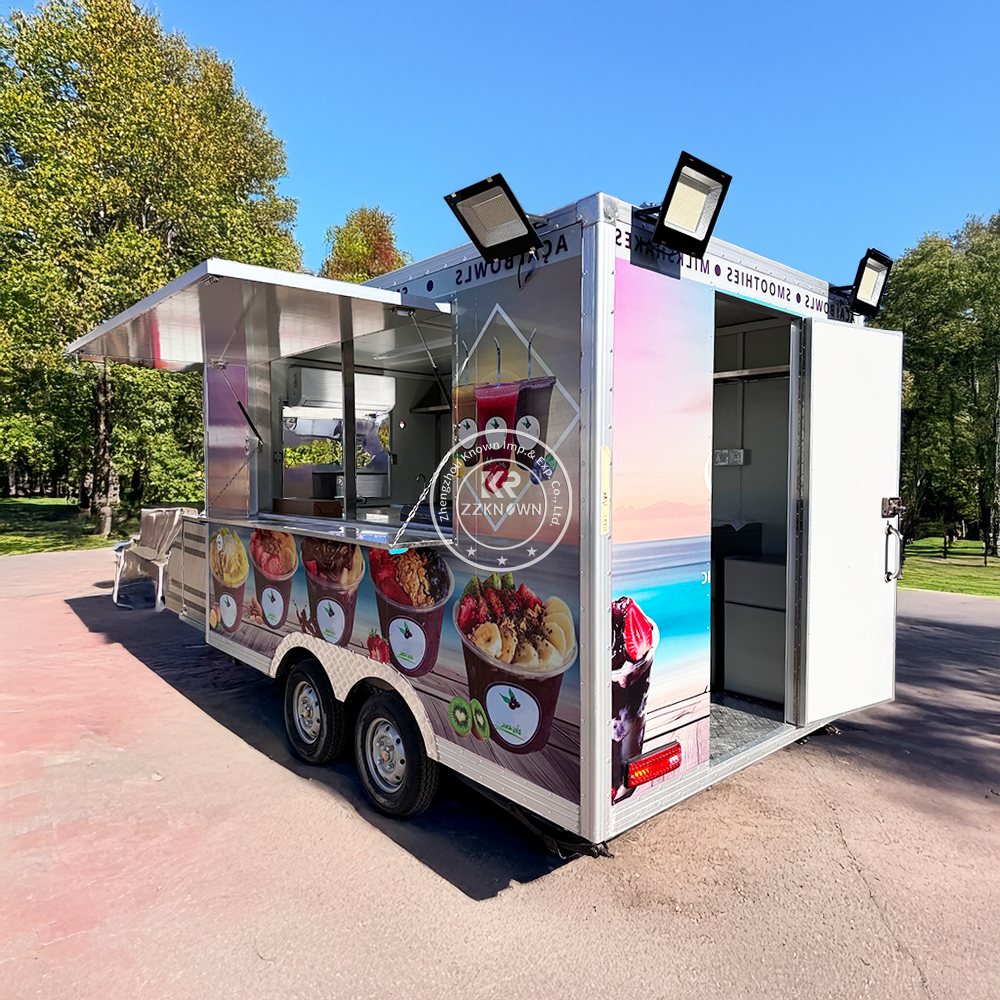
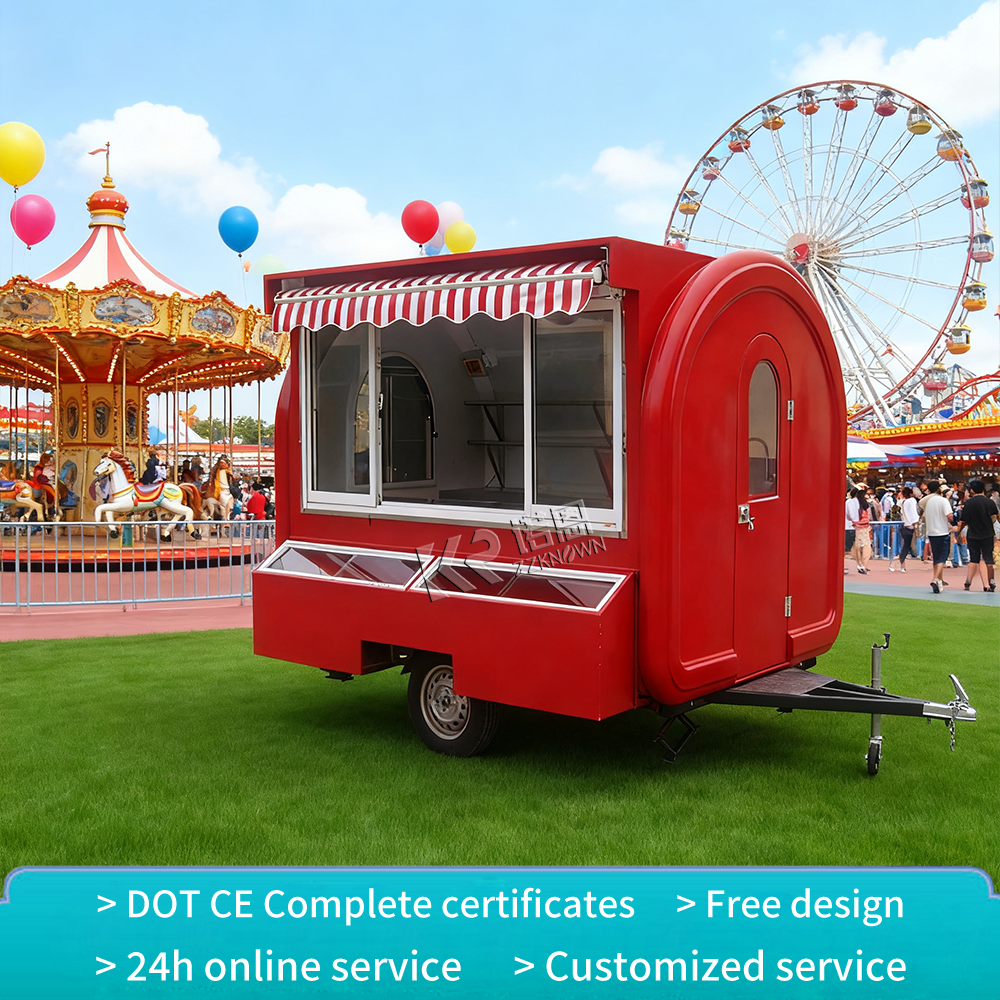
Real project image: ZZKNOWN KN-QF400. Approval, appliances and documents must be configured for the buyer’s destination.
Why is the KN-QF400 a useful example?
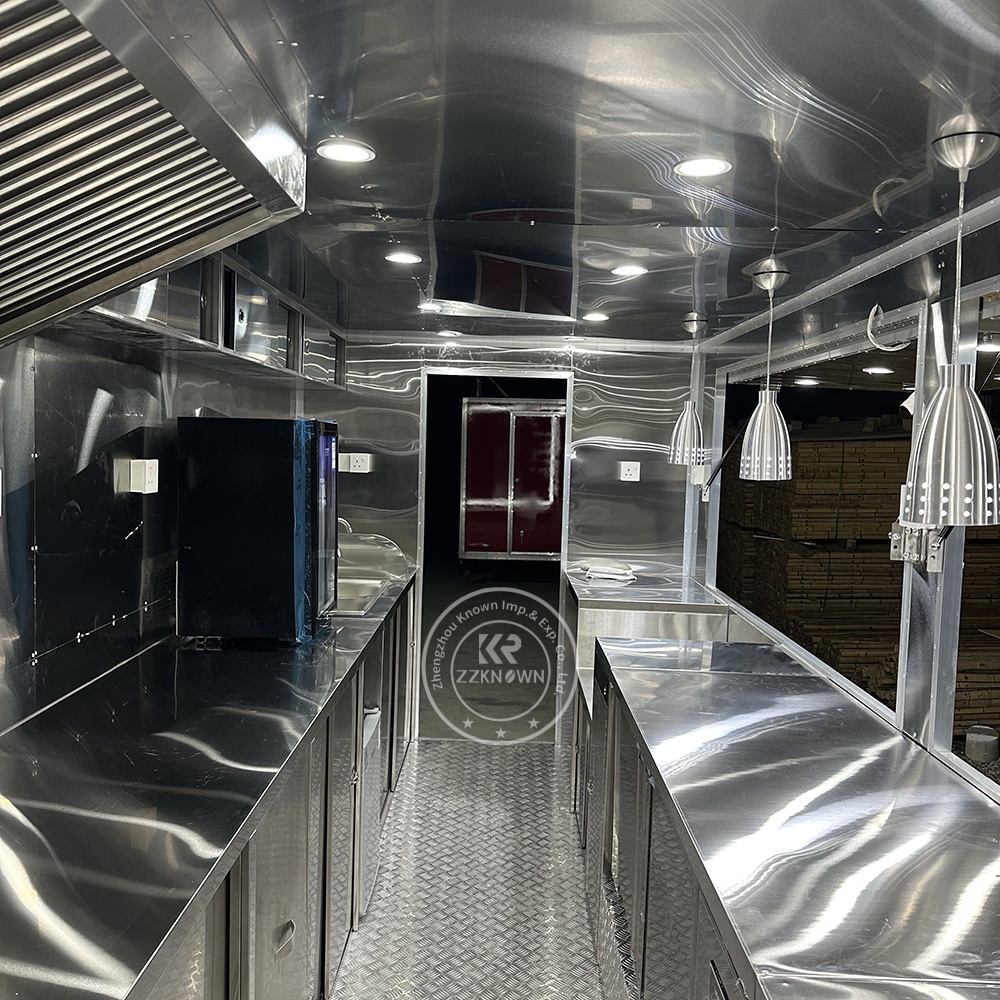
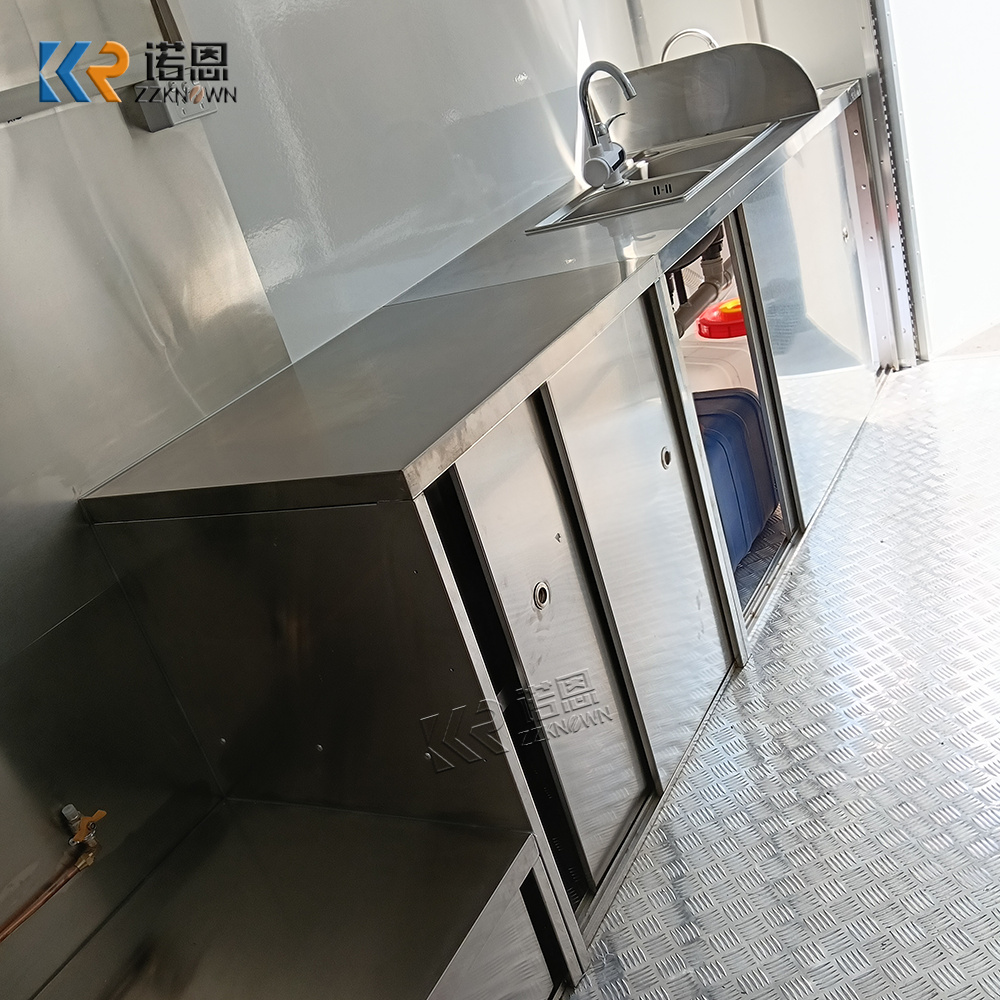
The published KN-QF400 food trailer shows how one platform can include a 3+1 sink arrangement, cold-storage spaces, hood, electrical outlets, air conditioning and gas lines. Those are configuration details—not a promise that every version carries every market approval.
The final country package changes the components, ratings, labels, drawings and documents. A U.S. build, EU build, GB build and Australian build should not be ordered from the same generic equipment sheet.
.jpg)
What does the ZZKNOWN engineer need before drawing the trailer?
The most useful file is often not a certificate at all. It is the local plan-review or registration checklist with the buyer’s authority contact marked. Once the pathway is known, ZZKNOWN can prepare a CAD layout, equipment schedule and utility diagram for review. Our food trailer layout guide explains why menu and workflow must be settled before equipment locations are locked.
How should buyers check a certificate without becoming an expert?
Start with the name on the document. Does it match the legal manufacturer or appliance supplier? Then find the model number, standard, issue date, expiry or surveillance terms, test report reference and intended market. Finally, compare that information with the label on the shipped component.
A certificate for a similar model is not automatically valid for yours. A lab report is not always the same as a certification listing. A declaration is not always third-party approval. A component certificate does not expand to the whole trailer. If the scope is unclear, ask the issuer or authority in writing.
What mistakes should an importer avoid?
Can one badge cover the whole project?
No. Separate road, kitchen, electrical, gas, fire and operating requirements into their own checklist rows.
Should you order appliances before plan review?
Only when the authority’s acceptance and utility requirements are clear. A cheaper unlisted appliance can become expensive rework.
Can the importer “add a VIN later”?
Do not treat identity as an afterthought. The VIN must come from a valid pathway and correspond to the responsible manufacturer and vehicle record.
Does road registration approve food service?
No. Health, fire, zoning, vending and commissary rules may still apply after the trailer is legally registrable.
Can a local electrician fix every mismatch?
Not always. Voltage, frequency, breaker capacity, appliance listing, plug type and wiring design should be coordinated before production.
Should you accept “guaranteed inspection pass”?
Be cautious. The authority judges the final trailer, site, menu, documents and operation. Ask for specific design commitments instead.
How was this guide researched?
We reviewed current primary sources from NHTSA, the European Commission and EUR-Lex, the UK Vehicle Certification Agency and GOV.UK, and Australia’s Department of Infrastructure. We compared how each source separates vehicle approval, identification and product marking. We then checked real ZZKNOWN product pages for model numbers, dimensions and project photography.
Regulatory statements in this article come from official public sources. Relative cost and schedule impacts are qualitative engineering judgments, not market price data. No buyer permit files, inspection outcomes or third-party legal opinions were used. Requirements outside the four featured markets were not generalized from these examples.
What do real buyers ask before importing?
Is DOT the same as a certificate issued by the U.S. government?
No. NHTSA uses a manufacturer self-certification system. The manufacturer applies a label certifying compliance with applicable FMVSS; NHTSA does not pre-approve every trailer.
Can I register a trailer in the United States with only a VIN?
Do not assume so. The VIN supports identity, but federal import compliance, the certification label, title documents and state registration requirements also matter.
Does a CE-marked refrigerator make the whole trailer CE certified?
No. The marking applies to the product and legislation in its declared scope. The road trailer and food operation follow separate approval routes.
Do I need UKCA instead of CE for every component in Great Britain?
Not necessarily. Current GB guidance recognises CE marking for many sectors, but sector rules vary. Check the current product regulation and keep vehicle approval separate.
What is the difference between ADR compliance and a RAV entry?
ADRs are applicable national vehicle standards. The RAV is the Australian register where the vehicle and compliance information must be entered before first supply under the relevant approval pathway.
Can ZZKNOWN provide every certificate for every country?
No responsible manufacturer should make that blanket promise. ZZKNOWN can review requested standards, source documented component options and prepare manufacturing records, while the final availability and approval route must be confirmed per destination and configuration.
When should I contact the local authority?
Before final CAD approval and before paying for non-returnable equipment. Send the menu, layout, equipment schedule and utility diagrams early enough to change the design.
What should I send ZZKNOWN for a certification review?
Send the operating city, destination checklist, trailer category and target weight, menu, equipment models, voltage, fuel type, sink and water requirements, tow vehicle and preferred delivery date.
Which related ZZKNOWN guides should you read next?
- How do you import a food trailer from China?
- How do DOT, VIN, CE and Australian standards differ?
- How do you plan a food trailer around HACCP principles?
- Which custom-built ZZKNOWN food trailer fits your menu?
Which official sources support this guide?
- NHTSA: Check Trailers for Federal Safety Regulations.
- NHTSA Importation and Certification FAQs.
- European Commission: Technical Harmonisation in the EU.
- Regulation (EU) 2018/858 on vehicle and trailer approval.
- UK Vehicle Certification Agency: What Is Vehicle Type Approval?.
- GOV.UK: Individual Vehicle Approval for Trailers.
- GOV.UK: Placing UKCA or CE Marked Products on the GB Market.
- Australia: Low-ATM Trailer Approval Pathways.
- Australia: Vehicle Identification Number Guidance.
Would you like a destination-specific certification checklist?
Send ZZKNOWN your destination country and city, menu, trailer size, target weight, tow vehicle, voltage, gas type and equipment list. We will organize the road-vehicle, appliance, plumbing, electrical and manufacturing-document questions before the final layout is approved.
Request a Certification Compatibility Review
Explore ZZKNOWN Food Trailers
Editorial note: This article is educational and does not replace legal, engineering, customs, registration, food-safety or fire-safety advice. Standards, marking rules and approval procedures can change. Verify the final trailer, components and documents with the authorities responsible for your destination.