A Real-World Breakdown of acai bowl trailer vs smoothie trailer for Global Buyers (No Hype, Just Practical Truth)
Let's start with a simple moment.
You're standing at a busy beach promenade. Two food trailers are side by side.
One is serving thick, colorful açaí bowls topped with fruit, granola, and peanut butter.
The other is blending fresh smoothies—fast, liquid, refreshing, and easy to drink on the go.
Both have queues. Both look profitable.
And you're thinking:
“If I’m going to invest in a food trailer… which one is actually better?”
That’s the real question behind acai bowl trailer vs smoothie trailer.
At ZZKNOWN, we manufacture and export both types of trailers to buyers in the U.S., Europe, Australia, and the Middle East. And after years of working with operators in real markets, one thing is clear:
There is no universal “winner”—but there is a clear “better fit” depending on your strategy.
So let's break it down properly.
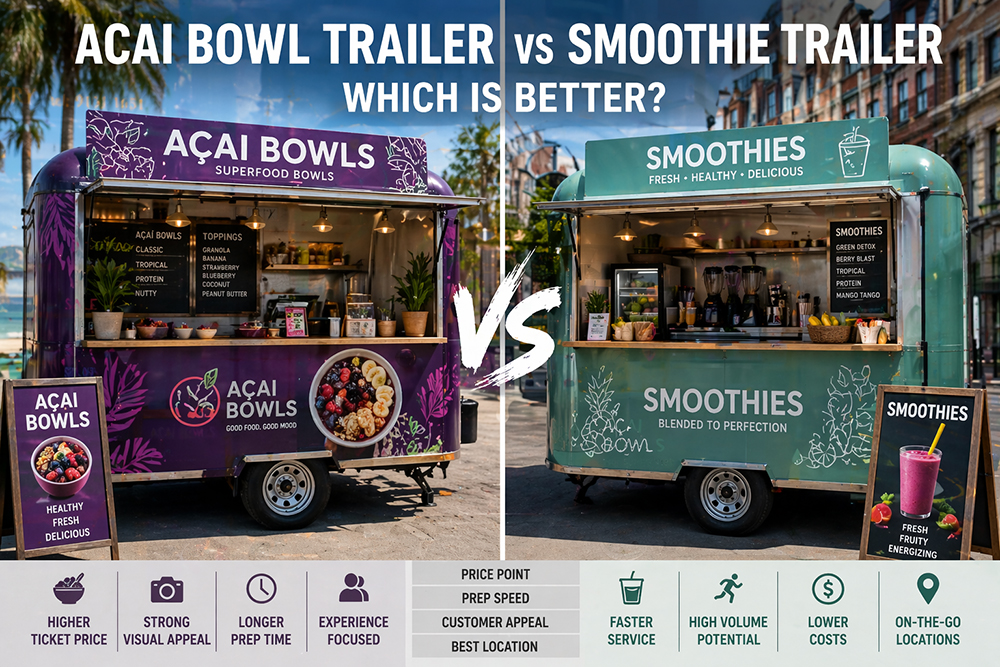
Simple conclusion:
First: What's the Core Difference?
What is an acai bowl trailer?
An açaí bowl trailer focuses on:
- Thick frozen açaí base
- Toppings (fruit, granola, nut butter)
- Spoon-based eating experience
- Higher visual presentation
It’s closer to a “premium dessert-meets-healthy meal.”
What is a smoothie trailer?
A smoothie trailer focuses on:
- Blended drinks
- Faster consumption
- On-the-go hydration
- Lower preparation complexity
It’s closer to a “functional drink business.”
Simple difference:
Açaí bowls = experience food
Smoothies = functional food
Which One Makes More Money?
Let’s be honest—this is what everyone wants to know.
Both can be profitable, but they perform differently.
Typical industry ranges:
| Category |
Average Price |
Cost per Item |
Margin |
| Açaí Bowl |
$10–$15 |
$3–$6 |
50%–70% |
| Smoothie |
$6–$10 |
$2–$4 |
45%–65% |
Key insight:
- Açaí bowls = higher ticket price
- Smoothies = higher volume potential
Real-world takeaway:
Açaí wins on profit per item
Smoothies win on speed and volume
Which One Sells Faster in Real Life?
Speed matters more than people think.
Smoothie trailer advantages:
- 30–60 seconds per order
- Easier workflow
- Fewer toppings
- Faster queue movement
Açaí trailer reality:
- 2–4 minutes per bowl
- More customization
- Slower peak-hour throughput
Conclusion:
Smoothies move faster.
Açaí sells higher-value orders.
Which One Works Better in Different Locations?
Let’s get practical.
Beach areas
Winner: Açaí Bowl Trailer
Why:
- Tourists want “Instagram food”
- People sit and eat
- Higher willingness to pay
City commuting areas
Winner: Smoothie Trailer
Why:
- People are in a hurry
- Grab-and-go behavior
- Faster transactions
Fitness zones
It depends:
- Morning rush → Smoothies
- Post-workout → Açaí bowls
Festivals & events
Winner: Açaí Bowl Trailer
Why:
- Visual appeal drives sales
- People stay longer
- Higher ticket spending
Which One Is Easier to Operate?
Smoothie trailer wins on simplicity
Why?
- Fewer ingredients
- Faster training
- Lower mistake rate
- Easier staffing
Açaí trailer requires more precision:
- Layering
- Presentation
- Topping control
- Inventory variety
Real operator insight from ZZKNOWN:
One U.S. client told us:
“Smoothies are like a fast-food system. Açaí is like a mini café experience.”
That description is surprisingly accurate.
Which One Has Better Branding Potential?
Açaí trailers dominate visually
Because:
- Colorful bowls
- Layered toppings
- Instagram-friendly presentation
Smoothie trailers rely more on:
- Speed branding
- Health messaging
- Clean design
Marketing reality:
Açaí = stronger social media impact
Smoothie = stronger repeat convenience business
Cost Differences (Startup Perspective)
Typical setup comparison:
| Category |
Açaí Trailer |
Smoothie Trailer |
| Equipment cost |
Higher |
Lower |
| Ingredient storage |
Complex |
Simple |
| Menu setup |
Medium-high |
Low-medium |
| Staff training |
Moderate |
Easy |
Key insight:
Smoothie trailers are cheaper to operate initially.
But açaí trailers often generate higher revenue per sale.
Real Case Studies From ZZKNOWN
Let’s talk about real-world outcomes—not theory.
Case 1: Açaí Trailer in California
Setup:
- Beach location
- 6-item menu
- Strong branding
Results:
- $800–$1,500 daily peak revenue
- High weekend performance
- Strong Instagram traffic
Why it worked:
Emotional + visual buying behavior
Case 2: Smoothie Trailer in Texas
Setup:
- Fitness center location
- Fast menu
- 3 core smoothie types
Results:
- High daily volume
- Stable weekday income
- Lower peak but consistent sales
Why it worked:
Speed + convenience
Case 3: Failed Hybrid Concept
One client tried combining both:
- Smoothies + açaí + juices + bowls
Result:
- Slow operations
- Confused menu
- Lower throughput
Lesson:
Too many concepts reduce efficiency.
Which One Should YOU Choose?
Let’s simplify decision-making.
Choose an Açaí Bowl Trailer if you want:
- Higher pricing
- Strong branding
- Instagram-driven traffic
- Tourist or beach markets
Choose a Smoothie Trailer if you want:
- Fast operations
- High daily volume
- Simpler workflow
- Fitness or urban commuter markets
Industry Insight: What Data Shows
According to foodservice trend reports:
- Health-focused fast casual is growing 6–9% annually in Western markets
- Beverage-based concepts scale faster operationally
- Visual food categories outperform traditional snacks on social media engagement
Key takeaway:
Açaí is “premium experience growth”
Smoothie is “volume efficiency growth”
Common Mistakes Buyers Make
1. Choosing based on trend, not location
What works in Miami may fail in Manchester.
2. Overcomplicating menus
More items = slower service = lower profit.
3. Ignoring workflow design
Trailer layout directly impacts speed and revenue.
4. Underestimating staffing needs
Açaí requires more training than smoothies.
FAQ: acai bowl trailer vs smoothie trailer
1. Which is more profitable overall?
Açaí has higher per-item profit; smoothies have higher volume efficiency.
2. Which is easier to start?
Smoothie trailers are easier due to simpler preparation.
3. Which works better in hot climates?
Both work, but smoothies perform better in fast-moving urban heat zones.
4. Which attracts more customers visually?
Açaí bowl trailers—because of colorful presentation.
5. Can I combine both?
Yes, but only if you design a very streamlined menu.
Final Thoughts: Which One Is Actually Better?
Let’s keep it real.
The question isn’t:
“Which is better overall?”
The real question is:
“Which fits your market, speed, and business style?”
From our experience at ZZKNOWN, successful operators don’t chase trends.
They choose based on:
- Location
- Customer behavior
- Operational efficiency
- Brand positioning










.jpg)