Imagine sitting at a cozy sidewalk café in Paris or strolling through a vibrant park in Vienna on a balmy Saturday afternoon. What do you see? People relaxing, children playing, and almost everyone holding a delicious, refreshing scoop of ice cream. Now, imagine yourself behind a beautifully crafted, vintage-style push-cart, smiling as you hand out premium artisanal gelato and watch the cash box fill up.
It sounds like a dream, doesn't it?
But then reality hits. You start thinking about spreadsheets, market analysis, profit margins, and—worst of all—the dreaded European bureaucracy. Suddenly, your dream feels buried under a mountain of paperwork.
If you have been wanting to launch your own mobile dessert business but feel completely overwhelmed by how to map out the strategy, don't worry. You are exactly where you need to be. Grab a notebook, pour yourself a fresh cup of coffee, and let’s talk like two old friends. In this guide, we are going to build a rock-solid ice cream cart business plan together, step by step, completely stripping away the confusion.
At ZZKNOWN, we’ve helped hundreds of global entrepreneurs transition from daydreamers to successful business owners. Let’s map out your roadmap to freedom.
If you talk to anyone who has tried to launch a massive motorized food truck or a heavy towable trailer in the EU, they will likely tell you it was a regulatory nightmare. Because those setups are legally road vehicles, they must comply with strict automotive safety laws and obtain a Certificate of Conformity (COC).
Getting a COC requires rigorous, expensive chassis inspections, brake testing, and emissions tracking. If the vehicle fails a single metric, you cannot legally drive or park it on public roads. Furthermore, with European cities aggressively expanding Ultra Low Emission Zones (ULEZ), diesel and petrol food trucks face heavy daily fines just for entering high-profit city centers.
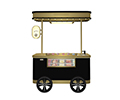
This is the ultimate regulatory loophole that belongs at the very front of your ice cream cart business plan. Because a ZZKNOWN ice cream cart is completely non-motorized (a traditional push-style design), it does not require a vehicle COC. It is legally classified as a commercial display unit or a light push-cart, not a motor vehicle.
To operate legally on European streets, your cart only needs a CE Certificate for its integrated electrical refrigeration system. Every single cart we manufacture comes standard with this CE certification. You can skip the motor vehicle department completely, ignore urban emission bans, and head straight to your local town hall for a simple, low-cost street vendor trading permit. It cuts your startup timeline from months down to mere weeks.
| Business Metric | Traditional Motorized Food Truck | ZZKNOWN Non-Motorized Cart |
| Vehicle COC Required? | Yes (Highly complex and expensive) | No (Completely Exempt) |
| Primary Safety Standard | Automotive Inspections + COC + Emissions | CE Certification Only (Included) |
| Eco-Zone / ULEZ Access | Heavily restricted or fined | 100% Free Access (Zero Emissions) |
| Average Initial Investment | €30,000 - €80,000+ | €3,000 - €7,000 |
| Location Flexibility | Limited to vehicle parking spaces | Fits on sidewalks, plazas, and indoors |
Think of the executive summary as the "hook" of your business plan. If you ever need to pitch to a local city council for a premium street trading permit, or if you want to convince a high-end wedding venue to make you their exclusive dessert partner, they will read this section first.
Keep it simple, clear, and focused on your unique value proposition. Answer these three core questions:
What is your brand concept? (e.g., "An eco-friendly, artisan gelato cart serving authentic Italian flavors.")
Who is your target audience? (e.g., "Leisure weekend walkers, local families, and private event hosts.")
Why will you succeed where others fail? (e.g., "By utilizing highly agile, non-motorized ZZKNOWN carts, we bypass heavy vehicle overhead and can access premium pedestrian plazas that motorized food trucks cannot reach.")
The biggest mistake new entrepreneurs make is assuming that the highest foot traffic equals the highest sales. They park their cart right outside a busy train station during the morning rush hour and wonder why thousands of commuters pass by without spending a single Euro.
According to data from the European Mobile Food Vendors Association, the best locations for an ice cream cart are determined by the mindset and walking speed of the pedestrian, not just the volume.
The "Leisure Mindset" Metric: Look for places where people are already relaxing, walking slowly, or waiting. Think about public park benches, museum exits, historic courtyards, or popular seaside boardwalks.
The Competitor Gap: Map out your local area. Are there brick-and-mortar ice cream shops nearby? If so, don't try to compete on price right on their doorstep. Instead, use your cart's agility to find "micro-locations" where a permanent shop could never fit—like a beautiful shade tree inside a botanical garden or a busy weekend flower market.
[Night Before: 22:00 - 06:00] --> Plug cart into standard wall outlet to freeze internal cooling plates.
              |
              v
[Morning Prep: 09:00 - 10:00] --> Load fresh ice cream/gelato pans from storage into the pre-chilled freezer.
              |
              v
[Day Operations: 11:00 - 19:00] -> Push cart to prime location; operate up to 12 hours completely unpowered.
              |
              v
[Evening Wrap: 19:30 - 20:30]  -> Wash down stainless steel pans, sanitize surfaces, log daily revenue.
In Europe, noisy gas generators are increasingly hated by local park councils and eco-conscious consumers. Fortunately, you don't need one.
Our ZZKNOWN carts utilize advanced, high-density commercial insulation and eutectic smart-cooling technology. You simply plug the cart into a standard electrical outlet in your garage overnight. The internal cooling elements freeze solid. When you unplug it the next morning, the freezer will independently hold a perfect, scoopable temperature (between $-16^\circ\text{C}$ and $-18^\circ\text{C}$) for 8 to 12 hours completely unpowered, even in direct summer heat.
Let's look at the actual numbers. One of the best things about a non-motorized push-cart business model is that your overhead is incredibly low. You aren't paying vehicle insurance, road taxes, expensive mechanics, or thousands of Euros in diesel fuel.
Here is a realistic breakdown of your first-year startup capital based on a typical European street-vending model:
| Expense Category | Estimated Cost (Year 1 Startup) | Frequency |
| ZZKNOWN Premium Cart | €3,500 - €5,500 | One-time |
| Local Street Trading License | €200 - €600 | Annual |
| Food Hygiene Certification | €50 - €150 | One-time |
| Initial Inventory (Gelato, Cones, Spoons) | €400 - €800 | Monthly |
| Public Liability Insurance | €200 - €400 | Annual |
| Marketing (Logo, Uniforms, Local Social Ads) | €300 | One-time |
| Total Estimated Startup Capital | €4,650 - €7,750 | — |
Let's do some fun math. Let’s say your average cost to produce a high-quality double-scoop waffle cone (including the ingredients, napkin, and spoon) is around €0.60. In most Western European cities, you can easily sell that premium artisanal cone for €4.00. That leaves you with a massive gross profit of €3.40 per scoop.
The Math Checklist:
Average daily sales on a sunny weekend: 150 scoops
Daily gross revenue: 150 × €4.00 = €600
Daily profit: 150 × €3.40 = €510
The Verdict: If you operate consistently on sunny weekends, you can completely recover your initial startup investment within 10 to 15 working days. Everything after that is pure profit for your bank account.
A True Story From Our Team's Consulting Archive:
A few seasons ago, we worked with a client named Sophia in Munich, Germany. Sophia bought a stunning, cream-and-gold ZZKNOWN pushcart. She drafted a business plan focused entirely on high-volume street sales. However, her local city council was incredibly slow at issuing street vendor permits, and she missed the entire month of May waiting for paperwork.
Sophia didn't panick. She adapted her business plan and made a massive strategic pivot: Private Event Catering.
She uploaded beautiful photos of her cart to Instagram and reached out to local wedding coordinators, corporate business parks, and luxury car dealerships. She offered a flat-rate package: €600 for 2 hours of unlimited ice cream for up to 100 guests. Because private property events do not require a city street permit, she started operating immediately. By August, she was completely booked out every single weekend for high-end weddings and corporate parties, earning more money in two hours than she would have standing on a street corner all day. She realized that flexibility is the heartbeat of a successful business plan.
European consumers are highly sophisticated. They don't just want food; they want an authentic, visual experience. Your cart itself is your most powerful marketing tool.
Embrace the "Insta-Identity": Keep your cart immaculately clean. Dress it up with a beautiful striped canvas awning, a typed or handwritten chalkboard menu, and fresh flowers. When your setup looks beautiful, customers will naturally take photos of their ice cream cones with your cart in the background and post them to social media—giving you free marketing.
Keep Your Menu Curated and Premium: Do not try to offer 30 different artificial flavors. Stick to 6 to 8 exceptional, high-quality options. Include four classic favorites (like Madagascar Vanilla, Deep Chocolate, Roasted Pistachio, and Sea Salt Caramel), two rotating seasonal specialties (like Lavender Honey or Spiced Fig), and at least one dairy-free vegan sorbet to cater to modern dietary habits.
No. While you do not need vehicle registration or a complex automotive COC for a non-motorized cart, you still need permission to conduct commercial business on public land. You must apply for a Street Trader's License from your local municipality or district council. Alternatively, you can partner with private property owners (like beach clubs, shopping center courtyards, or open-air cafes) to set up on their land without needing a city permit.
Absolutely not. A smart business plan always includes a weather backup strategy. Because our non-motorized carts produce zero exhaust fumes and run completely silently, you can seamlessly wheel them through standard double doors. During rainy weeks or the cold winter season, you can shift your business entirely indoors, catering to corporate office buildings, indoor trade show pavilions, holiday markets, and wedding venues.
In most European countries, health departments will require your base of operations (where you wash your equipment and store your inventory) to meet basic food safety standards. Many smart mobile vendors start by renting space from a local commercial kitchen during their off-hours, or they partner with a local pastry shop or dairy cafe to use their certified facilities for a small monthly fee.
This is a vital point for health inspectors! To pass your health audit with flying colors, all ZZKNOWN carts can be customized with an integrated, completely self-contained mobile sink system. This setup features an internal battery-powered water pump, a fresh-water tank, a waste-water tank, and an integrated instant water heater, ensuring you have hot running water to wash your hands on demand anywhere on the street.
Writing an ice cream cart business plan doesn't mean you need a degree in corporate finance or a mountain of capital. By choosing a classic, nimble, non-motorized push-cart, you cut through the regulatory red tape that stops most entrepreneurs in their tracks. You save thousands of Euros on vehicle compliance, eliminate fuel costs, and gain the ultimate freedom to take your business exactly where the profit is.
Do you have questions about which cart size fits your business plan best, or do you need copy-and-paste CE certification documents to attach to your local council permit application?
Leave a comment below, or send our friendly team at ZZKNOWN a direct message. Let’s work together like friends, look over your ideas, and get your dream business rolling smoothly into reality!



.jpg)