If you are planning to operate a hot dog food trailer in the United States, compliance is not optional — it is foundational.
One of the most misunderstood areas for new entrepreneurs is the term “DOT compliant.” Many buyers assume any trailer can legally operate nationwide. That is incorrect.
This guide explains:
What DOT compliance actually means
Federal vs state trailer regulations
Health department requirements
Fire code and safety standards
Electrical and plumbing compliance
How to avoid costly retrofits
How to purchase a compliant trailer from the start
If you want to operate legally, avoid shutdown orders, and protect your investment, read this carefully.
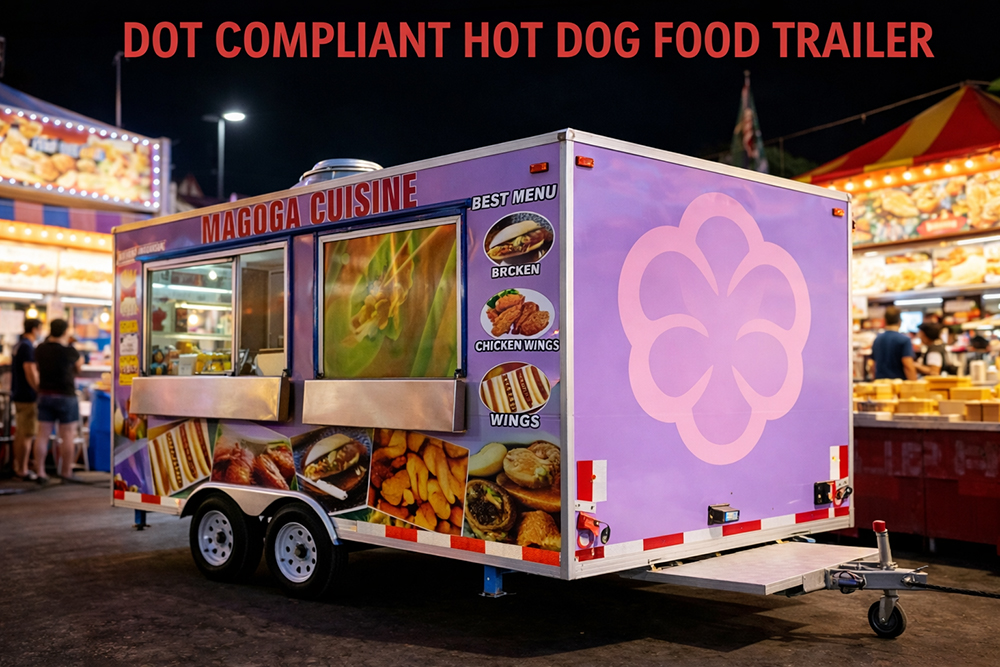
DOT refers to the U.S. Department of Transportation.
A DOT compliant trailer meets federal road safety standards required for legal towing on public highways.
Important clarification:
DOT compliance applies to roadworthiness, not food safety.
There are two layers of compliance:
Transportation compliance (DOT)
Food service compliance (local and state health departments)
Both must be satisfied.
For a hot dog food trailer to be legally towed across U.S. roads, it must meet specific structural and mechanical standards.
Every compliant trailer must have:
A valid 17-digit VIN
Manufacturer certification plate
Federal compliance label
Without VIN documentation, you cannot register the trailer.
DOT requires:
Tail lights
Brake lights
Turn signals
Side marker lights
Reflective tape (depending on weight class)
Lighting must meet FMVSS standards (Federal Motor Vehicle Safety Standards).
If trailer weight exceeds 3,000 lbs (varies by state):
Electric braking system required
Breakaway brake kit required
Safety chains required
Non-compliant braking is a common violation.
Must meet load rating requirements.
Improper axle weight distribution can:
Cause accidents
Invalidate insurance
Result in citations
Even with DOT compliance, you must:
Register trailer with DMV
Obtain license plate
Carry proof of insurance
Pass state inspection (if required)
Each state has slightly different thresholds.
For example:
California has stricter emissions and inspection policies.
Texas allows more flexibility but still enforces VIN documentation.
Florida requires proof of weight classification.
Always verify your target state requirements before purchase.
DOT compliance does NOT make your trailer food-legal.
To operate a hot dog food trailer, you must pass local health inspection.
Common requirements:
Most states require:
3-compartment sink
Separate handwash sink
Hot water system (typically 100–120°F)
Freshwater tank
Greywater tank (larger than freshwater)
NSF-certified refrigeration
Proper temperature control (41°F or below)
Thermometer installed
Interior must include:
Stainless steel prep areas
Non-porous surfaces
Easy-to-clean flooring
Wood interiors are often rejected.
Hot dog trailers using propane must meet fire standards.
Typical requirements:
Fire suppression system (if deep fryers or grills installed)
Proper propane tank enclosure
Fire extinguisher (Class K)
Gas line inspection
Some counties require third-party fire marshal approval.
Use properly rated wiring
Include circuit breakers
Be grounded properly
Meet NEC standards (National Electrical Code)
Improper wiring is a common reason for inspection failure.
Many states require:
Approved commissary kitchen
Daily cleaning and storage logs
Food prep location documentation
You cannot legally prepare certain foods at home.
Before purchasing, confirm:
Gross Vehicle Weight Rating (GVWR)
Tow vehicle capacity
Hitch rating
Brake controller compatibility
Overloading is illegal and dangerous.
New operators frequently:
Buy non-certified imported trailers
Ignore VIN documentation
Forget greywater tank capacity requirements
Skip fire inspection
Underestimate permit timelines
Retrofitting later can cost $5,000–$15,000.
Buying compliant from day one is cheaper.
If you purchase a properly built trailer:
Compliance cost built-in:
Included in price
If retrofitting:
| Item | Estimated Cost |
|---|---|
| Brake upgrade | $800 – $2,500 |
| Electrical correction | $1,000 – $3,000 |
| Plumbing modification | $1,500 – $4,000 |
| Fire suppression install | $2,000 – $5,000 |
Avoid these costs by selecting a manufacturer experienced with U.S. standards.
Ask the supplier for:
VIN documentation
Manufacturer certificate
Brake system specifications
Axle weight rating
Electrical diagram
Plumbing layout
Fire system certification (if applicable)
If the seller cannot provide documentation, walk away.
Many entrepreneurs import trailers.
When doing so, confirm:
U.S.-standard axle rating
DOT-approved lighting
Brake compatibility
Plumbing adapted to U.S. code
Electrical built for 110V/60Hz
Some international builders, including ZZKNOWN, offer U.S.-spec trailer builds designed specifically to meet American compliance standards before shipping.
Always confirm customization for your target state.
Typical process:
Purchase compliant trailer – 4–8 weeks build
Delivery and DMV registration – 1–3 weeks
Health inspection scheduling – 2–6 weeks
Fire inspection – varies
Final permit approval – 1–4 weeks
Total timeline:
2–4 months average
Planning ahead avoids revenue delays.
Most U.S. jurisdictions require:
General liability insurance
Commercial auto insurance (if truck)
Trailer insurance policy
Workers compensation (if staff)
Annual cost:
$1,000 – $3,000 average
Insurance companies may request proof of compliance before issuing coverage.
Before launch, confirm:
DOT compliant VIN plate
Functional brake system
Registered with DMV
Passed health inspection
Fire marshal approval
Insurance active
Commissary agreement signed
If all are satisfied, you are legally operational.
A DOT compliant hot dog food trailer is not just about legality — it is about protecting your investment, ensuring safety, and enabling uninterrupted business operation.
Entrepreneurs who prioritize compliance from the beginning:
Avoid fines
Avoid shutdowns
Avoid retrofit expenses
Accelerate time to revenue
In 2026, regulatory enforcement is tightening in many U.S. states. Cutting corners is no longer viable.
Choose compliance first, profit second — and long-term sustainability follows.