Published: August 17, 2026 | Last Updated: August 17, 2026 | Data scope: European Union packaging rules; operational guidance for global food truck and takeaway buyers

Direct answer: Since August 12, 2026, the EU Packaging and Packaging Waste Regulation generally applies, including PFAS concentration limits for food-contact packaging placed on the EU market. Food truck and takeaway operators should obtain material declarations and test evidence from packaging suppliers, review burger boxes, pizza boxes, wraps, cups, and lids, reduce unnecessary packaging, and prepare for later recyclability and reuse obligations.
It is five minutes before lunch service. Your burger station is hot, the first tickets are printing, and a delivery of takeaway boxes arrives. The cartons look exactly like last month's supply. The color is right. The size is right. They hold grease well. But one important question is now harder to ignore: what is in the barrier coating?
For food trucks, trailers, pop-ups, and takeaway restaurants serving the European Union, August 12, 2026 is not just another date on a sustainability calendar. Regulation (EU) 2025/40 on packaging and packaging waste—usually called the PPWR—entered into force on February 11, 2025 and generally began to apply on August 12, 2026. On that same date, specific PFAS limits for food-contact packaging became relevant to packaging placed on the EU market.
Based on ZZKNOWN's production experience, packaging decisions also shape the mobile kitchen itself. A burger box, paper wrap, cup carrier, and reusable-container return process need different storage, counter space, dispensing, and handoff flow. This guide explains the new rules in plain English and shows how to turn a compliance conversation into a practical food trailer layout.
The PPWR replaced the older directive-based approach with a regulation that applies directly across the EU, while still requiring businesses to consider implementing acts, guidance, national enforcement, food-contact rules, and waste systems. It covers packaging and packaging waste regardless of material or origin and addresses composition, design, recoverability, waste prevention, reuse, labeling, and producer responsibility.
For a mobile food business, the most immediate headline is Article 5's restriction on PFAS in packaging intended to contact food. From August 12, 2026, that packaging cannot be placed on the market when PFAS concentrations are equal to or above the stated thresholds, to the extent another EU law has not already prohibited that concentration.
This is more precise than saying “the EU banned every fluorine atom in every burger box.” The law uses three analytical thresholds and includes measurement details. It also operates alongside other EU legislation, including rules for food-contact materials, REACH chemical restrictions, and persistent organic pollutants. If your supplier gives you a one-line marketing claim but cannot explain the test method, the job is not finished.
| PPWR food-contact packaging threshold | Limit in Article 5(5) | What the buyer should request |
|---|---|---|
| Any individual PFAS by targeted analysis | 25 ppb (polymeric PFAS excluded from quantification) | Lab method, analyte list, reporting limits, sample identification, and result |
| Sum of PFAS by targeted analysis | 250 ppb, where applicable after precursor degradation (polymeric PFAS excluded) | Explanation of precursor treatment and the compounds included in the sum |
| PFAS including polymeric PFAS | 50 ppm; when total fluorine exceeds 50 mg/kg, supporting evidence is required on request to distinguish PFAS from non-PFAS fluorine | Total fluorine result plus the supplier's evidence and technical-documentation route |
Region and update note: The figures above reproduce the EU PPWR thresholds checked on August 17, 2026. They are not a home-testing guide. Sampling, laboratory competence, reporting limits, product variants, and legal interpretation matter. Ask a qualified EU food-contact packaging specialist or competent authority to review uncertain cases.
PFAS are a large family of synthetic substances built around very strong carbon-fluorine bonds. That chemistry can make materials resist oil, water, heat, and staining—the same properties that made some PFAS useful in grease-resistant papers, molded fiber items, coatings, inks, or processing applications.
The durability is also the problem. The European Chemicals Agency explains that PFAS resist degradation, can travel long distances, and increasingly appear as environmental pollutants; some are linked to harmful health effects. The PPWR's recitals say PFAS in food-contact materials can expose people and describe the risk as unacceptable for this use.
For an operator, the practical lesson is simple: do not judge a package by its natural brown color, “eco” appearance, or oil resistance. Kraft-colored paper can carry a coating. White molded fiber can be compliant or non-compliant depending on its composition and production. A supplier's evidence must identify the exact stock-keeping unit you buy, not a similar sample from a different factory.
Start with the items that contact hot, fatty food for the longest time. Burger clamshells, fried-chicken boxes, chip cartons, molded-fiber trays, paper bowls, and sauce cups may use barriers to resist grease and moisture. Heat, contact time, acidity, and food type also matter under the broader food-contact-material framework.
Ask the supplier for the material structure: base paper or fiber, barrier chemistry, inks, adhesive, inner liner, and any laminated film. Confirm that the declaration covers the finished article—not only the raw paper. If the lid and base come from different suppliers, treat them as separate components. The same applies to a cup and its lid.
A packaging change also deserves a service test. A compliant alternative that collapses under steam, leaks oil, or opens during delivery can create food waste and customer complaints. Test the exact menu under real holding times, stacking, travel, and temperature conditions while the supplier handles regulatory evidence.
Traditional corrugated pizza boxes may seem straightforward, but the complete format can include recycled fibers, printing inks, adhesives, coatings, liners, and small plastic features. Request confirmation for the finished box and any grease-resistant sheet placed under the pizza. Do not assume that removing a liner automatically solves every food-contact question.
Ventilation and storage are operational issues too. A box that traps excessive steam can soften the crust; a box stored beside a fryer can absorb grease or moisture before use. Specify a dry, protected cabinet sized for flat box blanks and design an assembly area that does not block plating. Based on ZZKNOWN's production experience, tall vertical compartments or adjustable shelves often use trailer space more efficiently than loose cartons under the counter.
Ask whether the paper's grease resistance comes from fiber treatment, a dispersion coating, a film layer, or another barrier. Then ask for the exact evidence covering that chemistry. Terms such as “waxed,” “coated,” “compostable,” “biodegradable,” or “plant-based” do not by themselves prove PFAS compliance, food-contact suitability, or recyclability.
Wrap dimensions affect waste. If one oversized sheet is used for every menu item, the business may be buying and discarding material it does not need. A better specification matches sheet size to the product, allows fast dispensing, and avoids double-wrapping. In a trailer, a protected dispenser near the handoff zone can reduce dropped sheets and keep clean packaging away from splash, raw food, and chemical storage.
Map the complete beverage set: hot cup, cold cup, lid, straw where used, sleeve, carrier, seal film, and any inner coating. A paper cup can still contain a plastic or other barrier layer. A compostable-looking clear cup may require a particular industrial collection route that does not exist at your event. A reusable cup needs return, inspection, washing, drying, and clean storage.
Later PPWR provisions introduce recycled-content, reuse, and consumer-choice requirements that differ by packaging type and business situation. Do not select one cup format for all EU markets from a single headline. Ask the supplier and a local adviser to map the product's material category, intended use, national collection system, deposit requirements, and any exemptions.
| Packaging route | Operational advantage | Evidence or system to verify | Relative cost/effort |
|---|---|---|---|
| PFAS-compliant fiber/paper single-use | Familiar service workflow and easy branding | Food-contact declaration, PFAS evidence, inks/adhesives, real recyclability route | $–$$ |
| Mono-material plastic format | Moisture resistance and consistent closure | Food-contact status, recycled-content rules, local sorting and recycling | $–$$ |
| Compostable packaging | Can suit specific permitted formats and controlled collection systems | Applicable standard, labeling, permitted use, local industrial collection—not a generic “green” claim | $$–$$$ |
| Customer's own container | Avoids issuing a package for that order | Hygiene procedure, contact-free filling method, size limits, allergy and spill controls | $ setup / staff training |
| Reusable packaging system | Reduces repeated single-use packaging when return cycles work | Deposit/return, tracking, collection, washing, inspection, storage, loss rate | $$$–$$$$ |
Dollar signs compare relative purchase and operating effort, not quotations. Actual cost depends on order volume, printing, barrier system, testing, destination, collection infrastructure, washing, deposits, and loss rates.
Begin with a product list that uses exact item codes. For each item, record the supplier, factory, material layers, dimensions, intended food type, temperature range, contact time, print, adhesive, coating, production lot, and country where it will be sold. A generic catalogue is not traceability.
Do not ask your food trailer manufacturer to certify a disposable box it did not manufacture or source. ZZKNOWN can plan storage and workflow around your chosen packaging dimensions, but the packaging supplier must provide product-specific compliance evidence. Your importer, distributor, platform, event, and local authority may also request records.
Start with the order, not the material. Ask whether the customer needs a bag, cutlery, napkin, sachet, lid, straw, or drink carrier. Defaulting every order to the maximum bundle creates cost and waste. A point-of-sale prompt can let customers choose only what they need.
Then simplify formats. One adjustable carton may replace two rarely used sizes if it still protects the food. A sauce dispenser may reduce individual sachets when hygiene and service conditions allow. A correctly sized burger wrap may eliminate an outer clamshell for eat-now orders. Test changes for heat retention, leakage, allergen separation, tamper needs, and delivery time.
In the trailer, put packaging in the order of use. Keep clean boxes and wraps away from splash and grease. Place fast-moving items between waist and shoulder height, with backup stock in dry closed cabinets. Give finished orders a clear landing zone. Small layout changes reduce double handling and accidental damage far more reliably than asking a rushed employee to “use less.”
The European Commission summarizes the PPWR goal as making packaging on the EU market recyclable in an economically viable way by 2030. The regulation moves toward design-for-recycling performance grades and later recycled-at-scale assessment. This is not permission to print a recycling symbol today simply because a box contains paper.
A multi-layer package may be technically separable in a laboratory but not accepted by the collection system where your truck operates. Food contamination can also reduce recovery. Operators should ask how the complete package—including coating, window film, label, ink, adhesive, lid, and liner—fits the applicable design criteria and local waste stream.
For plastic packaging, minimum recycled-content rules also phase in from 2030 or later depending on implementing-act timing and format. Contact-sensitive packaging has specific percentages and exceptions. That is a supplier and legal-review question, not a reason for a food truck to guess the recycled percentage from color or texture.
The official EUR-Lex summary explains that restaurants and cafes providing takeaway food or drinks must allow customers to bring their own containers by 2027 and offer a reusable packaging option by 2028, subject to the regulation's detailed scope, conditions, and exemptions. Those later steps deserve layout planning now.
A mobile kitchen needs a hygienic handoff method. The customer's container should not cross into a clean preparation zone or touch food-contact tools unnecessarily. Decide where staff receive it, how they reject a visibly unsuitable container, how portioning works, and how spills are controlled. Train staff and document the procedure with local food-safety advice.
A business-owned reusable system needs more infrastructure: container inventory, deposits or digital tracking, return bins, transport to washing, validated cleaning, drying, inspection, clean storage, and replacement. A tiny trailer may partner with an external washing or reuse provider instead of trying to wash dozens of returned containers beside food preparation.
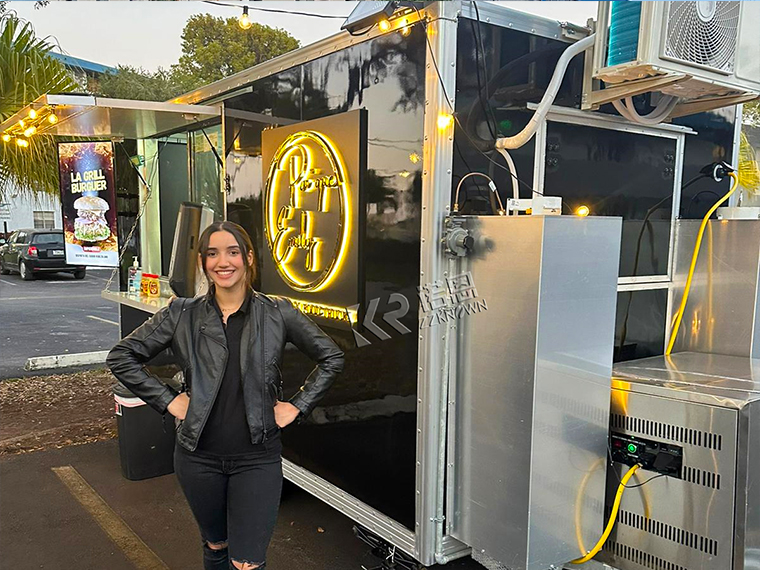
The ZZKNOWN KN-FS400 custom square food trailer is a useful real-product reference. Its published configuration measures 4 m × 2 m × 2.3 m (13 ft × 6.5 ft × 7.5 ft), uses two axles, and offers custom windows and branding. The standard family includes stainless workbenches on both sides, a double sink, water pump, LED lighting, and destination-market electrical socket options.
Those are verified published specifications—not a claim that the photographed unit was built for PPWR compliance or supplied with certified packaging. For a new European takeaway project, ZZKNOWN can use your packaging dimensions and daily order mix to plan closed dry cabinets, adjustable shelves, wrap dispensers, a serving counter, POS position, bagging zone, customer-container handoff point, and space for separated waste or reusable returns.
.jpg)
| Verified KN-FS400 parameter | Published value | Packaging-workflow question for a new order |
|---|---|---|
| Trailer size | 4 m × 2 m × 2.3 m | How much protected packaging stock is needed between restocking runs? |
| Running gear | Two axles | Where should bulk packaging be placed without compromising weight distribution? |
| Work surfaces | Stainless workbenches on both sides | Which section remains a clean assembly and handoff zone? |
| Customer-facing features | Custom windows and logo options | Where should POS, pickup, customer-container receiving, and reuse instructions sit? |
| Public factory-price range | USD 4,200–5,900 | Final equipment, EU road approval, shipping, tax, certification, and packaging systems are project-specific. |
Engineer note: “Send your menu, expected orders per hour, packaging item codes, flat and assembled dimensions, daily quantities, delivery-versus-walk-up share, POS equipment, bag sizes, reusable-container plan, and destination country. We can then size the closed cabinets, dispensers, counter, pickup shelf, and return area. Packaging compliance documents still come from the packaging supplier and must be confirmed for the exact EU market.” — ZZKNOWN Technical Engineering Team
Related design guides can help with the rest of the project. Compare body lengths in the food trailer size guide, review custom manufacturing options on the ZZKNOWN OEM/ODM page, and see the European food trailer buying guide for broader vehicle and import planning.
ZZKNOWN used four evidence layers. First, we checked the consolidated official text of Regulation (EU) 2025/40, including Article 5 and the PFAS thresholds. Second, we reviewed the European Commission's packaging-waste overview, March 2026 PPWR FAQ, and official EUR-Lex summary. Third, we used ECHA's PFAS explanation for the chemistry and environmental context. Fourth, we matched those regulatory facts with the current public KN-FS400 product specifications and ZZKNOWN's production-planning experience.
We did not treat an “eco” label as test evidence, claim that every business has identical duties, or certify any disposable package shown in a photograph. The article is procurement and layout guidance, not a legal opinion, laboratory report, declaration of conformity, food-safety plan, or substitute for the European Commission, a national competent authority, or a qualified compliance professional.
Yes. Regulation (EU) 2025/40 entered into force on February 11, 2025 and generally applies from August 12, 2026. Individual provisions can have later dates, implementing measures, conditions, or exemptions.
The PPWR uses specific concentration thresholds and analytical approaches. Do not replace the legal text with a casual “zero” claim. Ask for product-specific evidence addressing the 25 ppb, 250 ppb, and 50 ppm routes as applicable.
No. Color and appearance do not reveal barrier chemistry. Obtain a declaration and appropriate test evidence for the exact finished box, coating, ink, and production source.
Do not assume a blanket sell-through rule. The legal question depends on when and how packaging was placed on the market, supply-chain facts, enforcement guidance, and any applicable transition. Ask the competent authority or qualified adviser about your exact stock.
No. Compostability, food-contact compliance, PFAS concentration, and local collection are separate questions. Request evidence for each claim and confirm whether the destination actually collects that format for industrial composting.
The PPWR introduces later provisions for takeaway businesses, summarized by EUR-Lex as allowing customers' own containers by 2027 and offering reusable packaging by 2028. Confirm scope, timing, hygiene procedures, and exemptions for your business and Member State.
The packaging supplier or responsible economic operator should provide product-specific technical evidence. The food business should keep traceable records and verify that they match the exact items purchased.
Yes. Send the packaging dimensions, quantities, menu, service volume, and reuse plan. ZZKNOWN can plan closed cabinets, adjustable shelves, dispensers, counters, pickup flow, and return space. The packaging supplier remains responsible for packaging-specific documentation.
Send ZZKNOWN your EU destination, menu, order volume, takeaway packaging list, item dimensions, and reusable-container plan. Our team will prepare an initial food trailer layout with dry storage, dispensers, serving counter, pickup flow, and space for separated returns or waste.
Request the EU Packaging Checklist Plan a Packaging-Ready LayoutAuthor: ZZKNOWN Editorial Team
Technical review: ZZKNOWN Technical Engineering Team
Legal review boundary: Official EU sources were checked on August 17, 2026. This article explains procurement and trailer-layout implications but is not legal advice or a declaration of packaging conformity. Verify the current PPWR text, implementing guidance, national enforcement, food-contact requirements, and product-specific laboratory evidence.