Published: August 17, 2026 | Last Updated: August 17, 2026 | Data scope: Global buyer guidance with U.S., UK, and Australian official references
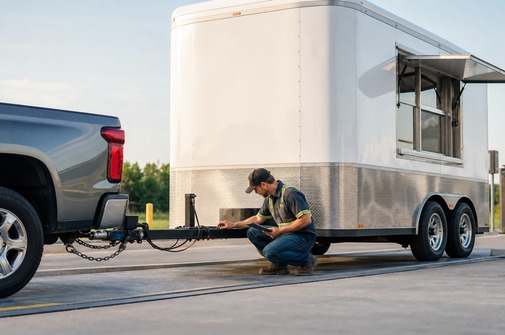
Direct answer: Choose a tow vehicle from the food trailer's real travel-ready weight, measured tongue weight, GVWR, axle ratings, and your exact vehicle's payload, tow rating, axle limits, hitch rating, and gross combination limit. Empty weight alone is not enough. Add water, food, LPG, equipment, generator, supplies, passengers, and truck cargo—then confirm the loaded combination on a certified scale before regular service.
“Can my SUV tow this food trailer?” It sounds like a yes-or-no question. In practice, it is the last line of a short engineering calculation.
Imagine two trailers that look identical in a photo. One serves coffee and packaged pastries. The other carries a griddle, fryer, hood, refrigeration, 120 liters of fresh water, LPG cylinders, a generator, and a week's worth of packaging. Their shell dimensions may match, but the second trailer can place hundreds—or more than a thousand—additional pounds on its axles and hitch. A brochure that lists only length and empty weight cannot tell you which tow vehicle is suitable.
Based on ZZKNOWN's production experience, the safest time to solve this question is before the chassis, axle configuration, tanks, and kitchen layout are finalized. This guide shows you how we think through the numbers with a buyer. It will not name a particular pickup or SUV and promise that it can tow your trailer. Ratings vary by year, engine, drivetrain, wheelbase, axle ratio, factory tow package, tires, and local law. The exact vehicle documents and real weights control.
Empty, dry, curb, and tare weights are not always defined the same way by every manufacturer or country. One published figure may include installed standard equipment but no water, LPG, food, or removable generator. Another may describe a basic shell before your selected hood, refrigerator, and stainless worktables are added. Ask what the number includes and whether it is calculated or measured.
The number you tow is the trailer's actual loaded weight on that trip. Think of opening day: the fresh tank contains water, refrigerators contain product, the LPG cylinders have been filled, cleaning chemicals and packaging are stored in cabinets, and a generator may be mounted on the drawbar or rear platform. Those items affect total weight, axle loading, balance, and tongue weight.
A useful planning formula is simple:
That estimate is for design. The final answer should come from a suitable certified scale. Weigh in the same condition you actually plan to travel, and document whether tanks are empty, partly full, or full.
In U.S. federal definitions, GVWR is the manufacturer-specified loaded weight of one vehicle. For a trailer, it is the maximum rated weight of the trailer and everything it carries. GAWR is the manufacturer-specified load capacity of a single axle system, measured at the tire-ground interfaces. GCWR is the manufacturer-specified loaded weight of the combination vehicle. These are ratings, not predictions of what your trailer happens to weigh today.
Payload capacity is the amount of weight a vehicle can carry, but always use the exact manufacturer's method and label. For trailer planning, buyers often estimate available trailer payload as GVWR minus the verified as-built empty weight. For the tow vehicle, passengers, cargo, aftermarket accessories, the hitch, and the trailer's tongue load all consume carrying capacity. A vehicle can appear to have enough trailer tow rating while running out of payload or rear-axle capacity first.
Tongue weight—also called hitch load, nose weight, or tow-ball down-weight in different markets—is the downward force the trailer applies at the coupling. It is part of the trailer's total weight, not an extra amount to add twice. It matters to both vehicles: too little or poorly distributed hitch load can contribute to instability, while too much can overload the tow vehicle, receiver, rear axle, or tires.
| Number | What it answers | Where to verify it | Common mistake |
|---|---|---|---|
| Trailer GVWR / ATM or MAM equivalent | Maximum rated loaded mass of the trailer under the applicable system | Trailer certification or vehicle plate and approved documents | Treating it as empty weight |
| Trailer GAWR / axle-group rating | How much each rated axle system can carry | Trailer label, axle, tire, wheel, and engineering records | Assuming two axles make every other component twice as strong |
| Actual trailer weight | What the loaded trailer weighs today | Certified scale in travel-ready condition | Using an estimate after the build is complete |
| Tongue weight | Downward load transferred to the hitch | Suitable tongue scale or documented scale procedure | Ignoring its effect on vehicle payload and rear axle load |
| Vehicle payload | How much passengers, cargo, accessories, and hitch load the exact vehicle can carry | Door label, certification plate, handbook, and manufacturer guide | Comparing only the advertised tow rating |
| Vehicle tow rating / GCWR | Manufacturer limit for the exact configuration and loaded combination | VIN-specific data, current owner's manual, towing guide, and manufacturer | Using the highest number from an advertisement for every trim |
Region and update note: References were checked on August 17, 2026. U.S. GVWR/GAWR/GCWR definitions come from 49 CFR 571.3. The UK commonly uses MAM and gross train weight. Australia uses terms including tare mass, GTM, and ATM. Similar ideas do not guarantee identical definitions, labels, or legal thresholds. Confirm the destination country's current rules and the exact vehicle documents.
Water is the load buyers underestimate most often because a tank looks like part of the trailer. The U.S. Geological Survey gives a practical figure of about 8.33 lb per U.S. gallon; one liter of water is approximately one kilogram. The tank, pump, heater, plumbing, and mounts add their own weight before the water is filled.
| Water volume | Approximate water weight | Why it matters |
|---|---|---|
| 25 L / 6.6 U.S. gal | 25 kg / 55 lb | Even a compact handwash supply is not weightless |
| 50 L / 13.2 U.S. gal | 50 kg / 110 lb | Tank position can noticeably change balance |
| 120 L / 31.7 U.S. gal | 120 kg / 265 lb | Comparable to several adults added to the trailer |
| 180 L / 47.6 U.S. gal | 180 kg / 397 lb | Waste capacity must be included in the worst realistic travel condition |
| 300 L / 79.3 U.S. gal | 300 kg / 662 lb | Illustrates the combined mass if 120 L fresh and 180 L waste tanks were both full |
Wastewater is not always exactly the density of clean water, and most operators do not intentionally tow with both tanks full. Still, design for the most demanding realistic condition instead of assuming a perfect routine. A delayed dump, an event without a drain, or a partly full tank can change axle and hitch loads. Partially filled tanks may also let liquid move, so secure baffled tanks and follow the tank manufacturer's installation requirements.
Next, list every appliance and removable item from real data—not memory. Refrigerators, fryers, ovens, ice machines, hood systems, suppression cylinders, LPG bottles, batteries, generator, spare tire, service counters, awnings, POS hardware, cookware, ingredients, and packaging all belong in the weight schedule. The location matters as much as the total. A heavy generator behind the rear axle can reduce tongue load; moving it to the drawbar can increase tongue load. Neither position should be chosen by guess.
Suppose a hypothetical trailer has a measured as-built empty weight of 3,600 lb. The operator expects 300 lb of food and beverages, 250 lb of cookware and supplies, 400 lb of water in the planned travel condition, and 200 lb of LPG, fuel, and removable equipment. The estimate becomes:
3,600 + 300 + 250 + 400 + 200 = 4,750 lb estimated travel-ready trailer weight
This is a teaching example, not a rating for any ZZKNOWN model. The trailer's certified GVWR, each axle/tire limit, measured tongue weight, and actual scale results must support the load.
California DMV guidance describes approximately 10–15% of gross trailer weight as a conventional-trailer hitch-weight reference for stability. Applied only as a preliminary illustration, 10–15% of 4,750 lb would be about 475–713 lb. Do not force your trailer to that range without using its manufacturer's loading instructions, hitch design, local rules, and measured result. Food trailers have concentrated equipment and tanks that can create a very different balance from an empty cargo trailer.
Now look at the tow vehicle. If the measured hitch load were 600 lb, that 600 lb would share the vehicle's payload with the driver, passengers, tools, bed cargo, aftermarket accessories, and hitch equipment. Then compare the fully loaded vehicle and trailer with the vehicle GVWR, front and rear GAWR, tow rating, GCWR, tire ratings, receiver rating, and any manufacturer requirements for a weight-distributing hitch or brake controller. Passing one line does not excuse failing another.
Any of those categories may work for some food trailers, and none works for every one. “SUV” or “pickup” is a body style, not a capacity certificate. Even two vehicles with the same badge can have different engines, cooling systems, wheelbases, axle ratios, suspensions, tires, and factory towing packages. Use the exact VIN/configuration and the current manufacturer instructions.
| Vehicle category to investigate | When buyers usually consider it | What often becomes the limiting check | Relative operating impact |
|---|---|---|---|
| SUV or crossover | Small, genuinely light trailer and limited cargo | Payload, hitch load, receiver rating, cooling, and short wheelbase | Potentially lower purchase/parking burden, but little reserve in some configurations |
| Midsize pickup | Compact to medium trailer with controlled equipment list | Payload and rear axle once passengers, bed cargo, and tongue load are added | Easier daily use; exact tow package becomes critical |
| Full-size light-duty pickup | Many medium builds after complete weight calculation | Configuration-specific payload, GCWR, receiver, tires, and local commercial rules | More capacity choices, but larger ownership and fuel costs |
| Heavy-duty pickup or commercial tow vehicle | Large, equipment-heavy, high-payload, or frequent-distance operation | Licence, registration, insurance, parking, commercial operation, and combination limits | Higher acquisition/operating burden with potentially greater rated reserve |
This table compares decision factors, not vehicle recommendations or price quotations. A heavier truck is not a substitute for checking the trailer, hitch, tyres, brakes, licence, and local route rules.
A correctly engineered dual-axle configuration can distribute trailer load, improve redundancy, and support an appropriate trailer rating. It does not automatically double payload. The usable rating remains constrained by the weakest applicable component and the approved design: chassis, drawbar, coupling, suspension, axles, wheels, tires, brakes, and certification.
Trailer brakes help the combination slow and may be legally required above a local threshold. A breakaway system can apply the trailer brakes if it separates. But installing brakes does not rewrite the tow vehicle's rating, increase its payload sticker, or strengthen an undersized receiver. Verify the brake type, controller compatibility, wiring, breakaway battery, parking brake where required, and inspection rules for the destination.
Australia's current VSB 1 illustrates why region matters: it expresses braking requirements in terms of GTM, uses ATM and GTM rather than U.S. GVWR terminology, and requires specific engineering and marking under Australian rules. The UK instead directs drivers to the vehicle handbook or VIN plate and says the fully loaded car plus fully loaded trailer must not exceed gross train weight. A global trailer order therefore needs a destination-country review before the chassis and braking package are released.
Engineer note: “Please send the tow vehicle's exact year, make, model, engine, drivetrain, wheelbase, axle ratio if listed, factory tow package, door-label ratings, receiver label, and manufacturer towing guide—plus your passengers and truck cargo. A photo of the truck or a model name alone is not enough. We use that information with your menu and equipment schedule to plan trailer size, axle configuration, tank location, and expected hitch load. Final suitability still requires local approval and travel-ready scale weights.” — ZZKNOWN Technical Engineering Team
For the trailer, send the menu first. It tells us which appliances, refrigeration zones, hood, gas system, storage, and water capacity the business actually needs. Then identify daily ingredient volumes, generator or battery plan, LPG cylinder arrangement, fresh/waste tank strategy, expected supplies, destination road standard, and how often the trailer will move. A trailer parked for a season and a trailer moved every day deserve different operational discussions.
ZZKNOWN can support custom food trailer engineering and OEM/ODM planning, including pre-production weight calculation, equipment weight scheduling, axle configuration selection, custom chassis design, and layout review. These services improve the information available for the buyer's tow-vehicle decision; they do not replace the tow vehicle manufacturer, local registration authority, or a certified scale.
The ZZKNOWN KN-QF500 Ice Cream & Bakery Food Truck is a useful real-project example. Its published configuration is a 5 m × 2 m × 2.3 m (16.4 ft × 6.5 ft × 7.5 ft) dual-axle trailer with a braking system. It includes a 2 m dual-temperature refrigerator, ice cream cabinet, cake cabinet, restroom, air conditioner, removable generator box, 120 L fresh-water tank, and 180 L waste-water tank.
Those are verified product-page specifications. They are not a published empty weight, GVWR, tongue weight, or tow-vehicle recommendation for the displayed unit. That missing distinction is the lesson: dimensions and equipment photos help you plan the business, but a towing decision needs the order-specific engineering weight schedule, certification data, and measured completed weight.
Using water density only, 120 L of fresh water is approximately 120 kg (265 lb). If a 180 L waste tank were full of water-like liquid, its contents would be about 180 kg (397 lb). Both completely full would represent roughly 300 kg (662 lb) of liquid before counting either tank or plumbing. Your normal operating practice may be different, so state the realistic travel condition in writing.
.png)
.png)
| Verified KN-QF500 item | Published specification | What must still be calculated for a new order |
|---|---|---|
| Body and running gear | 5 m × 2 m × 2.3 m, dual axle, four wheels, braking system | Destination-specific chassis, axle/tire ratings, GVWR or local mass ratings, finished balance |
| Cold equipment | Dual-temperature fridge, ice cream cabinet, cake cabinet | Exact selected-equipment mass and mounting location |
| Water capacity | 120 L fresh, 180 L waste | Travel fill levels, tank/plumbing mass, axle effect, and local requirements |
| Other equipment | Restroom, A/C, removable generator box | Selected generator and supplies, plus their effect on hitch load |
| Public factory-price range | USD 12,000–19,900 | Final equipment, chassis, certification, shipping, taxes, and tow vehicle are project-specific |
Start with the scale operator's instructions and the tow vehicle and trailer manufacturers' procedures. A useful set of readings normally separates enough information to check the loaded tow vehicle, trailer axles, and full combination. Depending on the scale and local practice, that may involve axle-platform readings with the complete combination and a separate trailer or tongue-weight procedure.
NHTSA has specifically advised buyers to obtain the fully loaded trailer tongue weight from the trailer manufacturer and relate it to the tow vehicle's axle ratings on its certification label. That advice is old but still useful as a safety principle: do not let the big tow-rating number distract you from the loads carried by the hitch and axles.
Related decisions are connected. Read the food trailer propane and LPG system guide when cylinders and gas appliances affect the weight plan. See the food trailer fire safety guide for hood, suppression, extinguisher, and layout coordination. For refrigeration-heavy menus, the food trailer temperature monitoring guide explains power-loss planning and cold-equipment control.
ZZKNOWN used four evidence layers. First, we reviewed the current public specifications and real project photographs for the KN-QF500. Second, we applied ZZKNOWN's production-planning experience with kitchen equipment schedules, tank placement, axle configuration, custom chassis, and export-market documentation. Third, we checked definitions and towing guidance on official U.S. eCFR, NHTSA, USGS, California DMV, GOV.UK, and Australian Department of Infrastructure pages available on August 17, 2026. Fourth, we separated verified facts from teaching examples and order-specific calculations.
We did not infer a weight rating from the KN-QF500's size or price. We did not claim that a particular SUV or truck can tow it. We did not treat a general tongue-weight percentage as universal law. This article is an early planning guide, not a vehicle approval, certified weight ticket, legal opinion, or substitute for the trailer manufacturer, tow vehicle manufacturer, licensed engineer, insurer, or local authority.
Possibly, if the exact SUV's manufacturer ratings, payload, axles, tires, receiver, brakes, and combination limits support the trailer's verified travel-ready weight and measured tongue load. “SUV” alone is not enough information. Send the exact configuration and label data.
There is no single universal percentage that replaces the manufacturer's instructions or local law. Stay within every rating and consider operating conditions such as hills, heat, wind, frequent travel, cargo variation, and braking. A practical reserve is valuable, but it must not hide an overloaded axle, payload, hitch, or tire.
No. Use a defined, measured as-built weight and add the real travel load: water, product, LPG/fuel, generator, smallwares, supplies, and waste. Then confirm the final combination on a certified scale.
Water adds about 1 kg per liter or 8.33 lb per U.S. gallon, plus the tank, mounts, pump, heater, and plumbing. A 120 L fill is roughly 120 kg (265 lb) of water.
No. The certified trailer rating and every component limit control. A second axle can be part of a higher-capacity design, but payload also depends on the chassis, suspension, tires, wheels, brakes, coupling, and applicable approval.
No. They improve braking control and may be required, but they do not change the tow vehicle manufacturer's GVWR, GAWR, payload, tow rating, GCWR, receiver rating, or tire limits.
Usually operators minimize unnecessary liquid weight, subject to hygiene, service, and local requirements. Define the worst realistic trip condition and design for it. Follow tank and trailer instructions, secure the load, and avoid assuming both tanks will always be empty.
ZZKNOWN can prepare a pre-production weight and layout plan from your menu, equipment list, tank strategy, destination standard, and tow vehicle data. It supports chassis and axle selection. Final compliance and suitability depend on approved specifications, as-built measurement, local requirements, and the travel-ready scale result.
Send ZZKNOWN your menu, equipment list, destination country, water-tank plan, and exact tow vehicle details. Our engineering team will recommend a practical trailer size and prepare an initial layout, equipment weight schedule, axle configuration, and pre-production weight review for quotation.
Send Menu + Equipment + Tow Vehicle Compare Food Trailer OptionsAuthor: ZZKNOWN Editorial Team
Technical review: ZZKNOWN Technical Engineering Team
Evidence boundary: KN-QF500 parameters and project photos are from the cited ZZKNOWN product page. Official regional references were checked on August 17, 2026. Hypothetical weights are labeled as examples. Final ratings, weighing, tow-vehicle selection, registration, insurance, and compliance remain project- and jurisdiction-specific.