







How a listed propane detector fits into the cylinder, regulator, hard-pipe, shutoff, testing, ventilation, and staff-response plan.
What should you remember first?
- Rules are local. Austin is a clear current example: new mobile food vending units inspected after May 1, 2022 must have a listed propane alarm installed inside the vehicle according to the alarm manufacturer’s instructions.
- An alarm does not prove the system is leak-free. It complements—not replaces—pipe sizing, correct connections, shutoff valves, professional testing, and inspections.
- Placement is model-specific. Propane vapor is heavier than air, but the exact mounting height, distance from appliances, ventilation openings, and contamination sources must come from the selected device instructions and the local inspector.
- Power continuity matters. A detector on a switched, disconnected, or incorrectly sized circuit cannot warn the crew.
- Smoke, carbon-monoxide, and propane alarms do different jobs. One label or combined enclosure does not mean every hazard is covered unless the device is specifically listed for each function.
- The response plan is part of the installation. Staff should know the sound, exits, shutoff procedure, emergency contacts, and the rule never to re-enter or restart equipment until a qualified professional says it is safe.
- Plan before fabrication. ZZKNOWN can reserve an appropriate detector location, 12-volt feed, accessible gas shutoffs, and documentation space once the buyer confirms the destination and final equipment schedule.
What does a food trailer propane alarm actually do?
Imagine the last ten minutes after a busy festival closes. The hood is quiet, the crew is wiping the stainless counters, and someone nudges a flexible connector while pushing a refrigerator back into position. Nobody sees a flame or an obvious broken pipe. A detector is meant to watch for propane vapor at its sensing location and sound before the crew would otherwise recognize the problem.
That sounds simple, but the wording matters. An alarm does not watch every cubic inch of a trailer. It detects gas that reaches its sensor within the device’s operating limits. Air movement, cabinets, equipment bases, doors, floor penetrations, the release point, and the detector location all affect how vapor travels. This is why buying a detector at the end of production and attaching it to any open wall is not an engineering plan.
The Propane Education & Research Council (PERC) says propane gas detectors can identify leaks that are not smelled, advises using a flammable-gas detector that senses propane, and tells users to follow the manufacturer’s installation, use, and care instructions. PERC also makes an important distinction: propane, smoke, and carbon-monoxide detectors are different devices, although combination products exist.
Is a propane alarm legally required in every food truck?
No universal sentence safely answers that question. Requirements vary by country, state or province, city, adopted code edition, unit type, permit path, fuel system, and inspector. A global buyer should ask the local fire authority and gas professional before the factory freezes the wall panels and wiring.
Austin, Texas provides a useful real-world example. The current Austin Fire mobile-food inspection page states that all new mobile food vending units inspected after May 1, 2022 require a listed propane alarm inside the vehicle, installed in accordance with manufacturer instructions. The same page requires manual gas shutoff valves at the supply and point of use, and it separately addresses propane piping and inspection documentation.
That does not turn an Austin rule into a nationwide rule. It gives buyers a concrete reason to treat detector provision as a destination question, not a decorative add-on. Your safest purchase specification is: “Provide a proposed alarm model, location, electrical supply, mounting detail, and access for review by the destination authority before installation.”
Why is detector position usually discussed near the floor?
Pure propane is colorless and odorless; an odorant is normally added to commercial fuel. The NIOSH Pocket Guide entry for LPG lists a relative gas density of 1.45–2.00 compared with air at 1. In everyday language, escaped propane vapor tends to move downward and can collect in low or poorly ventilated areas.
That physical behavior explains why many LP-gas alarm manufacturers specify a low-wall mounting zone. It does not justify inventing one universal mounting height. A sensor placed too high, behind a sealed cabinet, beside a strong supply-air stream, or where cleaners and cooking residue contaminate it may not perform as intended. Select the device first; then coordinate its own installation instructions with the inspector, cabinetry, floor level, doors, vents, refrigeration, and wash-down practices.
How is a propane alarm different from a leak test or other detector?
| Safety layer | What it is intended to do | What it does not prove | Who should define it |
|---|---|---|---|
| Propane / LP-gas alarm | Warn when propane reaches the sensor at an alarm concentration | That every pipe, fitting, valve, regulator, and appliance connection is leak-free | Device manufacturer, authority having jurisdiction, and qualified installer |
| Professional leak or pressure test | Evaluate the gas system using an approved procedure, instrument, pressure, and duration | That a future leak cannot occur after vibration, service, or an appliance change | Qualified or licensed gas professional under local rules |
| Carbon-monoxide alarm | Warn of carbon monoxide produced by incomplete combustion or other sources | Propane detection, unless the product is also specifically listed for LP gas | Device instructions and local fire/building requirements |
| Smoke alarm | Respond to smoke according to its product design and listing | Combustible gas or carbon-monoxide detection unless specifically designed and listed for it | Device instructions and local code |
| Odor awareness | Help people recognize the odorant normally added to propane | Reliable detection in every situation; odor may be masked, diminished, or missed | Operator training and propane supplier guidance |
| Manual shutoff valve | Let a trained person isolate fuel when it is safe and appropriate to do so | Automatic detection or automatic closure | Gas-system design, local code, and qualified installer |
The practical lesson is redundancy. A strong mobile-kitchen design does not ask one component to do six jobs. It gives each safety layer a clear purpose, documents who verifies it, and trains staff not to ignore one signal because another device appears normal.
What should “listed propane alarm” mean to a buyer?
“Listed” is not a marketing adjective. It normally indicates that a product has been evaluated by a recognized certification organization for a defined standard and use. Ask for the exact manufacturer, model, marking, listing information, supply voltage, installation manual, production date, and replacement-life instructions. Then ask the local authority whether that evidence is acceptable for your mobile food unit.
UL Solutions’ gas-device certification page points users to the UL Standards Catalog, including UL 1484. A label referencing a standard is useful only when it matches the actual product and intended application. Do not accept a generic screenshot, an unlabeled device, or a supplier statement that cannot be tied to a model.
What can a real alarm model teach us?
The Safe‑T‑Alert 30 Series flush-mount propane/LP alarm, model 30‑442‑P, is a real product example—not a blanket recommendation for food trailers. Its manufacturer page says it conforms to UL 1484 RV, uses 12 VDC power, draws 90 mA at 12 VDC, has an 85 dB alarm, and has an alarm point below 25% of propane’s lower explosive limit. The page showed a published online price of US$84.95 when checked on September 9, 2026.
Those figures help a buyer ask concrete questions: Is an RV-listed product accepted by my food-truck inspector? Is 12 VDC continuously available when shore power or the generator is off? Is the mounting cavity deep enough? Can staff see the status light and reach the test/mute control? Does the ambient temperature stay within the model’s range? What is the date code and end-of-life policy?
The manufacturer’s FAQ says propane and CO alarms older than five years should be replaced and that the owner’s manual governs product-specific replacement information. Treat that as the manufacturer’s policy for its products, not as a universal lifetime for every detector.
How do detector options compare before purchase?
| Option | Example parameters or cost | Best use in planning | Important limitation |
|---|---|---|---|
| 12 VDC dedicated LP-gas alarm | Safe‑T‑Alert 30‑442‑P example: 12 VDC, 90 mA, 85 dB, <25% LEL alarm point; US$84.95 published price | Simple always-on LP detection where the listing and model are accepted | RV conformity does not automatically equal approval for every commercial mobile kitchen |
| Combination CO + LP alarm | Model-specific voltage, alarm patterns, sensor life, listing, and price | Can reduce wall space when both functions and the combined model are accepted | Mounting requirements must satisfy both sensing functions; never assume every combination unit fits every trailer |
| Alarm with relay or shutoff integration | Project-specific detector, valve, controls, wiring, commissioning, and service cost | May support a designed automatic response where the complete system is approved | A relay output alone is not a complete listed gas-shutoff system; nuisance trips and reset logic require engineering |
| Portable handheld gas detector | Professional model and calibration/service costs vary | Useful tool for trained technicians during service or investigation | Not a substitute for a permanently installed alarm when one is required |
| No fixed detector | No hardware cost | Only where the authority and final design do not require one | Provides no continuous propane warning; may fail destination requirements |
Prices change, shipping and tax vary, and the detector is only a small part of the project. The real installed cost may include a power circuit, fuse, enclosure, wiring protection, labor, documentation, inspection, replacement access, and—in an integrated system—a compatible shutoff valve and commissioning.
Where should the detector go inside the trailer?
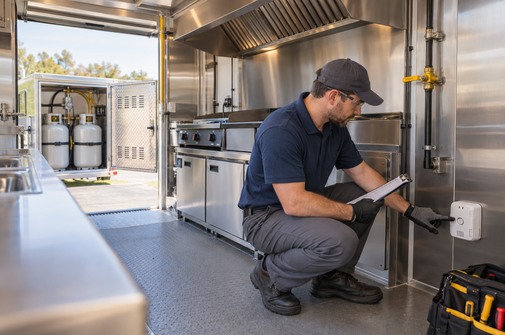
Start with the approved model manual, not a social-media diagram. Provide the installer with the finished-floor level, appliance and cabinet elevations, door swings, vents, HVAC supply and return locations, wash-down zones, battery compartment, generator position, and likely leak points. The mounting location should remain visible, reachable, cleanable, protected from impact, and accessible for replacement.
Avoid solving one problem by creating another. A detector cannot be buried behind a refrigerator merely because that wall is low. It should not become a footrest, be soaked during floor cleaning, or sit where a box blocks the sound and indicator. Any minimum spacing from appliances, vents, windows, chemical storage, or electrical equipment belongs to the selected product instructions.
How should the alarm be powered?
Many mobile or RV propane alarms use a hardwired 12-volt supply. That can be useful because the alarm may remain active when the trailer is not connected to shore power, but only if the battery system, fuse, wire size, disconnect logic, charging system, and low-voltage behavior have been designed correctly. Confirm whether the device may share a circuit and whether a master disconnect removes its power.
The commissioning checklist should record the model, voltage measured at the device, fuse or breaker identification, status indication, test result, and what happens when shore power and the generator are turned off. If the detector depends on a battery, include the battery state in the opening checklist. A green light today is not a maintenance program.
Should the alarm automatically close a gas valve?
Sometimes an authority or engineered design may use a detector signal to operate a listed valve. That is not the same as connecting any alarm relay to any solenoid. The sensor, controller, valve type, power condition, fail-safe behavior, manual reset, emergency stop, appliance instructions, gas pressure, and inspection process must work as one approved system.
Ask the engineer what happens during power loss, sensor failure, battery isolation, nuisance alarm, fire-suppression activation, and restart. Staff also need to know whether the manual shutoff remains the primary emergency action. Austin’s published page, for example, separately calls for manual shutoff valves at both the gas supply and each point of use; the detector requirement does not erase those valves.
How does the alarm fit with the cylinder cabinet and piping?
A good detector cannot rescue a bad cylinder installation. The gas-safety chain begins outside the occupied cooking space: approved cylinders, secure restraint, valve protection, regulator suitability, ventilation, separation from ignition and openings, accessible service, and locally compliant mounting. From there, correctly sized and supported piping carries fuel to individual appliance shutoffs and approved final connections.
For a fuller system explanation, read ZZKNOWN’s food trailer propane and LPG system guide and American-style gas-pipeline installation guide. Buyers preparing for U.S. inspection may also find the Oklahoma propane inspection guide useful as a second jurisdiction-specific example.
What should happen if the propane alarm sounds?
How should an operator test and maintain the alarm?
Follow the exact manual. The test button commonly checks electronics and the horn, but a manufacturer may distinguish that from testing the gas sensor. Safe‑T‑Alert’s FAQ, for example, says its test button checks electrical functions and describes separate sensor testing. Do not spray unapproved chemicals, lighter gas, or cooking fuel at a sensor; use only the procedure and test material authorized by the manufacturer and your safety professional.
Create a visible log with installation date, model, serial or date code, monthly or manufacturer-specified checks, cleaning method, power status, abnormal alarms, service, and scheduled replacement. Train new staff to recognize the signal. Replace the device after a fault, contamination, damage, end-of-life indication, or the manufacturer’s stated interval.
How does a real ZZKNOWN model support alarm planning?
The ZZKNOWN KN‑QF400 oxidized-aluminum food trailer is a real project reference. Its live product page lists a 4000 × 2000 × 2300 mm (13.1 × 6.6 × 7.5 ft) body, dual axles with brakes, a 110V/60Hz electrical system, eight outlets, stainless workstations, a 3+1 sink arrangement, a 3-meter hood, refrigerated-worktable spaces, and internal gas piping with valves.


| Published KN‑QF400 item | Live model-page value | Propane-alarm planning question |
|---|---|---|
| Body size | 4000 × 2000 × 2300 mm | Which low-wall location remains visible and reachable after all equipment is installed? |
| Electrical system | 110V/60Hz; eight outlets | Will the chosen alarm need a separate continuously energized 12 VDC supply and fuse? |
| Ventilation | 3-meter hood with chimney | Could strong airflow or make-up air conflict with the alarm manufacturer’s placement rules? |
| Gas provision | Internal piping with valves | Where are the supply and point-of-use shutoffs, and how will they be labeled and accessed? |
| Refrigeration spaces | Two refrigerated-worktable provisions | Will equipment or kick plates block the detector, sound, wiring, or replacement access? |
| Custom layout | Project-specific equipment package | Has the destination authority reviewed the final detector model and position? |
The published model is evidence of a real ZZKNOWN trailer, not evidence that a particular detector is approved everywhere. During a custom project, ZZKNOWN can add a proposed detector position and power route to the drawing after receiving the destination requirements and selected device documentation.
What should buyers confirm before manufacturing begins?
- Destination country, state/province, county, and city
- Authority or inspector contact and written comments
- Final trailer model, dimensions, and floor level
- Every propane appliance make, model, input, and data plate
- Cylinder type, number, capacity, and mounting detail
- Regulator, pressure, pipe-size, and valve plan
- Proposed alarm manufacturer and exact model
- Listing/certification evidence and intended use
- Installation manual and mounting restrictions
- Detector height and distance dimensions on the elevation
- Continuous power source, fuse, wiring, and disconnect logic
- Visible status, test-button, horn, and replacement access
- Interaction with HVAC, doors, cabinets, and cleaning
- Manual shutoff and optional automatic-shutoff logic
- Professional leak/pressure test responsibility
- Commissioning, staff training, log, and replacement plan
Send this information before the interior wall and cabinetry drawings are approved. Moving a detector symbol on a drawing is easy; adding a new low-voltage route behind finished stainless steel is not.
What should the factory and local professionals each do?
The factory can coordinate space, routing, mounting support, wiring provision, labels, photographs, component data, and pre-shipment functional checks within the confirmed specification. A qualified destination professional should verify the completed gas installation, perform any required leak and pressure tests, commission approved automatic controls, and document the results. The local authority decides whether the unit meets the adopted requirements.
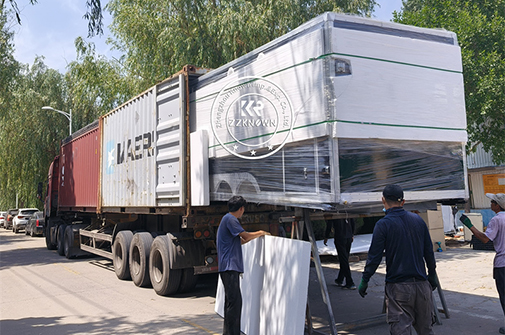
This division matters for global buyers. A clean factory photo is useful evidence of workmanship, but it cannot replace a local license, field test, permit, or inspection. Ask for a responsibility matrix showing who selects, supplies, installs, tests, approves, maintains, and replaces every safety component.
How were the facts in this guide collected?
We used a source-first method. First, we reviewed the current Austin Fire mobile-food inspection page and its published mobile-vending requirements for the jurisdiction-specific listed-alarm and manual-shutoff example. Second, we reviewed PERC’s mobile-food and commercial propane-safety resources for detector purpose and emergency guidance. Third, we checked NIOSH’s LPG chemical-hazard entry for physical properties. Fourth, we reviewed UL Solutions’ gas-device certification information and the manufacturer pages for the real Safe‑T‑Alert 30‑442‑P model, including published specifications, price, testing guidance, and replacement policy. Finally, we checked the live ZZKNOWN KN‑QF400 product record and real project images.
No inspection approval, alarm performance result, installed cost, customer outcome, or personal experience has been invented. Factory observations are explicitly presented as ZZKNOWN production experience. Prices and rules are dated September 9, 2026 and should be reconfirmed before purchase or fabrication.
What do real buyers ask about food trailer propane alarms?
Does every propane food trailer need an alarm?
Not under one worldwide rule. Some authorities expressly require one; others may rely on different adopted provisions or project conditions. Confirm the exact destination and permit path. Austin is one documented example that requires a listed alarm for new MFV units inspected after May 1, 2022.
Can I mount the alarm anywhere near the floor?
No. Low placement relates to propane vapor behavior, but the exact mounting zone and clearances are device-specific. Follow the chosen alarm’s manual and obtain local approval. Avoid hidden, wet, impact-prone, contaminated, or strongly ventilated locations.
Is a carbon-monoxide alarm the same as a propane alarm?
No. They detect different hazards. A combination device may perform both functions only when its labeling, listing, instructions, and application confirm both. Do not infer LP-gas protection from “CO alarm” on the box.
Does the test button prove there is no gas leak?
No. The button checks functions defined by the manufacturer, often the electronics and horn. It is not a pressure test and does not inspect the cylinder, regulator, pipe, fittings, valves, connectors, or appliances.
Can the alarm replace an annual professional gas-system test?
No. A fixed alarm continuously watches its own sensing location; a professional test evaluates the gas system through a defined procedure. Follow the test frequency, qualification, and documentation required by your authority.
Should the alarm stay powered when the trailer is parked?
Follow the device instructions and approved electrical design. If gas remains connected, an alarm that loses power cannot warn. Confirm battery capacity, disconnect behavior, charging, fuse protection, and storage procedures with the manufacturer and local professionals.
Can ZZKNOWN install the alarm before export?
ZZKNOWN can coordinate a buyer-confirmed model, support, wiring, and location when the specification and destination approval are clear. The buyer should still arrange any required destination testing and inspection. If the local authority prefers field installation by a licensed party, the factory can reserve the approved provision.
What should I send ZZKNOWN for an LPG-safety layout?
Send the operating city, inspector comments, trailer size, menu, appliance data plates, maximum simultaneous propane load, cylinder plan, selected alarm documentation, power plan, hood and ventilation details, staff count, and any automatic-shutoff requirement.
Would you like a propane-alarm and gas-layout review?
Send ZZKNOWN your destination, trailer size, exact appliance list, and inspector’s written requirements. We will place the proposed alarm, power route, cylinder cabinet, regulator, piping, shutoffs, equipment, and service access on one drawing for discussion before production.
Request a Free LPG Layout Review Compare Real Food Trailer ModelsWhich related guides should you read next?
- Food Trailer Propane System Guide: cylinders, regulators, ventilation, and safety
- Oklahoma Food Truck Propane Inspection 2026 Guide
- Food Trailer Fire Safety Guide: equipment, suppression systems, and daily inspections
- Real model: ZZKNOWN KN‑QF400 oxidized-aluminum food trailer
- About ZZKNOWN’s layout, production, inspection, and export support
- Food trailer buyer FAQ
Which official and primary sources support this guide?
- Austin Fire — Mobile Food Vending Fire Inspections
- PERC — Mobile Food Facilities Safety and Training
- PERC — Important Propane Safety Information
- NIOSH — Pocket Guide Entry for LPG
- UL Solutions — Fire, Smoke and Gas Device Certification
- Safe‑T‑Alert — 30 Series Flush-Mount Propane/LP Alarm
- Safe‑T‑Alert — Alarm Testing and Replacement FAQ
Safety disclaimer: This educational article does not replace adopted codes, device or appliance instructions, a permit, qualified gas or electrical work, inspection, emergency instructions, or legal advice. If you smell propane, hear escaping gas, or receive an alarm, leave the area and contact emergency services and qualified professionals from a safe location.