ZZKNOWN Engineering Guide
A buyer-friendly guide to planning the gas system before the kitchen equipment is fixed in place.
Direct answer
A safe food trailer propane system is designed around the final appliance load. It normally includes approved cylinders in an exterior-accessible ventilated location, correctly sized regulation and piping, accessible shut-off valves, protected appliance connections, leak testing, operating instructions, and trained staff. Because gas rules vary, the destination authority and licensed gas professional must approve the complete installation before operation.
This guide is for global food-trailer buyers. Its most detailed public baseline is the United States: the 2024 edition of NFPA 58, Chapter 16 guidance summarized by the Propane Education & Research Council (PERC), NFPA’s 2024 Food Truck Safety Fact Sheet, and current local inspection examples. Product data for ZZKNOWN model KN-QF400 was checked on August 12, 2026.
Important: NFPA editions apply only where adopted. Canada, Europe, the United Kingdom, Australia, New Zealand, the Middle East, and other markets use their own gas standards, appliance approvals, cylinder connections, licensed trades, and inspection systems. Treat this article as a design conversation, not a permit or certificate.
Picture a buyer ordering a trailer for “burgers.” At first, that sounds specific. Then the equipment list arrives: a 36-inch griddle, two fryers, a six-burner range, and a propane water heater. Another burger operator chooses one griddle and electric fryers. The two businesses may use a similar trailer body, but they do not have the same gas demand, piping branches, ventilation needs, cylinder strategy, or operating time.
That is why a responsible propane conversation starts with the appliance nameplate. Record manufacturer, model, fuel, rated input, required inlet pressure, connector type, whether a flame-failure device is included, and whether the appliance is approved in the destination market. Add the maximum simultaneous input rather than assuming every appliance will run alone.
According to PERC’s mobile food facility safety program, propane safety is critical to preventing leaks, fires, and potential explosions in confined cooking spaces. The practical buyer lesson is simple: the gas system is part of the kitchen design, not an accessory added after the appliances arrive.
A typical system begins at one or more approved containers. Vapor leaves the service valve, passes through a regulator arrangement that reduces pressure to the level required by the downstream system, and travels through approved piping or tubing. Branches feed individual appliances through accessible isolation valves and approved final connections. Some designs also include excess-flow protection, pressure test points, automatic shut-off functions, detection, or interlocks.
The exact arrangement depends on the country, total appliance input, cylinder type, operating climate, regulator selection, pipe length, elevation, appliance requirements, and the rules adopted by the authority having jurisdiction (AHJ). A simple sketch should show the entire route before production begins.
| System element | What it does | What the buyer should provide | Who confirms it |
|---|---|---|---|
| Container | Stores LPG and supplies vapor | Destination, expected service hours, refill/exchange practice | Local propane supplier, licensed gas professional, AHJ |
| Regulator | Reduces and controls delivery pressure | Total input, inlet/outlet requirements, climate | System designer and appliance supplier |
| Main piping | Carries gas to appliance branches | Final layout, pipe route, appliance inputs | Licensed installer and inspector |
| Shut-off valves | Isolate supply or individual equipment | Operator access and equipment positions | Installer and AHJ |
| Final connection | Connects the fixed system to an approved appliance | Exact appliance model and movement/service needs | Appliance instructions and licensed installer |
| Detection/interlock | Warns or initiates a designed safety response | Local requirement and operating sequence | AHJ, system manufacturer, qualified technician |
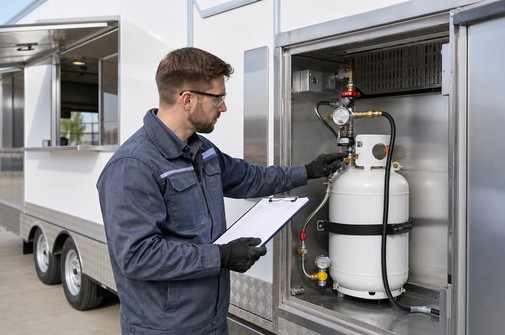
PERC’s summary of the 2024 NFPA 58 mobile-food requirements says a propane container should be outside the vehicle or in a recess or vented cabinet accessible from outside. It also highlights access to the main shut-off without tools, readable container markings, secure positioning, and protection against transportation damage. Those principles are useful globally even when a different standard controls the project.
Do not design the cabinet as spare storage. Cleaning chemicals, cardboard, oil containers, batteries, and generator fuel do not belong beside the LPG container. The compartment needs the clearances, ventilation openings, labels, weather protection, restraints, valve protection, and service access required by the destination. Vent openings should not be casually covered by branding panels or luggage.
Cylinder size is not only a “how long will it run?” decision. Total appliance input, vaporization in cold weather, available refill sizes, exchange practices, legal storage capacity, trailer payload, axle loading, and cabinet geometry all matter. Ask the local supplier what containers and connectors are actually available before the rack is welded.
A regulator must match the fuel, container arrangement, system capacity, required outlet pressure, local listing, and operating environment. A small regulator can starve appliances when several burners run together. An incorrect pressure can create poor combustion or unsafe appliance operation. A blocked or badly oriented vent can also interfere with performance.
Do not select by appearance or thread size. Provide the system designer with the maximum simultaneous appliance input, pipe length, pressure requirements, cylinder arrangement, expected lowest temperature, and destination. Ask for the selected regulator model and capacity to appear on the gas drawing or bill of materials.
Engineer’s note
Based on ZZKNOWN’s production experience, regulator and pipe discussions become much faster when the buyer sends photographs of every appliance data plate. Menu names are not enough. A “large fryer” does not tell the engineer its fuel, rated input, manifold pressure, connection, local approval, or whether two fryers will operate simultaneously. Nameplate evidence makes the configuration review concrete.
A trailer adds vibration, road shock, moisture, cleaning chemicals, heat, equipment movement, and tight service spaces. Approved piping and fittings must be sized, supported, protected, and routed for those conditions. Do not route a gas line where a drawer, sharp metal edge, hot exhaust surface, wheel spray, removable appliance, or stored object can damage it.
PERC’s 2024 operator fact sheet says piping, tubing, and fittings must be approved for propane use and sized, installed, and protected according to the applicable code. It also calls for pressure testing of new or modified systems and annual documented leak testing under the described U.S. framework. Local frequency and method may differ, but the evidence principle is universal: record what was tested, when, how, by whom, and what was repaired.
The main supply valve should be accessible quickly. Individual appliance valves let technicians isolate a branch and help operators understand which line serves which appliance. Labels need to survive heat, grease, cleaning, and vibration. A valve hidden behind a fixed refrigerator or beneath a drawer is technically present but operationally poor.
Final appliance connections must follow the appliance instructions and local rules. A connector should not be stretched, crushed, routed through an unsafe opening, or used as a substitute for proper fixed piping. If an appliance is removable for cleaning, the movement range and restraint method should be planned before the connector is selected.
Passive compartment ventilation provides a route for escaped vapor and helps prevent accumulation when designed correctly. A gas detector can provide an early warning or participate in a designed shut-down sequence, but it does not replace compliant container location, ventilation, correct piping, leak testing, or human response.
Detector selection is technical: gas type, sensing technology, low-level position, alarm visibility and audibility, power source, test function, replacement interval, and interlock logic matter. Some local fire authorities expressly require an LP-Gas detection alarm and monthly documented testing. Ask the AHJ what is required, then use a device intended and approved for that application.
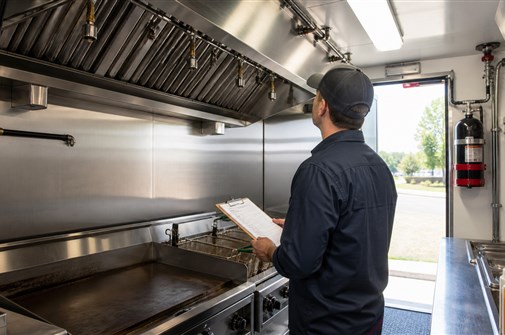
Commissioning is more than applying bubbles to one joint. A qualified person confirms system configuration, pressure, tightness, regulator operation, valve access, appliance connection, combustion, ventilation, labels, shutdown behavior, and documentation under the applicable procedure.
PERC’s summary says cylinder connections should be leak-checked each time a cylinder is replaced, annual system leak tests should be documented, and a leaking supply must be turned off until repaired and proven leak-free. The NFPA Food Truck Safety Fact Sheet also tells operators to inspect gas systems before each use.
Never use a match, lighter, or burner flame to search for a leak. An OSHA accident record describes a 2021 food-truck incident in which gas was left flowing after a fryer would not light; ignition eight minutes later caused an explosion and serious burns. One record is not an industry rate, but it shows why failed ignition requires shut-off, ventilation, and the appliance procedure—not repeated attempts.
| Daily question | Pass condition | If it fails |
|---|---|---|
| Are cylinders upright, secured, undamaged, and within qualification? | No movement, impact damage, heavy corrosion, or unreadable markings | Keep closed and contact the supplier |
| Is the cabinet clean and ventilated? | Openings clear; no unrelated storage or ignition source | Clear and correct before opening supply |
| Do the regulator, piping, valves, and connectors look normal? | No damage, looseness, abrasion, heat exposure, or odor | Close supply, ventilate, and use a qualified technician |
| Has a changed cylinder connection passed an approved leak check? | Documented pass with no leakage indication | Do not operate; correct and retest |
| Are main and appliance shut-offs accessible and labeled? | Staff can point to and reach them immediately | Restore access and brief the team |
| Is detection ready where required? | Normal status and testing current | Follow manufacturer/AHJ procedure before service |
| Does every operator know the emergency sequence? | Stop, shut off if safe, evacuate, call emergency services, report | Train before cooking begins |
This comparison is for planning, not a quotation. Actual installed cost depends on destination approvals, total input, cylinder capacity, regulator type, pipe length, number of branches, detector/interlock requirements, licensed labor, commissioning, and documentation.
| Configuration | Typical use | Engineering work | Relative budget impact |
|---|---|---|---|
| Single low-input branch | One approved light-duty appliance | Short route, limited branches; all approvals still required | Lower |
| Mixed commercial line | Griddle, fryer, range, or water heater | Capacity calculation, multiple valves, longer piping, coordinated hood/fire plan | Medium |
| High-output dual-cylinder | Multiple fryers, griddle, oven, heavy service | Vaporization, changeover, larger cabinet, added weight, system capacity | Higher |
| Detection and automatic interlock | Required or chosen safety-control package | Listed devices, power, logic, commissioning, maintenance | Project-specific |
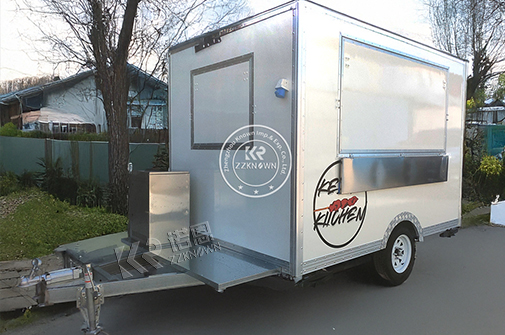
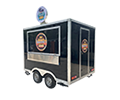
The ZZKNOWN KN-QF400 oxidized-aluminum food trailer provides a real project reference. Its published specifications list a 4000 × 2000 × 2300 mm body, dual axles, 110V/60Hz electrical system, a 3-meter hood, a 3+1 sink arrangement, equipment spaces for refrigerated worktables, and installed internal gas piping with valves for cooking equipment.
.png)
.png)
The page verifies the model and published configuration; it does not prove that one gas specification is accepted everywhere. For a new build, ZZKNOWN can reserve routing, individual valves, an exterior cylinder compartment, detector location, and service access around the buyer’s confirmed appliance schedule. A licensed local professional must still approve, commission, and document the completed system.
| Market | Confirm before production | Do not assume |
|---|---|---|
| United States | Adopted NFPA/IFC editions, state propane rules, fire-marshal inspection, listed appliances | One city’s approval transfers nationwide |
| Canada | Provincial authority, gas code, approved appliances/components, licensed gas fitter | U.S. components or connector sizes are automatically accepted |
| EU and UK | Country-specific vehicle LPG rules, regulator pressure, cylinders, appliances, ventilation, installer certification | A general CE claim approves the entire installation |
| Australia/New Zealand | Applicable AS/NZS requirements, state/territory rules, approved appliances, licensed gas fitter and certificate | Road registration covers gas compliance |
| Middle East and other markets | Civil defense/fire authority, municipality, gas supplier, cylinder availability, site rules | Another country’s drawings can be copied unchanged |
We used a five-part method. First, we reviewed PERC’s current mobile-food safety and training page. Second, we checked its 2024 NFPA 58 operator update for training, construction, operation, piping tests, and cylinder placement. Third, we compared the NFPA Food Truck Safety Fact Sheet and public local inspection checklists. Fourth, we reviewed the OSHA food-truck propane accident record as a documented incident—not as a frequency statistic. Fifth, we checked the current ZZKNOWN KN-QF400 product record for model data and project images.
No customer approval, inspection outcome, test certificate, personal experience, or installed cost has been invented. Manufacturer recommendations are labeled as production experience; legal conclusions remain pending local verification.
There is no safe answer from trailer length alone. Add the rated input of simultaneously operating appliances, estimate service duration, account for climate and vaporization, check refill availability, and apply local capacity limits. Then let the system designer and propane supplier select the arrangement.
Do not assume so. The U.S. mobile-food guidance discussed here directs containers outside the vehicle or into an exterior-accessible vented recess/cabinet and prohibits unconnected containers inside. Other markets have their own rules. Obtain approval for the exact location.
That depends on the approved design, container pressure, outlet requirement, load, piping, climate, and local rules. “Two-stage” is not a substitute for a calculation or an approved component schedule.
Only approved materials in approved locations should be used. Flexible appliance connectors have specific purposes and limitations; they should not casually replace protected, supported distribution piping. Follow the appliance instructions and local gas code.
Some jurisdictions require one, and buyers may choose detection as an additional control. Confirm the approved detector, location, test schedule, power supply, alarm, and any automatic shut-off function with the AHJ and qualified installer.
ZZKNOWN can design and install project-specific gas provisions when the destination, appliances, standards, and commercial scope are confirmed. The buyer should also plan for local inspection, commissioning, connector or regulator adaptation if required, and certification by an authorized local professional.
A different fryer can change input, pressure, connection, pipe capacity, combustion air, hood and suppression coverage, and approval status. Stop and obtain professional review before connecting it.
Keep the approved gas drawing, component and appliance data, commissioning and pressure-test records, leak-test logs, cylinder documents, inspection certificates, service history, detector tests, operator training records, and emergency contacts required in your jurisdiction.
Send the destination city and country, menu, trailer model or target size, photographs of every appliance data plate, maximum simultaneous appliance use, preferred cylinder source, estimated daily service hours, operating climate, and any written inspector comments. You can also review the food trailer fire-safety guide and the American-standard gas-pipeline installation guide, compare ZZKNOWN food trailer models, explore the OEM/ODM process, and check the buyer FAQ.
Send ZZKNOWN your cooking-equipment list, destination, and trailer size. We’ll organize a gas and electrical layout for discussion with your local fire, gas, electrical, and health authorities.
Request a Free Configuration Plan Compare Food TrailersSafety disclaimer: This article is educational. It does not replace adopted codes, an approved plan, a permit, appliance instructions, inspection, or work by a licensed gas professional.