ZZKNOWN Engineering Guide
A practical, buyer-friendly guide to planning a safer mobile kitchen before the first appliance is installed.
Direct answer
A fire-safe food trailer starts with the menu, not the extinguisher. Identify every heat, grease, gas, and electrical load first; then design the hood, listed suppression system, shutoffs, ventilation, portable extinguishers, clear exits, and inspection routine around those hazards. Your local fire authority has the final word, so approve the layout before production and recheck it whenever equipment changes.
This guide is written for global buyers, but the most detailed public references are from the United States. The U.S. baseline uses the 2024 edition of NFPA 96, the NFPA Food Truck Safety Fact Sheet dated October 2024, NFPA extinguisher-placement guidance dated December 2024, and U.S. Fire Administration data available through 2023. Product information was checked on the ZZKNOWN website on August 6, 2026.
Important: Standards are adopted and amended locally. A statement such as “commonly required” is not a permit decision. Buyers in Canada, Europe, the United Kingdom, Australia, New Zealand, the Middle East, and other markets should send the same equipment plan to their local fire, gas, electrical, health, and vehicle authorities before the build is frozen.
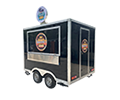
Imagine two buyers standing over the same attractive 4-meter trailer drawing. One sees a black exterior, a wide serving window, and a fast route to opening day. The other asks a less exciting question: “Where does the heat go if we run two fryers and a griddle at the same time?” That second question can change the hood length, makeup air, suppression coverage, gas routing, electrical load, appliance spacing, exit path, and even the position of the service window.
This is why fire safety belongs at the beginning of design. It is not a red cylinder added beside the door after the kitchen is complete. It is a system connecting the menu, appliances, fuel, ventilation, controls, structure, people, and daily habits.
The scale of the cooking hazard is not theoretical. The U.S. Fire Administration reports that cooking was the leading cause of nonresidential building fires throughout 2014–2023. Its 2023 national estimate included 33,300 nonresidential cooking fires. A food trailer is not a building, so that dataset is context rather than a trailer incident rate. Still, it explains why fire officials pay close attention to commercial cooking equipment in a compact mobile space.
Start with a one-page hazard map. List every appliance, its fuel, its heat output, whether it produces grease-laden vapors, the clearance it needs, and what must shut down if suppression activates. Then add the hood, duct, fan, suppression nozzles, manual pull station, gas or electric shutoff, portable extinguishers, exits, cylinders, generator, battery system, and electrical panel.
| Hazard | Questions to ask | Typical control to confirm | Who should verify it |
|---|---|---|---|
| Grease cooking | Which appliances produce grease-laden vapors? | Commercial hood, grease filters, duct, fan, and listed suppression coverage | Fire authority and qualified suppression contractor |
| LP-Gas | Where are cylinders, regulator, flexible connection, valves, and piping? | Secure mounting, protected piping, leak testing, accessible shutoff, ventilation | Licensed gas professional and AHJ |
| Electrical load | What is the simultaneous load, circuit plan, and shore/generator source? | Sized conductors and breakers, protected outlets, bonding/grounding, labeled isolation | Licensed local electrician and electrical inspector |
| Escape | Can staff reach an exit without passing the fire? | Clear travel path, operable door, visible extinguisher, no blocked threshold | AHJ and operator |
| Generator or batteries | Where do exhaust, heat, fuel, and service access go? | Separation, ventilation, weather protection, correct charging and overcurrent protection | Equipment manufacturer, electrician, and AHJ |
A commercial hood does two jobs that buyers often mix together. Ventilation captures heat, smoke, and grease-laden vapors. Fire suppression is a separate protective system designed to discharge an extinguishing agent over the protected cooking hazards and into specified hood or duct areas when activated. The system may also be designed to shut off fuel or electrical energy to protected appliances. Exact interlocks and coverage depend on the approved system and local rules.
The 2024 edition of NFPA 96 contains dedicated chapters for fire-extinguishing equipment in mobile and temporary cooking operations and for use, inspection, testing, and maintenance. That matters because a mobile kitchen is not simply a small restaurant. Vibration, equipment changes, cylinders, generators, temporary event sites, and repeated relocation create additional design and inspection questions.
Here is the practical lesson: do not buy a generic hood and assume a suppression installer can make everything work later. Send the installer the final appliance schedule, cooking surface dimensions, fuel type, hood geometry, duct route, fan data, and trailer drawing. Ask for the nozzle and pull-station locations to be marked before fabrication. If a fryer moves after approval, stop and ask whether the system must be redesigned.
Engineer’s note
Based on ZZKNOWN’s production experience, one of the most useful early documents is not a catalog page—it is a dimensioned appliance line. When the buyer confirms the exact fryer, griddle, range, oven, and refrigerator models before stainless-steel fabrication, the team can reserve realistic clearances, service access, utilities, hood length, and a clean exit route. The local licensed contractors still approve the fire, gas, and electrical systems, but a coordinated drawing reduces late rework.
A common planning approach is to consider a Class K extinguisher for commercial cooking-oil and fat hazards, plus another extinguisher suited to ordinary combustible and energized electrical hazards. However, “Class K plus ABC” is not a universal approval formula. The AHJ decides the required type, rating, number, mounting location, travel distance, and inspection tag for a specific operation.
Placement matters as much as ownership. The extinguisher should be visible and accessible along a normal path of travel, not hidden behind a refrigerator or mounted where the operator must cross the cooking hazard. The NFPA extinguisher location fact sheet explains visibility, access, and mounting concepts. Staff also need training. If a fire is growing, the exit is threatened, or the operator is not trained, evacuation and emergency response come before equipment.
Propane conversations should be precise. Mark the cylinder location, orientation, restraint, regulator, flexible connector, fixed piping, individual appliance valves, main shutoff, ventilation, impact protection, test points, and access for cylinder replacement. Protect piping from vibration, abrasion, heat, road debris, and accidental storage damage. Never let boxes, food supplies, cleaning chemicals, or a generator crowd the cylinder area.
The 2024 NFPA Food Truck Safety Fact Sheet calls for leak testing cylinder connections with an approved method each time a cylinder is replaced, documenting the test, closing LP-Gas container valves when the system is not in use, and testing an installed gas detection system monthly. It also says the sheet is not a complete list and directs operators to local jurisdiction requirements.
Why be so strict about ignition procedures? An OSHA accident record from 2021 describes a food-truck worker who left gas flowing while getting another lighter; ignition caused an explosion and serious burns. That single case is not a rate or trend, but it is a clear reminder: if ignition fails or gas is suspected, shut the supply, ventilate, follow the appliance procedure, and use a qualified technician. Do not keep clicking a lighter.
Write down every electrical load and ask which devices will operate simultaneously. A menu may look simple until the espresso machine, air conditioner, water heater, refrigerator, freezer, lighting, fryer, point-of-sale system, and battery chargers all start together. Undersized conductors, informal adapters, overloaded receptacles, damaged extension cords, and unclear changeover between shore power and a generator are avoidable risks.
A safer plan uses a load schedule, correctly sized conductors and overcurrent protection, local-standard receptacles, required ground-fault protection, clear circuit labels, protected cable routes, and accessible isolation. The electrical system should be checked in the destination country because voltage, frequency, plug type, breaker rules, cable standards, and inspection methods differ. “110V” or “230V” on a sales sheet is not an electrical approval.
A useful checklist is short enough to finish and specific enough to act on. Assign one person, record exceptions, and stop service when a critical control is not ready.
| Daily question | Pass condition | If it fails |
|---|---|---|
| Are hood filters, surfaces, and the appliance line free of unsafe grease buildup? | Clean, seated correctly, no dripping grease | Clean before cooking; schedule professional duct service as required |
| Is the suppression system visibly ready? | Nozzle caps, seals, gauge/indicator, pull station, and service tag appear normal | Do not operate protected appliances; call the service provider |
| Are gas connections and cylinders secure? | No odor, damage, corrosion, loose restraint, or failed leak test | Close supply, ventilate, remove ignition sources, and use a qualified technician |
| Are cords, plugs, outlets, and the panel normal? | No heat damage, exposed conductors, loose plugs, moisture, or repeated breaker trips | Isolate the circuit and call a qualified electrician |
| Can everyone exit immediately? | Door opens, aisle is clear, steps are stable, extinguishers are visible | Clear the route before opening |
| Does the exhaust system run before heat starts? | Fan operates normally with no unusual noise or blocked discharge | Stop cooking and inspect the system |
| Do staff know today’s emergency roles? | They can point to shutoffs, pull station, extinguishers, exit, and meeting point | Brief the team before service |
The table below is a planning comparison, not a product quote. “Budget impact” describes the relative coordination and hardware typically involved. Installed pricing varies widely with jurisdiction, hood length, suppression brand, appliance lineup, labor, certification, shipping, and whether work is completed at the factory or locally.
| Kitchen profile | Typical equipment | Hood/suppression planning | Fuel-system planning | Relative budget impact |
|---|---|---|---|---|
| Light-duty beverage | Coffee, refrigeration, blender, light warming | May be simpler; confirm every heating appliance and local rule | Often electric-only | Lower |
| Mixed cooking | Griddle, range, oven, limited frying | Commercial hood and protected appliance line often become central | Gas, electric, or both | Medium |
| High-grease, high-output | Multiple fryers, griddle, charbroiler, wok or heavy BBQ | Longer hood, more capture demand, coordinated suppression and cleaning access | Higher gas flow or large electrical demand; more interlocks | Higher |
| Solid-fuel specialty | Wood, charcoal, smoker, solid-fuel oven | Special exhaust, spark/ember, ash, clearance, storage, and extinguishing questions | Fuel storage and ash handling add controls | Highest / quote required |
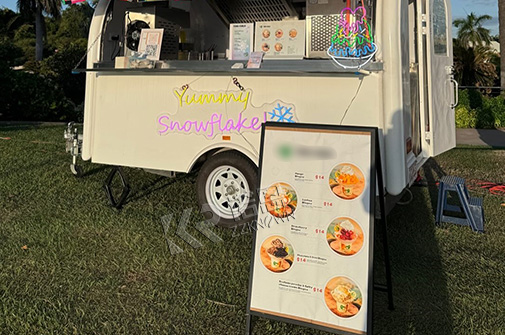
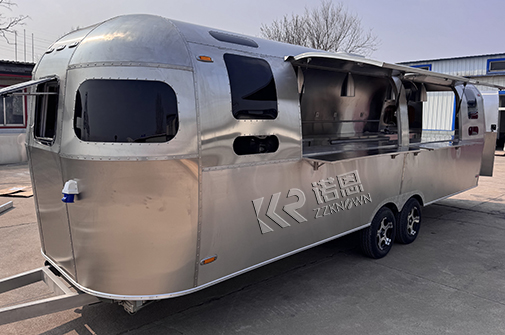
The ZZKNOWN KN-FS410 4.1-meter square food trailer is a useful real model for discussing coordination. Its published project specification lists a 4.1 m × 2.15 m × 2.35 m body, a 2.3-meter dual-layer range hood, 110V/60Hz power planning, dedicated appliance provisions, stainless-steel interior surfaces, removable equipment stands, and a gas system with individual valves. The page also lists the proposed griddle, fryer, claypot stove, and BBQ grill footprints.
.png)
.png)
Notice the evidence boundary. The model page can confirm dimensions and published equipment provisions. It cannot replace a local permit, and it does not prove that every option shown is installed or accepted in every country. For a new project, ZZKNOWN asks buyers to provide the menu, appliance models, destination, event or street-use scenario, preferred fuel, and local inspector comments. The engineering team can then prepare a coordinated layout for local review.
The physics of heat, grease, gas, and electricity do not change at a border, but approval language does. Use the U.S. references in this guide as a structured question list—not as a promise that NFPA wording is automatically law in your market.
| Region | Start with | Do not assume |
|---|---|---|
| United States | Local fire marshal/AHJ, health department, electrical and gas inspectors; adopted editions and amendments | That one state or event approval transfers nationwide |
| Canada | Province, municipality, fire service, licensed gas/electrical trades, event requirements | That a U.S. listing or drawing is automatically accepted |
| EU and UK | Destination-country fire, gas, electrical, workplace, ventilation, vehicle, and food-business authorities | That CE marking alone approves the finished mobile kitchen or its site operation |
| Australia and New Zealand | State/territory or local authority, fire service, licensed gasfitter/electrician, vehicle and event rules | That road compliance approves gas appliances or fire protection |
| Middle East and other markets | Civil defense/fire authority, municipality, utility, gas supplier, vehicle authority, site or mall operator | That another country’s package will be accepted without review |
We used a transparent, four-part method. First, we reviewed publicly accessible official U.S. fire-safety sources: the 2024 NFPA 96 index, NFPA’s October 2024 mobile-food safety checklist, NFPA’s December 2024 extinguisher-placement fact sheet, U.S. Fire Administration nonresidential fire-cause estimates through 2023, and one OSHA food-truck accident record. Second, we checked the current ZZKNOWN product page for model KN-FS410 and its published dimensions, appliance plan, hood, electrical, and gas provisions. Third, we separated verified facts from engineering guidance. Finally, we marked every destination-specific approval as a local verification item.
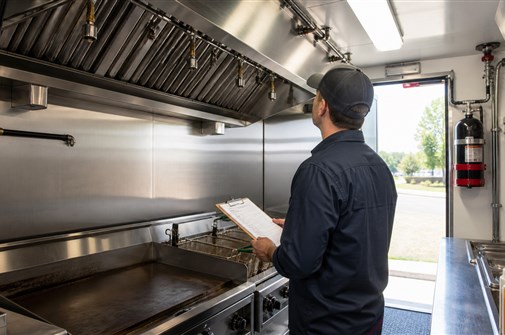
No customer incident, approval, cost, or inspection result has been invented. Relative budget labels are planning categories, not quotations. The generated cover image is illustrative; the two model images above are drawn from the live KN-FS410 product record and are labeled as real project references.
Not every menu creates the same ventilation or suppression requirement. A cold-service or beverage trailer may be treated differently from a fryer-and-griddle kitchen. The appliance listing, cooking process, grease production, building or event setting, and local code determine the answer. Send the complete appliance schedule to the AHJ before production.
No. A portable extinguisher does not replace a required hood suppression system, safe gas and electrical installation, ventilation, cleaning, training, or evacuation. The local authority must confirm extinguisher type, rating, number, placement, and inspection schedule.
It can be planned as an option where the selected system, export process, destination rules, and local service arrangements allow it. The better first question is whether the destination AHJ accepts that system and who will commission, tag, maintain, and recharge it locally. Request a project-specific confirmation rather than assuming it is included.
Possibly, but never treat it as a furniture swap. A different fryer can change dimensions, energy input, clearances, hood capture, suppression nozzle coverage, shutoff, gas demand, electrical load, and cleaning access. Ask the suppression contractor, electrician or gasfitter, and AHJ before the change.
Follow the adopted local code, the listed system manufacturer, and the qualified service provider. Daily operators should make simple visual checks, but formal inspection, testing, maintenance, discharge work, and tagging belong to trained and authorized professionals. Keep records inside the business file and available for event inspectors.
The approved location depends on the trailer and local rules, but cylinders should be upright, securely restrained, protected from impact and heat, accessible for shutoff and replacement, and kept away from ignition sources, openings, exhaust, and unsafe storage. A licensed local gas professional should approve the final arrangement.
No single mark answers every question. Roadworthiness, vehicle identification, product conformity, gas installation, electrical work, commercial ventilation, fire suppression, health permits, and event permission may be reviewed by different authorities. Ask for a compliance matrix that names each requirement and the party responsible.
Send your destination city and country, menu, exact appliance models and dimensions, fuel types, simultaneous electrical loads, proposed cylinders or generator, preferred trailer size, number of staff, event or street-use scenario, and any written inspector comments. Photos or sketches of special equipment also help.
Begin with the menu and appliance list. Then compare ZZKNOWN food trailer models, review the OEM/ODM customization process, and read the buyer FAQ. If you are still comparing total startup budgets, use our food trailer cost guide as a separate planning reference.
Send ZZKNOWN your menu, destination, trailer size, fuel preference, and appliance list. We’ll prepare a coordinated layout for discussion with your local fire, gas, electrical, and health authorities.
Request a Layout & Quote Explore ZZKNOWNSafety disclaimer: This article is educational and does not replace an approved design, permit, inspection, manufacturer instruction, or advice from a licensed fire-protection, gas, or electrical professional.