Published: August 12, 2026 | Last Updated: August 12, 2026 | Data scope: Global design guidance with U.S. food-safety references
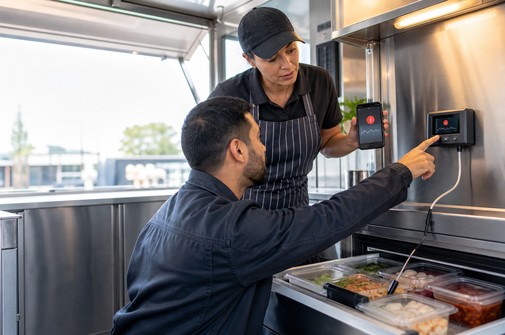
Direct answer: A reliable food trailer refrigeration monitoring system combines an independent temperature sensor, practical alarm limits, time-stamped records, a trained response plan, and a power-loss strategy. The thermostat controls the cabinet; it does not prove that food stayed safe. Monitor the warmest useful location, verify products with a calibrated food thermometer, and act on alarms before a short electrical problem becomes spoiled inventory.
Picture the lunch rush. The service window is open, tickets are stacking up, and the refrigerator sounds exactly as it did an hour ago. Nothing looks wrong. Then someone reaches for a dairy container and notices it is not as cold as expected. Was the door left open? Did the shore-power plug loosen? Has the compressor stopped, or is the display simply showing a convenient temperature near the cooling outlet?
This is the uncomfortable truth about cold storage in a mobile kitchen: temperature loss is often quiet. A small trailer moves between sites, sits in sun, experiences voltage changes, and has doors opened far more often than a home refrigerator. By the time a crew can feel the difference, the safest and least expensive response window may already be closing.
Based on ZZKNOWN's production experience, the best solution is not one expensive gadget. It is a simple chain of control: select the right refrigeration equipment, place an independent sensor correctly, create useful alerts, keep understandable records, and decide in advance what the crew will do when power fails. This guide walks through that chain as if we were planning your trailer together.
A paper check at opening and closing can be useful, but it leaves a wide blind spot. A refrigerator may warm for two hours after the lunch rush, recover before the closing check, and leave no obvious evidence. A crew member may also read the controller display instead of an independent thermometer, copy yesterday's number, or place the probe beside the cold-air outlet where the reading looks reassuring.
Manual checks are snapshots. A logger creates a movie. It shows how long a cabinet remained warm, how quickly it recovered after loading, and whether the same problem appears every afternoon. This does not eliminate staff checks. It makes those checks more meaningful because the operator can compare a product measurement, an air reading, and the recent trend.
The U.S. Food and Drug Administration's HACCP guidance explains that continuous monitoring is preferable when feasible and that monitoring equipment should be calibrated for accuracy. It also connects monitoring with assigned responsibility, corrective action, verification, and records. That is the practical model here: the sensor is only one part of a working system. See the FDA HACCP principles and application guidelines.
For a U.S.-oriented starting point, the FDA Food Code generally sets cold holding for time/temperature control for safety food at 41°F (5°C) or less. USDA consumer guidance recommends keeping a refrigerator at 40°F (4.4°C) or below and a freezer at 0°F (-17.8°C). These numbers are related, but they answer slightly different questions: one is a model retail-food rule, while the others are practical appliance targets and freezer-quality guidance.
Do not turn those reference numbers into an automatic alarm setting without considering your equipment. Air temperature rises quickly when a door opens even though food warms more slowly. Defrost cycles can also create a temporary spike. Your alert should warn early enough to protect product but should not be so sensitive that the crew starts ignoring normal events. Final limits, delays, and corrective actions should be approved with the local regulator or food-safety consultant.
| Cold-storage point | Useful planning reference | What the operator still needs to verify |
|---|---|---|
| Refrigerated TCS food | FDA Food Code: generally 41°F (5°C) or less for cold holding | Local adoption, product temperature, and permitted corrective action |
| Refrigerator cabinet | USDA: 40°F (4.4°C) or below | Warmest loaded zone, door-opening pattern, recovery time, and sensor accuracy |
| Freezer cabinet | USDA: 0°F (-17.8°C) for freezer storage | Product condition, local rules, and whether the goal is safety, texture, or shelf-life quality |
Region and update note: Regulatory references were checked on August 12, 2026. FDA's public Food Code page still lists the 2022 Food Code as the most recent full edition and provides a December 2024 supplement. FDA also lists an updated Food Code among its 2026 priorities. Always confirm the latest adopted code with your city, state, province, country, event organizer, and insurer before design approval.
The thermostat is the equipment's control brain. It senses temperature, switches cooling on and off, and may show a number on the cabinet. An independent monitor is the witness. It should have its own sensing point, display or logger, alarm logic, and preferably a record that the operator can review.
| Monitoring layer | What it does | Main limitation | Relative cost |
|---|---|---|---|
| Built-in digital thermostat | Controls the cabinet | May read a colder control location and may not retain history | Included / $ |
| Independent display thermometer | Provides a separate visual check | No history; someone must look | $ |
| Local alarm and data logger | Stores trends and sounds an on-site alert | Cannot notify an off-site owner unless connected | $$ |
| Remote cellular/cloud monitor | Sends phone alerts and stores remote records | Needs signal, power, account management, and recurring service in some systems | $$$–$$$$ |
The dollar symbols show relative equipment and integration cost, not a quotation. Actual cost depends on probe count, communications method, certification, subscription, installation, and destination market.
If you place the sensor directly in the cold-air stream, you learn when the evaporator blows cold air—not necessarily what the warmest food experiences. If you put it in the door, every opening may create a noisy alarm. A better starting point is a representative, relatively warm loaded zone with airflow around the probe, away from the cooling outlet, wall, drain, and frequently handled food.
A buffered probe can reduce short air spikes. Some operators place the sensor in a purpose-made glycol bottle or equivalent thermal buffer. That can better approximate product response, but it also slows the alarm. The right choice depends on whether you are trying to detect a door event quickly, document longer product exposure, or protect a high-value frozen menu. Do not improvise a buffer that contaminates the cabinet or conflicts with the sensor manufacturer's instructions.
| Sensor location | What it tells you | Common mistake |
|---|---|---|
| Representative warm zone | Whether the most challenging useful area is recovering | Letting containers block airflow around the probe |
| Near the return-air path | Air returning from the loaded cabinet | Confusing it with actual food temperature |
| Buffered probe | A slower response that may resemble product temperature changes | Choosing a delay so long that a real failure is reported late |
| Food probe check | The temperature of a selected product or between-pack check | Using an uncalibrated or unsanitized probe |
A useful alarm has four settings: a temperature threshold, a time delay, a notification destination, and a response instruction. The threshold catches a meaningful rise. The delay filters normal door openings or defrost. The destination reaches a person who is actually working. The instruction tells that person what to check.
Start with observation rather than guesswork. During commissioning, load the cabinet as it will be used, log a normal service day, observe door openings and defrost cycles, and measure recovery after fresh stock is added. Then place the alert below the point where your approved corrective-action margin disappears. A high alarm that arrives too late is merely a historical note; an alarm that sounds every five minutes becomes background noise.
Engineer note: “Send the menu, ingredient risk, cabinet type, equipment data plate, voltage and frequency, typical ambient temperature, door-opening frequency, route time, parking conditions, and backup-power plan. We can then reserve the correct circuit and sensor locations in the layout. The final alarm limits and food-safety response must be approved for the operator's local rules.” — ZZKNOWN Technical Engineering Team
They shorten the time between failure and response, which can be extremely valuable when a trailer is parked overnight. But a remote alert is not a magic shield. Wi-Fi can disappear after the venue closes. A cellular gateway can lose signal. A cloud account can expire. The sensor itself can lose power at the same time as the refrigerator.
For off-site monitoring, ask five practical questions: Does the gateway have its own battery? Will it send a “device offline” warning? Is local data stored when the internet fails? Can more than one person receive the alarm? Can you export records in a format the business can keep? A dashboard that looks impressive during a sales demo is less useful than a plain system that reports power loss reliably.
Keep the record simple enough that the crew will use it. At minimum, identify the trailer, cabinet, sensor, date, reading or file, person responsible, alarm event, product check, corrective action, and final disposition. If a reading is out of range, “temperature high” is not a complete response. Record what was checked, what happened to the food, how the equipment was restored, and who approved the decision.
Calibration also belongs in the record. FDA guidance says thermometers should be calibrated at a frequency that ensures accuracy. Follow the instrument manufacturer's method, use a recognized reference procedure appropriate to the thermometer, label damaged devices, and document replacement. A logger with beautiful graphs is still weak evidence if nobody can show that its sensors were reasonably accurate.
A log also supports maintenance. A gradually longer recovery time may point to a dirty condenser, blocked airflow, worn door gasket, low refrigerant, excessive loading, or high ambient heat. The trend lets a technician investigate before the cabinet fails completely.
First, keep refrigerator and freezer doors closed. Confirm whether the failure affects the whole trailer or only the refrigeration circuit. Check the inlet, breaker, residual-current protection device, plug, cable, and approved backup source without bypassing electrical protection. Record the time. Then check cabinet history and product temperature using the approved method.
FoodSafety.gov says a refrigerator can keep food safe for about four hours during an outage if the door remains closed. It advises discarding refrigerated perishable food after four hours without power. A full unopened freezer may hold temperature for about 48 hours, or about 24 hours when half full. These are emergency consumer guidelines, not permission to ignore local retail-food rules or uncertain histories. Never taste food to decide whether it is safe.
| When the power loss is discovered | What should happen next? |
|---|---|
| Immediately | Keep doors closed, record the time, identify the failed circuit, notify the responsible person, and prepare an approved backup source. |
| During restoration | Review logger history, verify selected products with a calibrated thermometer, avoid unsafe temporary wiring, and separate questionable stock. |
| Before service resumes | Apply local corrective-action rules, document disposition, confirm stable cabinet recovery, and investigate the cause. |
Related planning matters too. If your trailer uses LPG cooking equipment, refrigeration backup still depends on electrical design; read our food trailer propane and LPG system guide. For extinguisher, hood, and suppression coordination, see the food trailer fire safety guide. If you are considering solar or batteries, our solar-powered food trailer guide explains why appliance load and operating time must be calculated before choosing a system.
A generator is not automatically large enough because its label shows a high wattage. Refrigeration compressors draw startup current, while the trailer may also run lighting, water heating, ventilation, air conditioning, POS equipment, and cooking appliances. The generator must match voltage, frequency, grounding arrangement, inlet rating, continuous load, startup surge, fuel storage rules, noise limits, ventilation, and local fire requirements.
A battery/inverter system can bridge a short interruption or keep a monitoring gateway alive, but runtime depends on usable battery capacity, inverter efficiency, compressor cycling, ambient heat, and the rest of the connected loads. Solar panels may extend runtime but should not be treated as guaranteed emergency power. For many buyers, the most dependable architecture is an independent refrigeration circuit, a correctly sized shore-power connection, a planned generator connection where permitted, and a small separate backup for the alarm gateway.
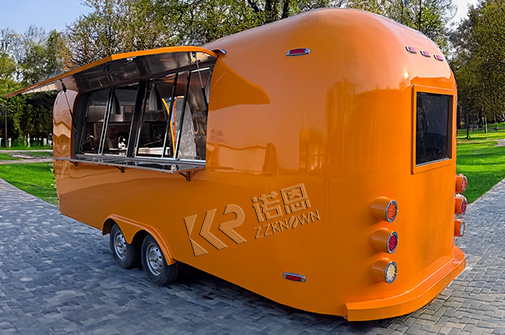
The ZZKNOWN KN-QF500 Ice Cream & Bakery Food Truck is a useful real-world reference because its menu depends on several cold-storage zones rather than one small refrigerator. The published project is a 5 m × 2 m × 2.3 m (16.4 ft × 6.5 ft × 7.5 ft) dual-axle trailer with a 2 m dual-temperature refrigerator, an ice cream display cabinet, and a cake display refrigerator. It uses 110V/60Hz U.S.-standard power with an external connection and includes a removable generator box.
Those are verified product-page specifications—not a claim that the displayed project included a particular cloud sensor or alarm brand. For a new build, ZZKNOWN can use the menu and destination power standard to plan independent circuits, accessible probe routes, protected controller mounting, airflow clearance, and an optional remote temperature-monitoring package.
.png)
.png)
| Verified KN-QF500 parameter | Published value | Monitoring design question for a new order |
|---|---|---|
| Trailer size | 5 m × 2 m × 2.3 m | Where can sensors, gateways, and service access fit without blocking workflow? |
| Refrigeration | 2 m dual-temperature fridge, ice cream cabinet, cake cabinet | How many zones need independent probes and separate alarms? |
| Power | 110V/60Hz, 10 sockets, external U.S.-standard connection | What are the continuous load, startup surge, circuit rating, and backup priorities? |
| Backup provision | Removable generator box | Which approved generator, inlet, transfer method, ventilation, and fuel rules apply locally? |
| Public factory-price range | USD 12,000–19,900 | Final price varies with equipment, monitoring scope, electrical standard, shipping, and certification requirements. |
ZZKNOWN used a three-part method. First, we reviewed the current public specifications and project photographs for the KN-QF500. Second, we compared those equipment facts with ZZKNOWN's production-planning experience for refrigeration circuits, equipment layout, insulation, shore power, generator provisions, and optional monitoring. Third, we checked U.S. reference values and emergency guidance against official FDA, USDA FSIS, and FoodSafety.gov pages available on August 12, 2026.
We did not treat a marketing thermostat specification as proof of food safety, and we did not claim that one U.S. guideline automatically applies worldwide. The article is design and operating guidance, not a health-department approval, electrical calculation, HACCP plan, or substitute for local professional review.
At opening, confirm that the display is active, the sensor ID matches the cabinet, the time is correct, and the reading is plausible. Check food with a calibrated thermometer according to your plan. During cleaning, do not pull or sharply bend probe cables. Keep sensors out of standing water unless the manufacturer specifically rates them for immersion.
Weekly, review the graph rather than only the latest number. Look for slower recovery, repeated alarms, missing data, and unusual overnight cycles. Clean condenser surfaces on the equipment manufacturer's schedule and inspect door gaskets, hinges, latches, drains, and airflow space. Test notification recipients and escalation contacts.
At the documented calibration interval, compare or calibrate the instrument using an appropriate method. Replace a damaged, drifting, or unreadable device. After any electrical or refrigeration repair, recommission the alarms under loaded conditions. A monitoring system is trustworthy because it is maintained and acted upon, not because it was expensive when purchased.
Usually no. If the zones have different setpoints or independent doors, each needs its own representative sensor and alarm logic. A single reading can hide a failure in the other compartment.
It depends on local rules, but a control display alone often lacks independent verification and time-stamped history. Ask the health authority what records it accepts, then choose a logger and manual product-check procedure accordingly.
Not automatically. Air can briefly exceed a food limit during normal door openings or defrost. Establish thresholds and delays from commissioning data, product risk, the approved corrective-action plan, and local requirements.
Only if the sensor gateway still has power and a working connection. Consider cellular coverage, Wi-Fi availability, gateway battery backup, offline data storage, and a separate “device offline” alert.
Possibly, but it must be calculated from the actual equipment data plates, compressor startup demand, continuous loads, voltage/frequency, derating, inlet capacity, and local electrical and fire rules. Do not size it from trailer length alone.
FoodSafety.gov provides an emergency reference of about four hours for an unopened refrigerator, but actual decisions depend on time, product temperature, door opening, logger history, and local retail-food rules. When the history is uncertain, use the conservative approved action and never taste food to test safety.
It can be included as an optional project requirement. Send your destination country, menu, cabinet list, communication preference, power standard, and record-export needs so the engineering team can plan circuits, sensor points, mounting, and commissioning.
Send your menu, daily ingredient quantities, refrigerated and frozen holding needs, equipment model/data plates, service hours, ambient climate, travel time, destination power, available shore supply, and backup-power preference. Photos or a sketch of the desired workflow are helpful.
Send ZZKNOWN your menu, cabinet list, destination country, voltage/frequency, service hours, ambient climate, and backup-power preference. Our team will prepare a refrigeration and monitoring layout for quotation—covering equipment zones, circuit planning, sensor locations, and service access.
Request a Cold-Storage Layout Explore ZZKNOWN OEM/ODMAuthor: ZZKNOWN Editorial Team
Technical review: ZZKNOWN Technical Engineering Team
Evidence boundary: Product parameters and project photos are from the cited ZZKNOWN KN-QF500 page. Regulatory references are official U.S. sources checked on August 12, 2026. Final equipment selection, electrical design, HACCP plan, and compliance remain project- and jurisdiction-specific.