GLOBAL BUYER GUIDE · POTABLE-WATER MAINTENANCE
Direct answer: To sanitize a food trailer fresh-water system, drain and inspect the tank, clean the fill hose and accessible surfaces, then flush and sanitize the tank, pump, and hoses using a procedure approved for your location and equipment. Respect the required concentration and contact time, drain and rinse as directed, refill from an approved source, and complete any required water test before service. Do not copy another state’s chlorine recipe blindly.
Published: November 4, 2026 | Last updated: November 4, 2026 | Scope: global buyer guide; U.S. federal model-code and Alaska examples are clearly identified.
Imagine bringing your trailer out of storage on the first warm weekend of the year. The stainless counters look great. The tires are ready. Then the first cup of water from the hand sink smells stale. Nobody wants to discover that problem while a line of customers is forming. The water system has been sitting quietly for months, but “not in use” is not the same as “ready for food service.”
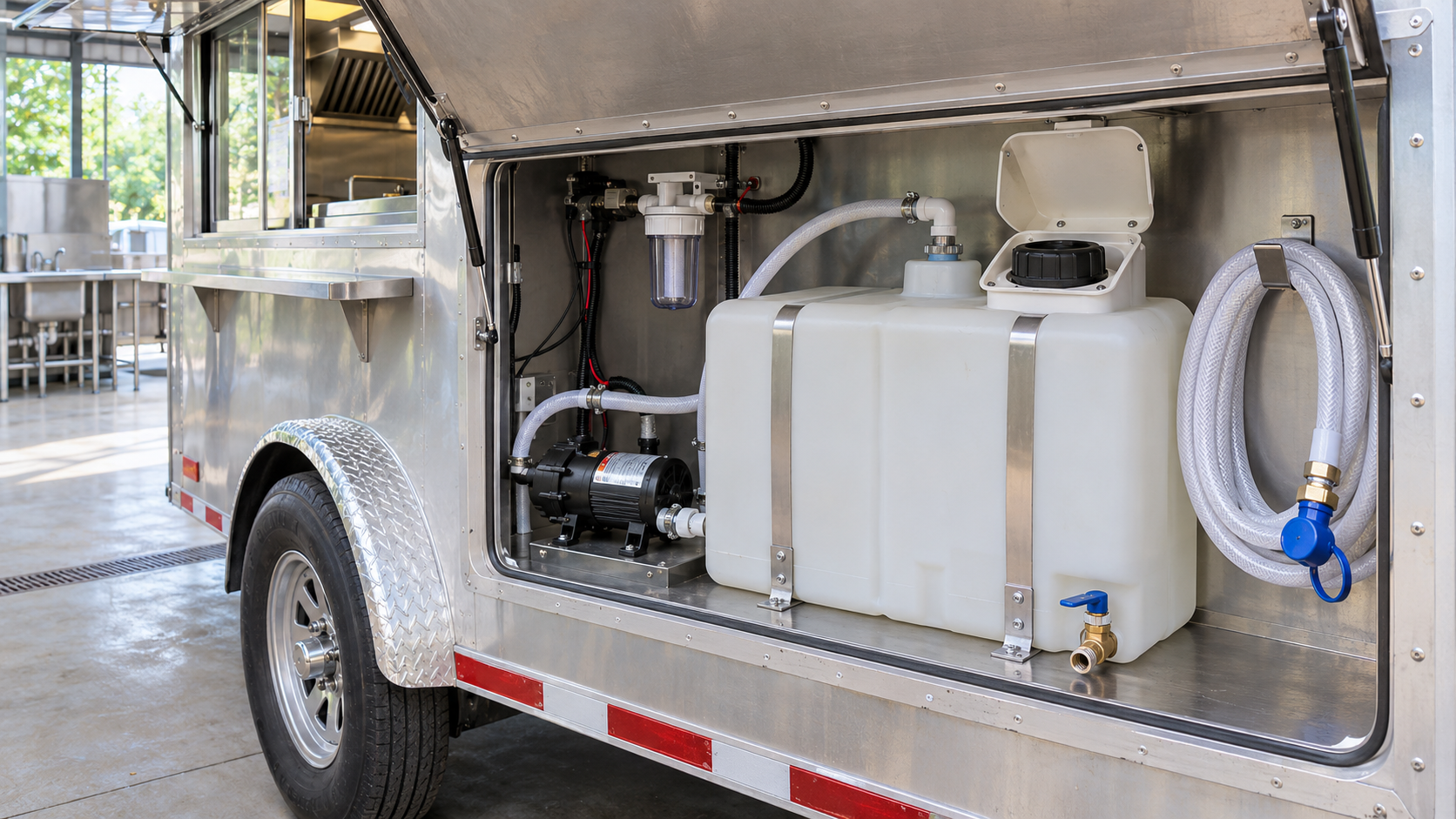
Water can pick up contamination at a poorly protected fill port, a hose left uncapped, a servicing-area connection, or a repair point. Stagnant water can remain in low spots if the tank and lines do not drain completely. A pump strainer or heater may hold water even when the main tank reads empty. The issue is not only the tank’s capacity; it is whether the full potable path can be inspected, drained, cleaned, sanitized and returned to service.
Based on ZZKNOWN’s production experience, buyers usually ask for a tank volume first. A more useful follow-up is: “Can the operator reach the low-point drain, the pump and the fill connection without dismantling half the kitchen?” That question shapes the service panel, hose route and tank orientation before fabrication. It also makes routine maintenance more realistic after delivery.
The FDA Food Code 2026, section 5-304.11, says a water tank, pump and hoses shall be flushed and sanitized before being placed in service after construction, repair, modification and periods of nonuse. It is a model code offered for adoption by jurisdictions, not a worldwide operating permit or one universal concentration formula. Sections 5-304.12–14 also address backflow prevention, protected fittings and dedicated drinking-water equipment. The 2026 text does not give one chlorine dose and contact time for every mobile unit.
Alaska provides a particularly useful, location-specific example. The Alaska Department of Environmental Conservation’s mobile-unit water-testing guidance, citing 18 AAC 31.500, requires covered mobile food units and kiosks (except pushcarts) to superchlorinate each potable tank with a 50 ppm chlorine solution for at least two hours at least annually and before seasonal startup, then drain, thoroughly rinse and refill. It also calls for certified-laboratory coliform samples before initial and seasonal startup and every three months during operation. If a sample exceeds the maximum contaminant level, the guidance calls for immediate repeat treatment and another sample within 24 hours after superchlorination. These are not global instructions for every food truck.
| Source and place | Verified trigger or value | How a buyer should use it |
|---|---|---|
| FDA Food Code 2026, U.S. model | Flush and sanitize after construction, repair, modification or nonuse | Check the edition and procedure actually adopted locally |
| Alaska, 18 AAC 31.500 | 50 ppm chlorine for at least 2 hours; at least annually and before seasonal startup | Use only for a covered Alaska unit under current ADEC direction |
| Alaska water testing | Certified-lab coliform tests before initial/seasonal startup and every 3 months during operation | Schedule sampling and retain results for ADEC |
| Other markets | No universal value established by these U.S. sources | Request the local health/plumbing authority’s method |
Make a simple map of the water system from source to faucet. Note the tank’s usable volume, material, cleaning access, low drain, pump and strainer, water heater, filters, bypasses, mixing valves, ice machine and every branch line. Ask the equipment manufacturers which chemicals, concentrations and temperatures their components tolerate. A method that is acceptable for the tank shell may damage a filter cartridge, heater component or rubber seal. Remove or bypass devices only according to their instructions.
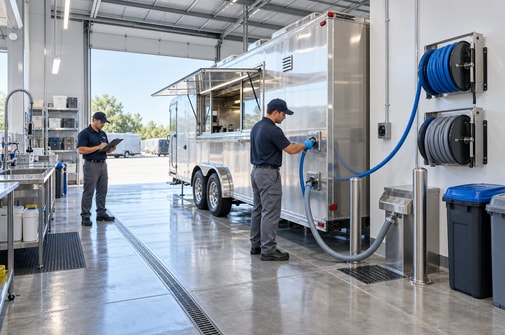
Arrange an approved water source and an approved wastewater disposal point. Empty the food-service equipment that could receive the first sanitizer solution. Set aside a dedicated potable-water hose, caps, gloves, eye protection and a test method suitable for the sanitizer you have been told to use. A concentration number is only useful if it is actually measured at the point and time required by the procedure. Record the product label and lot when appropriate.
If the water has a strong odor, visible sediment, slime, discoloration, or unexplained recurring test failure, stop treating the problem as routine seasonal maintenance. Identify the source and involve the local health authority or a qualified water-system technician. Sanitizer cannot repair a cracked tank, an exposed hose end or a cross-connection to wastewater.
First isolate the trailer from the drinking-water supply, switch off the pump and heater as their manuals require, and let hot components cool. Drain the potable tank to an approved receptor; never let the potable hose touch a waste outlet or the ground. Open the service panel and check for standing water, deposits, damaged gaskets, loose fittings, leaks and inaccessible dead ends. Photograph anything that needs repair before covering it with a sanitizing cycle.
In the FDA Food Code 2026, sections 5-302.11 and 5-302.15 address an enclosed tank and tank inlet/outlet geometry that drains completely and protects the inlet from waste discharge, road dust, oil and grease. Section 5-302.12 describes how an inspection/cleaning port, if the tank has one, is to be protected and secured. These details matter when specifying a new trailer. A drain valve hidden behind a fixed cabinet or a fill neck beside a waste hose will be awkward to maintain regardless of how large the tank is.
Yes. The clean-water hose is part of the water system, not a disposable accessory. Inspect the full length for cracks, cloudy residue, kinks and damaged couplings. Clean and sanitize it using an approved procedure, then cap both ends and store it in a protected location. Replace a hose that cannot be cleaned reliably. Keep the potable hose dedicated to potable-water service; use a different hose for gray-water discharge. Clearly identifying the hose helps the next crew member make the right connection under time pressure.
Wipe and inspect the fill port, cap, vent and surrounding wall before opening the tank. The FDA Food Code’s sections 5-303.12 and 5-304.13 call for protective covers or devices at inlets, outlets and hose fittings when not in use. A cap that is lost or placed on the dirty ground should not be quietly put back on the potable inlet. A spare clean cap can be a much better investment than a larger tank.
Follow a written, locally accepted procedure and the equipment instructions. In general, remove visible debris and deposits before sanitizing; a chemical contact step is not a substitute for physical cleaning. For a tank with a permitted cleaning port, use the access as designed and avoid tools that scratch its smooth interior. If the tank cannot be safely accessed, ask the manufacturer how it is intended to be cleaned. Do not improvise a new opening or reach through a fitting that was never designed as a service port.
After cleaning and rinsing away any detergent, prepare the specified sanitizing solution using the correct product, verified concentration and protective equipment. Fill or circulate it through the portions of the tank and line system required by that procedure. Open each appropriate outlet long enough to confirm treated water reaches it, then maintain the required contact time. If the procedure calls for a test strip or other measurement, use it as directed and record the reading. The Alaska example is 50 ppm for at least two hours for covered Alaska units; another jurisdiction, component maker or approved method may differ.
Do not send a high-strength solution through a heater, cartridge filter, ice maker, beverage machine or other appliance unless its manufacturer allows it and the regulator’s process covers it. Some devices need an isolated treatment or a later filter replacement. The purpose is to restore a safe system, not to damage expensive equipment or leave sanitizer trapped in a branch line.
When the prescribed contact period has ended, drain the tank through the intended low point, flush the approved line path and rinse as the governing procedure requires. Alaska specifically says to drain, thoroughly rinse and refill. Do not use the trailer for drinks, ice, handwashing or warewashing while a strong treatment solution remains in the potable system. Refill from an approved potable-water source with the dedicated clean hose, protect the inlet and close all caps. Restore bypassed equipment only according to its manual.
Then operate every outlet and check for leaks, unexpected odor, unusual taste, pressure loss and trapped air. A persistent chemical smell is not proof that “it is extra clean”; it can mean the rinse is incomplete or a branch was missed. A stale odor returning after a day can point to retained water, a dirty hose, a filter or another contamination source. Document what happened rather than simply repeating chemical treatment without diagnosis.
Seasonal start-up should be a planned job, not a five-minute fill. Inspect for freeze damage and leaks, confirm the tank and hose are clean and intact, complete the applicable flush-and-sanitize cycle, refill from an approved source, and perform any required sampling before operating. In Alaska, ADEC calls for a certified-laboratory coliform sample before initial and seasonal startup and every three months during operation. It also directs operators to forward lab results to the local ADEC food-safety office. A failed sample has a separate immediate response and a retest within 24 hours after superchlorination. Do not confuse that failed-result retest deadline with the routine sampling schedule.
For a unit outside Alaska, ask the local regulator whether a lab sample, operator test, inspection or documented sanitization is required after nonuse. The FDA model gives a sanitization trigger but does not create Alaska’s exact testing calendar everywhere. If your water source is under a boil-water advisory or known contamination event, follow the authority’s emergency instructions. Do not treat a routine maintenance article as permission to keep operating on uncertain water.
Store the unit according to the tank, pump and heater manuals and local climate. In freezing regions, a complete drain-down and approved winterization method are essential to avoid cracked fittings; in warm regions, prolonged stagnant water and dirty hose storage may be the bigger concern. Neither situation is solved by leaving the fill cap open. Keep the potable inlet, outlet and hose ends capped and protected from dust, insects and splash.
Before an extended shutdown, record the date, the water remaining, any drained components and any equipment taken out of service. On return, treat that record as a starting point, not proof the system is clean. The FDA Food Code’s “periods of nonuse” language is a reminder to flush and sanitize before returning to service. Set a calendar reminder for local inspections and samples so a seasonal opening does not get delayed by a missing lab appointment.
The published Tswagstra customer project uses ZZKNOWN’s real KN-FS400 platform. Its case page lists a 400 × 200 × 230 cm trailer, two 25 L water tanks, a 24 V water pump, plumbing, a floor drain and sinks; it also documents a selected three-compartment sink plus handwash basin. The case is useful because it makes the water system more than an abstract “tank included” line item. It does not prove the position of every hidden drain or establish that a 25 L fresh tank will satisfy another buyer’s local capacity rule.
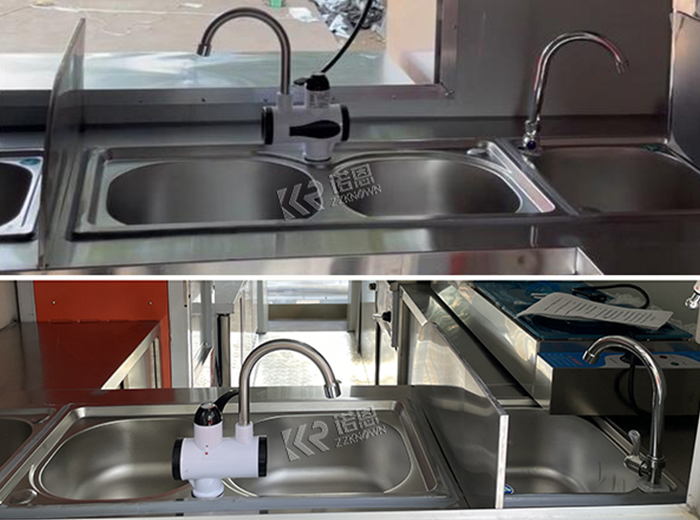
A newer KN-FS400 product configuration also lists clean and waste tanks, a pump and hot/cold sink plumbing. These are real model references, not evidence that every KN-FS400 has the same tank geometry or sanitization access. For a custom build, ask ZZKNOWN to identify the proposed fill position, complete-drain point, service panel, pump access, protected hose storage and any heater or filter bypass on the actual drawing.
“Can a technician follow the water from fill point to every faucet, isolate components that cannot receive the treatment solution, drain the tank and low spots completely, and inspect every connection afterward?” That is the practical design check. Based on ZZKNOWN’s production experience, removable access panels and reachable valves can be more valuable over the trailer’s life than a nominal capacity increase. This is a general engineering explanation, not a signed review of this article or any reader’s build.
Yes. Print or copy the table below into the operating binder. Fill one row per service event and attach any chemical records, test-strip readings, lab reports and repair notes required by your local authority. A ticked box is not a substitute for a water test when one is required; it is a reminder that the hose, pump, heater and leak inspection belong in the same job.
| Date | Tank cleaned | Sanitization / method | Hose / fill cap | Pump / heater | Leaks / test | Initials |
|---|---|---|---|---|---|---|
| ________ | ________ | ________ | ________ | ________ | ________ | ________ |
| ________ | ________ | ________ | ________ | ________ | ________ | ________ |
We reviewed the official FDA Food Code 2026 Chapter 5 text, the current Alaska ADEC mobile-unit testing page and Alaska regulation 18 AAC 31.500, the CDC’s chemical-safety guidance, and published ZZKNOWN product and project pages. We compared each numerical claim with its jurisdiction and did not collect a new field dataset or laboratory result. The Alaska 50 ppm/two-hour value and sampling calendar apply to the covered Alaska units described by ADEC; the KN-FS400 dimensions and components are published case/product specifications, not new measurements. Sources and product pages were checked November 4, 2026.
Author: ZZKNOWN Editorial Team. Technical review: No named technical reviewer has been documented for this article. The final sanitization method and plumbing design should be approved by the relevant local authority and qualified equipment professionals before use.
Use your local rule, water-test schedule, manufacturer instructions and actual operating conditions. The 2026 FDA model specifically triggers flushing and sanitization after construction, repair, modification and periods of nonuse. Alaska adds at least annual and pre-seasonal treatment for its covered units. A regular visual and hose check between deep treatments is sensible, but do not claim one calendar interval works everywhere.
Do not assume so. That number is an Alaska regulatory example. Your destination may require a different approved procedure, and your tank, pump, seals, heater or filter may impose compatibility limits. Ask the health authority and component makers for the method before adding chemicals.
It may signal a problem, but odor alone cannot identify its cause or prove a microbial result. Check the source water, hose, cap, tank, pump strainer, heater and line dead ends. If the issue persists, stop food-service use of that water and request the testing or professional assessment required locally.
Yes, the FDA model explicitly names the water tank, pump and hoses in its flush-and-sanitize provision. A clean tank can be recontaminated through an uncapped hose or dirty coupling. The exact procedure for each component still needs to respect manufacturer instructions.
Map those devices before treatment. Do not route a strong sanitizing solution through them unless their manuals allow it. Some require bypass, separate cleaning or a replacement filter. Return every branch to service only after the approved rinse, refill and any required testing.
Not everywhere. Alaska requires certified-lab coliform testing before initial and seasonal startup and quarterly during operation for covered units; it also specifies a rapid retest after an exceedance. Elsewhere the schedule may differ. Ask your local regulator what evidence is required before reopening.
Ask for the tank material and capacity, approved fill location, protected hose storage, complete-drain arrangement, inspection access, pump compartment, heater/filter service plan, backflow protection and a drawing showing separation from wastewater. Then share your destination’s official checklist with the builder.
Tell ZZKNOWN your menu, operating city, sink plan and daily water demand. Ask us for a custom layout showing fill, inspect, drain, clean and service access—then have your local authority review it before production.
Request a water-system layout and quote →Related ZZKNOWN guides: servicing-area planning · three-compartment sink layout · pest-proof design.