Published: October 29, 2026 | Last updated: October 29, 2026 | By ZZKNOWN Editorial Team
Technical review: No named engineering or regulatory reviewer is claimed for this article. Final drawings must be checked by the buyer's qualified designer and local authority having jurisdiction.
A practical wash–rinse–sanitize guide for buyers who need more than a “3+1 sink included” line on a spec sheet.
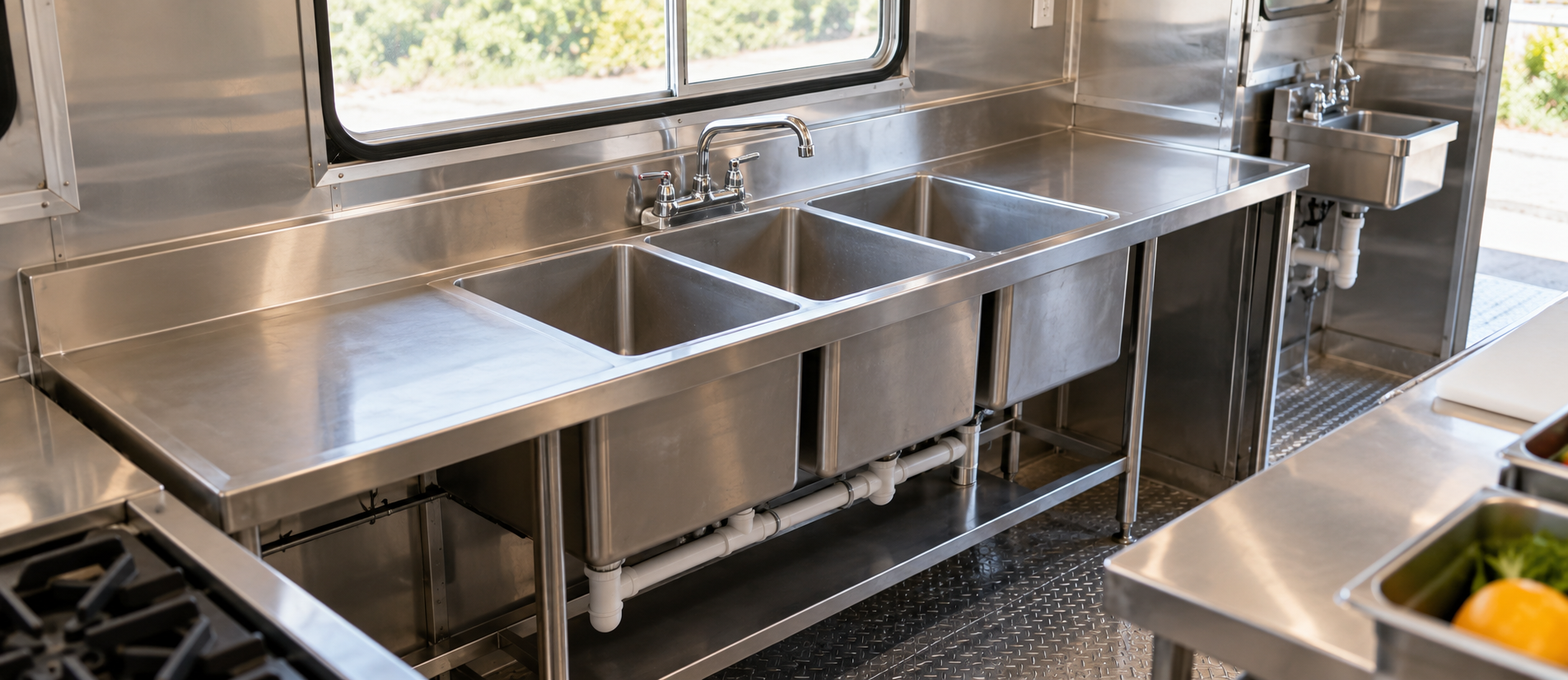
Scope and data date: Global purchasing guide with U.S. regulatory examples. Official sources were checked October 29, 2026. The U.S. FDA Food Code 2026 is a model code; state, county, city, and non-U.S. rules can differ. No universal tank size, sink dimension, chemical dose, or permit outcome is promised.
Picture the lunch rush: a spatula falls, sauce pans pile up, and the only empty counter is next to ready-to-serve food. A three-bowl sink may be installed, yet the team still has nowhere to set dirty items, nowhere to let clean ones dry, and no reliable way to check sanitizer. That is the real design problem. From ZZKNOWN's production-planning experience, buyers get a better layout when they describe the complete cleaning journey before choosing the cabinet size. We do not claim that every ZZKNOWN build has passed every jurisdiction's inspection; the design must match the actual menu and local approval.
In the FDA Food Code 2026, section 4-301.12 generally calls for at least three compartments for manual washing, rinsing, and sanitizing, while allowing approved alternatives under specified conditions. Section 4-301.13 also addresses drainboards or equivalent holding space before cleaning and after sanitizing. The distinction matters: the code describes a functioning process, not merely a count of stainless basins.
The simplest mental model is a one-way street. First, scrape food into a waste container. Put the item into the wash basin with an appropriate cleaning solution. Move it into a separate rinse basin to remove detergent and loose residue. Then immerse it in a properly prepared sanitizing solution—or use an approved hot-water process—before allowing it to drain and air-dry. The wash and rinse waters are not magic; they must stay clean enough to do their jobs and be changed when soiled.
| Zone | Purpose | What buyers should plan |
|---|---|---|
| Dirty landing | Hold scraped, soiled items | A drainboard, rack, or movable table that does not cross clean traffic |
| Basin 1: wash | Remove grease and visible soil | Hot-water capacity, detergent, brush, largest-item immersion |
| Basin 2: rinse | Remove wash chemicals | Fresh rinse water and a clear transfer route |
| Basin 3: sanitize | Reduce remaining microbes | Approved chemical or approved hot-water method; suitable test tools |
| Clean landing | Drain, air-dry, protect | Separate rack or board away from splashing and raw-food prep |
Start outside the water: scrape or pre-rinse large food scraps, because a sink full of crumbs becomes dirty fast. The FDA model's section 4-603.12 covers precleaning; section 4-603.14 describes effective wet cleaning. In practice, the wash basin needs a detergent appropriate for the soil—think greasy griddle tools versus syrupy blender parts—and enough room to move a brush around the whole item. A basin that accepts a pan only diagonally with its handle sticking out is not a comfortable wash station.
The FDA model's section 4-501.19 specifies a manual wash solution of at least 43°C/110°F or the temperature stated by the cleaning-agent label. That is a wash-solution condition, not a universal water-heater setpoint for every plumbing fixture. Some destinations impose their own hot-water delivery requirements; for example, Porter County, Indiana's mobile-unit guidance calls for sufficient hot and cold water for utensil washing and handwashing. Tell the builder how many racks or pans may need washing in an hour, not just the number of sinks you want.
Because wash chemicals and loosened grease should not travel into the sanitizer. FDA section 4-603.16 specifies a distinct separate water rinse after washing and before sanitizing for a three-compartment sink. Its explanation notes that leftover detergent can dilute or inactivate sanitizer. That is the everyday reason the three steps stay separate. If staff are using the middle basin as a storage bin, the workstation has effectively become a two-step process.
Keep the rinse water clean; replace it when it turns cloudy or greasy. A faucet that can reach the required compartments and a splash-aware backsplash help the process feel natural, but neither substitutes for the basin itself. Position the sink so a worker can travel from dirty to clean without walking dripping equipment past uncovered ingredients.
Sanitizing is controlled by chemistry or heat, contact time, and the item being clean first. If you choose a chemical method, use a product legally suitable for food-contact surfaces in your market, follow its label, and keep the solution at the applicable concentration, temperature, pH, and contact time. FDA sections 4-501.114 and 4-703.11 describe those variables for the U.S. model. A generic “splash of bleach” recipe is not a substitute. Chlorine, iodine, quaternary-ammonium, and other approved formulations are not interchangeable, and the correct test device depends on the product.
Section 4-302.14 of the FDA 2026 model calls for a device that accurately measures sanitizing-solution concentration. The 2026 changes to section 4-501.116 also emphasize using a test kit according to its manufacturer's instructions. Keep strips dry, in date, and within reach of the station. Train staff to test the solution they are actually using, not a bottle mixed hours earlier. If the result is outside the label or local-code range, remix and retest before processing clean utensils.
Hot-water sanitizing is another method only where the equipment, temperature, time, and worker-safety arrangements are appropriate and accepted. The FDA model cites 77°C/171°F for the manual immersion sanitizer water and at least 30 seconds of immersion under the relevant provisions. For many compact trailers, a chemical process is easier to plan, but that is a design observation—not a claim that chemicals are universally required or safer. Ask the local regulator which path is accepted.
Onto a clean drainboard or rack where they can drain and air-dry. Do not towel-dry still-wet items or stack damp pans in a closed cabinet. FDA section 4-901.11 requires air-drying or adequate draining before food contact, with a narrow allowance for polishing items already air-dried. Section 4-903.11 addresses protected clean storage. The key design question is whether the clean side is genuinely protected from the dirty side, splash from the faucet, and food prep traffic.
This is why a narrow sink welded tightly between a refrigerator and a prep counter can disappoint after delivery. There may be three bowls but no hygienic staging space. Porter County's mobile-unit page explicitly asks for proper drainboards, utensil racks, or movable dish tables for soiled and clean dishes. That gives a buyer a useful planning prompt: what is the busiest 15-minute period, and how many pans might be waiting on each side?
Start with your largest reusable item that must be washed onboard. It could be a sheet pan, blender jar, stockpot insert, fryer basket, or serving utensil—not necessarily your biggest cooking appliance. FDA section 4-301.12(B) says compartments must be large enough to immerse the largest equipment and utensils. Porter County repeats this idea for its mobile units. Measure length, width, depth, and handles; then allow clearance for a human hand to clean every surface. “Fits through the opening” is a weak test if the item cannot be submerged or turned.
Do not interpret that rule as a guarantee that every fixed or oversized appliance must fit into a three-bowl sink. The FDA model provides for approved alternative warewashing equipment under section 4-301.12(C), and a commissary can be part of some local operating plans. Those alternatives require specific approval. Put the largest-item list and proposed cleaning method on your plan-review sheet before steel is cut.
There is no responsible global number. A smoothie trailer with washable blender jars has different traffic from a burger trailer with griddle tools and pans. Estimate item count per service, how long each batch occupies the wash, rinse, and sanitizer, and how many items must air-dry before reuse. Then size the dirty and clean landing areas to the peak queue, not the average day. Where floor space is tight, a removable rack or approved movable dish table may help, provided it stays stable, cleanable, and truly separates flows.
For water, count more than the three basins: handwashing, food-prep use where applicable, cleaning, rinse-water changes, and the expected event length all draw from the same potable supply. The water heater must recover fast enough under simultaneous use; the pump, wiring, plumbing protection, and wastewater tank must be planned together. The food trailer pre-opening operational test guide explains why buyers should run the actual water system under load before an inspection appointment. Test at the faucets, not only at the heater outlet.
Usually, “3+1” is shorthand for three warewashing basins plus one separate handwashing basin, but shorthand is not a drawing. Confirm the fourth basin's location, access, soap and drying supplies, splash separation, hot/cold water, and drainage on the plan. Under FDA 2026 section 5-205.11, a handwashing sink must stay accessible and be used only for handwashing. The model's section 5-202.12 requires the fixture to deliver at least 29.4°C/85°F water; some local rules can set a different requirement. Avoid reusing an older county-specific temperature as if it were current everywhere.
Ask for a plan showing the cook line, serving position, hand sink, warewashing station, and clean utensil storage all at once. A hand sink hidden behind an open cabinet door is not helpful in service. Likewise, a fourth basin immediately beside raw-food prep may need splash control. Good sink planning is really workflow planning.
One verifiable example is ZZKNOWN's KN-FS400 4-meter burger and hot-dog trailer. Its public product page lists a 4 m × 2 m × 2.3 m trailer and a custom-fit 3+1 sink with hot and cold water taps. That is a real model and a useful starting point for layout discussion. The page does not publish bowl dimensions, drainboard capacity, sanitizer details, heater recovery, or a permit approval for your destination. Those must be confirmed on the actual build specification.
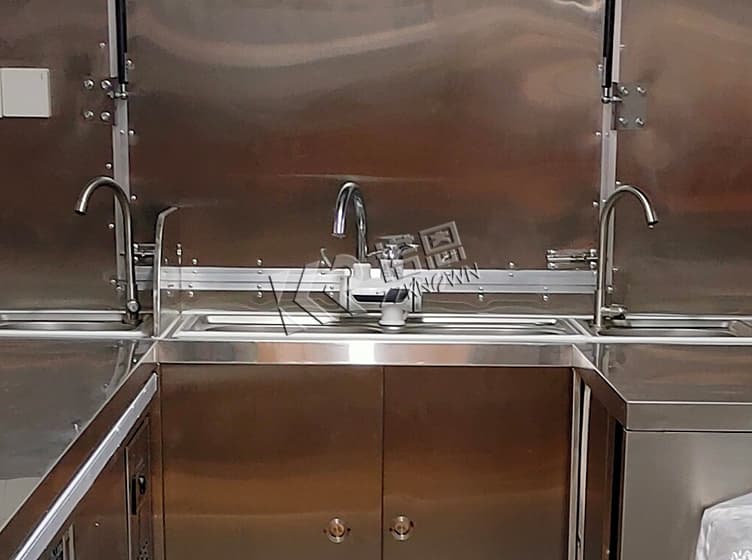
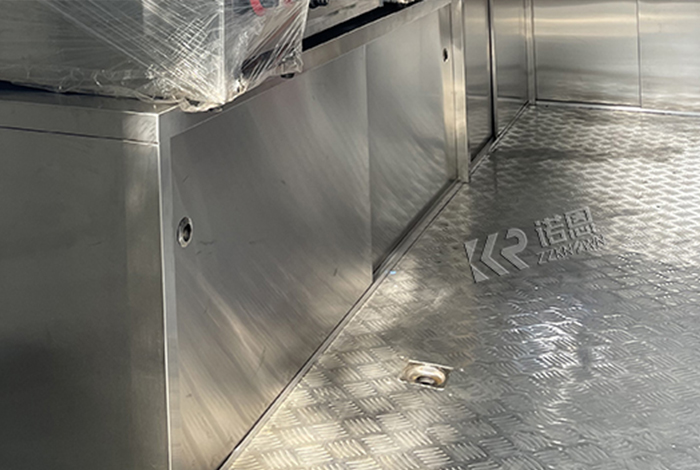
Engineering note from the layout perspective: A custom stainless counter can integrate the bowls, faucet, and drainboards, but the fabrication drawing should also show access for plumbing repairs, tank and heater locations, splash edges, electrical clearances, and the load added by a full water system. A sink that works only when the trailer is empty is not a working design. Share the menu and full equipment list with ZZKNOWN so the workstation is designed with the whole kitchen, not dropped into the last open space.
| Choice | When it may work | Trade-off to check |
|---|---|---|
| Compact 3-bowl only | Very limited reusable equipment, if approved | May lack bowl immersion or clean/dirty landing space |
| 3 bowls plus integral boards | Steady onboard warewashing | Uses more counter length; verify dry area at peak |
| 3 bowls plus approved rack/table | Flexible staging in constrained layouts | Must remain stable, cleanable, separate, and acceptable locally |
| Commissary/alternative plan | Special menus or oversized equipment | Needs explicit regulator approval and a workable operating plan |
This is a parameter comparison, not a price quote. Costs depend on bowl gauge and dimensions, fabrication method, drainboards, heater and tank capacity, pump, plumbing, electrical supply, and local installation. Ask for an itemized quote; a cheaper sink line can become expensive if it forces a late layout change.
For broader planning, see ZZKNOWN's washable wall and ceiling material guide and pest-proof food trailer design guide. Both matter around a wet, high-traffic workstation.
We compared the publicly available FDA Food Code 2026 text—especially sections 4-301.12–.13, 4-302.14, 4-501.19, 4-501.114–.116, 4-603.12–.16, 4-703.11, 4-901.11, and 5-202.12/5-205.11—with Porter County's mobile-unit page, Texas DSHS's current mobile-vendor licensing information, and the public KN-FS400 specification. We did not perform lab testing, run a buyer's inspection, interview a named engineer, or collect comparable supplier price quotes. Tarrant County's older checklist is not used here as the governing Texas permitting source because licensing changed in July 2026.
No universal answer applies worldwide. The FDA U.S. model generally provides for three compartments when manual warewashing is needed, with specific approved alternatives. Your menu, reusable equipment, commissary arrangement, and local authority determine the actual requirement.
No. Handwashing needs its own accessible sink where required; the warewashing basins are for the wash–rinse–sanitize flow. Do not design a station that depends on sharing the sanitizer basin with handwashing.
Not automatically. Even if customers receive single-use serviceware, your staff may still use reusable tongs, blender jars, knives, or pans. List those items and ask the local regulator whether an onboard sink, approved commissary, or another plan is acceptable.
You need adequate, separated places for dirty and cleaned items under the applicable rule. The FDA model allows drainboards, utensil racks, or tables; some local documents specify a particular arrangement. Show the exact proposed solution on the drawing.
Buy a device intended for the sanitizer chemistry and concentration range you will actually use, and follow its instructions. Do not assume chlorine strips can verify a quaternary-ammonium solution or vice versa.
No. In the FDA 2026 model, 110°F/43°C refers to the manual wash solution, or the cleaning-agent label temperature. Hand-sink delivery and chemical-sanitizing conditions have separate rules, and local requirements may differ.
Send your destination, menu, daily volume, largest reusable item with dimensions, cooking and refrigeration equipment list, planned water and power sources, commissary plan, and any health-department plan-review notes. That is enough to begin a meaningful layout discussion.
Send ZZKNOWN your largest washable utensil, service volume, destination market, and proposed trailer size. Ask for a layout showing three bowl dimensions, separate hand sink, dirty/clean landing, heater, fresh and wastewater systems, and the items that still need local approval.
Request a custom sink layout and itemized quoteEditorial disclosure: This guide is published by ZZKNOWN, a food trailer manufacturer. It is educational buying guidance, not legal, food-safety, or engineering certification. Confirm the latest adopted rules with your destination authority before construction or operation.