


Food Trailer Servicing Area Design: Water, Waste, Cleaning and Commissary Planning
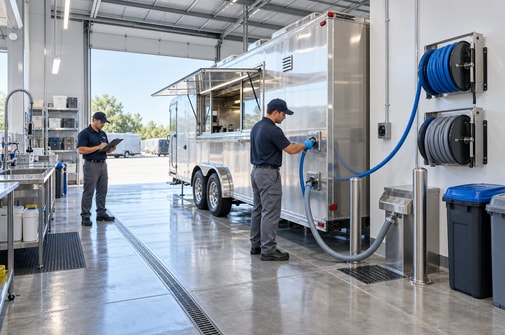
- A self-contained trailer may still be required to return to an approved commissary or servicing area.
- Potable-water filling and wastewater dumping must be physically and operationally separated.
- Tank capacity, menu, operating hours and crew size determine how often the unit needs service.
- Local rules control approval; the FDA Food Code is a model, not a universal federal operating permit.
- Freeze the servicing plan before production so inlets, outlets, tanks, access panels and equipment remain reachable.
What is a food trailer servicing area?
Think of the servicing area as the trailer's home base. The FDA Food Code defines it as an operating base to which a mobile food establishment returns regularly for tasks such as cleaning the vehicle and equipment, discharging liquid or solid waste, refilling water tanks and ice bins, and loading food. A jurisdiction may use related terms—commissary, depot, base of operations, support facility or central preparation facility—but the practical idea is similar.
The important point is easy to miss: the servicing area is not simply a parking space with a garden hose. It is part of the food-safety system. Clean water enters there. Waste leaves there. Food and clean equipment may be loaded there. If those movements cross each other, or if the area cannot be cleaned, the design creates daily contamination risks even when the trailer itself looks perfect.
That is why we encourage buyers to discuss the base while they are still choosing a food trailer model. Based on ZZKNOWN's production experience, late decisions about tank access and drain locations often force awkward hose routes or cabinet changes that could have been avoided on the first layout.
Why can a self-contained trailer still need a commissary?
“Self-contained” normally means the trailer carries its own water, wastewater, power and cooking equipment during service. It does not automatically mean the business is excused from returning to an approved base. The local regulator may still require an off-trailer place for potable-water filling, wastewater disposal, unit washing, food preparation, cold or dry storage, grease handling and records.
New York City offers a clear example. Its official street-vending guidance says mobile units must be stored at a commissary, depot or approved alternative facility—not at home—and returned at least daily for cleaning and maintenance. The same guidance lists potable water, liquid and solid waste equipment, enclosed unit-washing areas, food storage and daily logs among the services a commissary should provide. That is a local example, not a rule for every country or U.S. city, but it shows why “I have two tanks” is not the same as “my operating base is approved.”
Which daily tasks should the design support?
Picture the end of a busy festival. The crew is tired, the wastewater tank is nearly full, utensils need washing and tomorrow's ingredients must be organized. A good servicing design turns that messy moment into a short, consistent route instead of a series of improvised chores.
| Service task | What the area needs | What the trailer needs | Common design mistake |
|---|---|---|---|
| Fill potable water | Approved water source, protected outlet and required backflow control | Dedicated capped inlet, food-grade hose and reachable tank | Using the same hose or connection zone as wastewater |
| Remove wastewater | Approved sanitary sewer receptor, utility sink or dump station as authorized | Low, accessible outlet; leak-resistant valve; drainable tank | Outlet hidden behind equipment or axle |
| Wash the unit | Washable surface, drainage, water supply and weather/pest protection where required | Sealed, cleanable exterior and protected openings | Wash runoff entering a storm drain or clean-water zone |
| Clean utensils | Approved warewashing sink or dishwasher, sanitizer and drying space | Safe transport space for soiled and clean items | Mixing dirty returns with ready-to-use utensils |
| Restock food and ice | Approved preparation and storage areas | Door/window access that avoids waste connections | Loading food beside an active dump hose |
| Handle refuse and grease | Covered receptacles and approved collection route | Secure containers that will not leak in transit | Open bins or grease containers beside food loading |
| Record service | Log station or digital workflow | Unit/permit identifier | No proof of when or why the facility was used |
What does the FDA Food Code say about water and wastewater?
The 2022 FDA Food Code is the current full edition as of this update. FDA describes it as a model that state, local, tribal and territorial jurisdictions may adopt or adapt. Therefore, use it as a design reference and always check the law actually adopted at your destination.
For potable water, Chapter 5 allows approved mains and other lawful systems, including pumps, pipes, hoses, water transport vehicles and containers. It also describes alternative supplies for mobile facilities, including commercially bottled water, closed portable containers, an enclosed vehicular tank, an on-premises tank, or hoses connected to an approved adjacent source.
For wastewater, section 5-402.14 says sewage and other liquid waste must be removed from a mobile food establishment at an approved waste servicing area or by a sewage transport vehicle without creating a public-health hazard or nuisance. Section 5-402.15 calls for the retention tank to be thoroughly flushed and drained in a sanitary manner. Section 5-403.11 directs sewage to an approved public treatment plant or a lawful individual system.
Those sentences lead to a practical design rule: a waste outlet must not invite splashing, pooling or improvised disposal. It should be low enough to drain, reachable without crawling under hot equipment, and compatible with the receiving method accepted by the authority.
How should potable-water filling be designed?
Start at the source and follow the water all the way to the sink. Every component that touches potable water matters: source, backflow protection, hose, coupling, inlet cap, tank, pump, pipes, heater and faucets.
- Use an approved source. Confirm that the commissary or event connection is accepted by the local regulator.
- Reserve one food-grade hose for potable water. Color-code and label it, cap both ends and store it above the floor in a closed or protected compartment.
- Protect the supply from backflow. The device or air-gap arrangement must match local plumbing requirements and the filling method.
- Keep the inlet covered. Put it where road spray, grease, refuse and the waste hose cannot contaminate it.
- Make the system drainable and serviceable. Access to the tank, pump, strainer and low-point drains saves hours during sanitizing and winterization.
The FDA Food Code's public-health rationale explains that potable-water hoses should be dedicated and identifiable, inlet and outlet geometry should avoid pooled water, openings need protective covers, and systems should be flushed and disinfected after construction or repair. These are small details on a drawing, but they shape what your crew touches every day.
How should wastewater discharge be designed?
Wastewater is not simply “used water.” It may carry grease, food particles, sanitizer and organic material. Treat its route as a controlled dirty-side process. Put the outlet on the utility side of the trailer, clearly below and away from the potable-water inlet. Use a valve and cap that resist leakage in transit, and choose a hose diameter and receiving connection that allow the tank to empty without backing up.
The receiving point matters just as much. For example, the official NYC commissary agreement identifies a mop or utility sink, or a wastewater dump station connected to the sanitary sewer, as possible wastewater-disposal services. Your city may specify a different receptor. A storm drain, street gutter, landscape bed or open ground should never be treated as a convenient substitute.
How large should the fresh-water and wastewater tanks be?
There is no honest one-size-fits-all number. Required capacity can depend on the adopted code, menu, food-preparation process, handwashing demand, warewashing method, hours between service visits and whether the authority allows mid-shift refilling. The correct calculation begins with your actual operating day.
| Operating profile | Likely water-demand drivers | Servicing implication | Questions to resolve before ordering |
|---|---|---|---|
| Packaged drinks and sealed snacks | Handwashing and light surface cleaning | Lower demand may allow a smaller system where approved | Is an alternative facility or reduced setup allowed? |
| Coffee and beverages | Handwashing, machine supply, pitcher rinsing and ice | Fresh-water use can be steady even without cooking | Does equipment require direct feed, filtration or drainage? |
| Burgers, fries and grilled foods | Handwashing, utensils, greasy equipment and cleaning | Waste volume and grease controls become important | What warewashing and grease-disposal process is approved? |
| High-volume event service | Long hours, multiple operators and continuous preparation | Large tanks add weight; a planned mid-shift service may be safer | Where can service legally occur during the event? |
| Cold-climate operation | Normal demand plus winterization and freeze protection | Heated compartments and complete drainage may be needed | What temperature and storage conditions must the unit survive? |
Do not size the waste tank by copying the fresh tank automatically. Account for beverages, ice melt, equipment drains and cleaning water that may enter the waste system. Then ask your regulator whether a minimum excess capacity is required. Finally, add full-tank weight to the trailer's payload calculation. One liter of water weighs approximately one kilogram; one U.S. gallon weighs about 8.34 pounds. That basic physics can change axle selection and cargo planning.
Where should the utility connections go on the trailer?
A well-planned utility side lets a worker complete service without circling the trailer or crossing the food-loading path. In a typical arrangement, the potable inlet sits high and protected; the wastewater outlet sits low; electrical service, gas storage and ventilation remain separated as required; and every access panel can open while hoses are connected.
Before approving a layout, simulate the real sequence: park, chock, connect potable water, fill, disconnect and cap, connect the waste hose, empty and flush, disconnect and cap, wash, inspect, restock and document. If one hose must pass through a doorway, under the serving counter or across the clean utensil route, revise the drawing.
Also think about the towing site. Some commissary bays are narrow. Connections placed on both sides may be impossible to reach when another unit is parked nearby. Share bay dimensions, approach direction and receiving-point location with your trailer engineer. The food trailer layout guide can help you map the working zones before equipment is locked in.
How should the physical servicing bay be arranged?
The bay should separate clean supply, dirty return and vehicle movement. Start with a durable, nonabsorbent, cleanable surface that is graded to an approved drain. Provide enough lighting to see leaks and soil. Where the Food Code provision applies, an outdoor servicing area may need overhead protection except during waste discharge. Local building, plumbing, wastewater, fire and environmental rules may add requirements.
A practical bay often includes a protected potable-water point, a separate sanitary dump receptor, a unit-washing zone, handwashing and warewashing support, covered refuse containers, grease handling, secure chemical storage, hose reels and space for inspection. It also needs safe clearance for the tow vehicle, trailer tongue, doors, awnings and roof equipment.
| Servicing option | Best fit | Control level | Main cost drivers | Approval questions |
|---|---|---|---|---|
| Dedicated private commissary | Fleet or high-volume operator | Highest scheduling and layout control | Lease/build-out, permits, plumbing, drainage, utilities and maintenance | Can the property and facility be permitted for all planned services? |
| Shared commercial commissary | New operator or small fleet | Shared schedules and storage | Membership, hourly use, storage, parking and extra services | Does the agreement cover water, waste, cleaning, storage and prep? |
| Restaurant or licensed kitchen partnership | Operators with an existing food business | Depends on owner and regulator | Contract, modifications, storage and access hours | Will the authority approve it as the mobile unit's base? |
| Alternative approved facility | Limited menus in jurisdictions that allow it | Narrowly defined | Basic service setup and documented access | Is the menu eligible, and which activities are permitted there? |
This is a parameter comparison rather than a price quote because facility cost changes dramatically by country, sewer connection, lease market, required permits and existing infrastructure. Ask providers for an itemized monthly and per-use total, then compare it with the capital and operating cost of a private base.
What can a real ZZKNOWN project teach us?
The Tswagstra street-food trailer project in Miami started with the KN-FS400 platform. The published project specification lists a 400 × 200 × 230 cm (about 13 × 6.5 × 7.5 ft) dual-axle unit, two 25-liter water tanks, double sinks, plumbing, a water pump and a floor drain. The customer also selected a three-compartment sink plus handwashing basin for the U.S. project.


The lesson is not that every buyer should copy those tank sizes. It is that a real model gives the regulator and manufacturer something concrete to review. For a new project, ZZKNOWN would start with the destination, menu, operator count, service duration and commissary arrangement, then adjust the tanks, sinks, heater, pump, inlet, outlet and access panels. See the current KN-FS400 product configuration for another view of the platform.
How do you prevent clean and dirty routes from crossing?
Draw two arrows on your site plan. The clean arrow runs from approved storage and potable water toward the trailer. The dirty arrow runs from wastewater, soiled utensils, refuse and used grease away from it. If the arrows cross, ask whether timing, barriers or a different connection location can eliminate the conflict.
Use different colors and connection types for fresh and waste hoses. Store them in separate compartments. Keep caps tethered and clean. Never place the potable hose on the floor while emptying the waste tank. Move packaged food and clean utensils only after waste service is complete and the area has been cleaned. Simple sequencing is often as valuable as expensive equipment.
What should be included in the daily servicing record?
Your authority may prescribe the exact form. New York City, for example, calls for daily facility records that identify the unit by permit or decal number and record the date, time and purpose of use. Even where the form is less specific, a useful service log can protect the operation during inspections and troubleshooting.
- Date, arrival and departure time, unit ID, permit number and operator.
- Potable-water source and fill completed.
- Wastewater discharged to the approved receptor and tank flushed.
- Unit interior/exterior cleaning, utensil washing and sanitizer check.
- Refuse, used oil or grease transfer completed.
- Food, ice, propane or other supplies loaded as permitted.
- Leaks, damaged caps, pump faults, blocked drains or corrective action.
Keep the log easy to complete. A one-minute mobile form tied to the trailer ID is more reliable than a complicated spreadsheet that crews postpone until Friday.
Which approvals should you check before construction?
Start with the health department or other retail-food authority, but do not stop there. A servicing base may also touch plumbing, sanitary sewer, pretreatment, grease control, building use, fire safety, propane storage, zoning, environmental discharge and vehicle-storage rules. The authorities may be different even within one city.
Send reviewers the menu, process flow, trailer floor plan, plumbing schematic, tank capacities, materials, water-heater details, equipment list and servicing agreement. Ask them to mark required revisions. For U.S. buyers, the FDA maintains an official directory of state retail food codes, which is a useful starting point for finding the adopted rules. Also review our food trailer propane and LPG system guide and food trailer fire-safety guide when the base will store or exchange fuel cylinders.
What should buyers send to ZZKNOWN for a service-ready layout?
- Destination: country, state/province, city and intended event or operating locations.
- Menu and process: what arrives prepared, what is cooked, how utensils are washed and how grease is generated.
- Operating day: crew size, service hours, customer volume and access to mid-shift servicing.
- Base details: commissary address, bay size, utility-side orientation, water source and waste receptor.
- Authority feedback: plan-review checklist, tank minimums, sink requirements, backflow notes and accepted connection types.
- Equipment schedule: model, voltage, water supply, drain connection and peak demand for each appliance.
With that information, the ZZKNOWN OEM/ODM team can build a layout around real service conditions instead of guessing. If the regulator has not reviewed the plan yet, treat the drawing as a proposal for discussion—not proof of approval.
How were the facts in this guide collected?
Data collection method: We reviewed the January 18, 2023 version of the 2022 FDA Food Code and its Chapter 5 provisions on water, mobile tanks, wastewater and disposal; checked FDA's current Food Code and state-code directory pages; reviewed New York City's current official mobile-vending/commissary guidance and commissary agreement; and compared those public requirements with published ZZKNOWN product and project specifications.
Scope and date: Regulatory references were checked for this global-buyer guide on September 14, 2026. U.S. examples do not automatically apply elsewhere, and city or state rules may have changed after the update date. Product specifications can vary by order. Confirm current requirements with the authority having jurisdiction and confirm the final build specification in your sales contract.
What do real buyers usually ask?
1. Can I service my food trailer at home?
Do not assume so. Many jurisdictions require an approved commercial commissary or servicing facility and prohibit residential food preparation, storage or unit servicing. Ask the local health authority before signing a lease or planning a home-based setup.
2. Does a large onboard water tank remove the commissary requirement?
Not necessarily. Tank capacity solves only part of the operation. The authority may still require approved food storage, warewashing, cleaning, waste disposal, grease handling or overnight unit storage at a base.
3. Can fresh water and wastewater use the same hose?
No. Use a dedicated food-grade potable-water hose and a separate waste hose, with distinct storage, caps and preferably different connection types. This reduces cross-contamination risk.
4. Can wastewater go into a storm drain?
Generally, do not discharge there. The FDA model directs mobile-unit liquid waste to an approved waste servicing area or sewage transport vehicle and sewage to an approved disposal system. Use only the receptor authorized by your local agencies.
5. How often should the trailer return to the servicing area?
The local permit controls. New York City requires at least daily return for cleaning and maintenance and its commissary agreement states no less than once every 24 hours. Other jurisdictions may set different schedules or approve different arrangements.
6. Should the wastewater tank be larger than the fresh-water tank?
It may need to be, depending on local minimums and all liquid entering the system. Calculate handwashing, warewashing, beverage equipment, ice melt and cleaning discharge, then confirm capacity and payload with both the regulator and trailer engineer.
7. What should I verify in a shared commissary contract?
Verify legal approval, access hours, parking, water filling, wastewater and grease disposal, unit washing, food preparation, cold/dry storage, propane rules, log responsibilities, insurance, fees and what happens if the facility closes.
8. Can ZZKNOWN provide a 2D or 3D utility layout?
Yes. Send the menu, destination, local plan-review notes, trailer size, tank targets, equipment list and commissary connection details. ZZKNOWN can prepare a project-specific layout and quotation for review before production.
Where can you verify the official requirements?
- FDA — Food Code 2022
- FDA — 2022 Food Code print version
- FDA — State Retail and Food Service Codes and Regulations
- NYC Business — Street Vending in NYC
- NYC Health — Mobile Food Vending Commissary Agreement
- Massachusetts — Retail Food Code Standards for Mobile Food Establishments
Ready for a service-ready food trailer layout?
Send ZZKNOWN your menu, destination, operating hours, commissary plan and local review checklist. We will help translate those inputs into a practical 2D or 3D layout, equipment schedule and project-specific quotation before production.
Request a Layout and Quote Explore Food Trailer Models