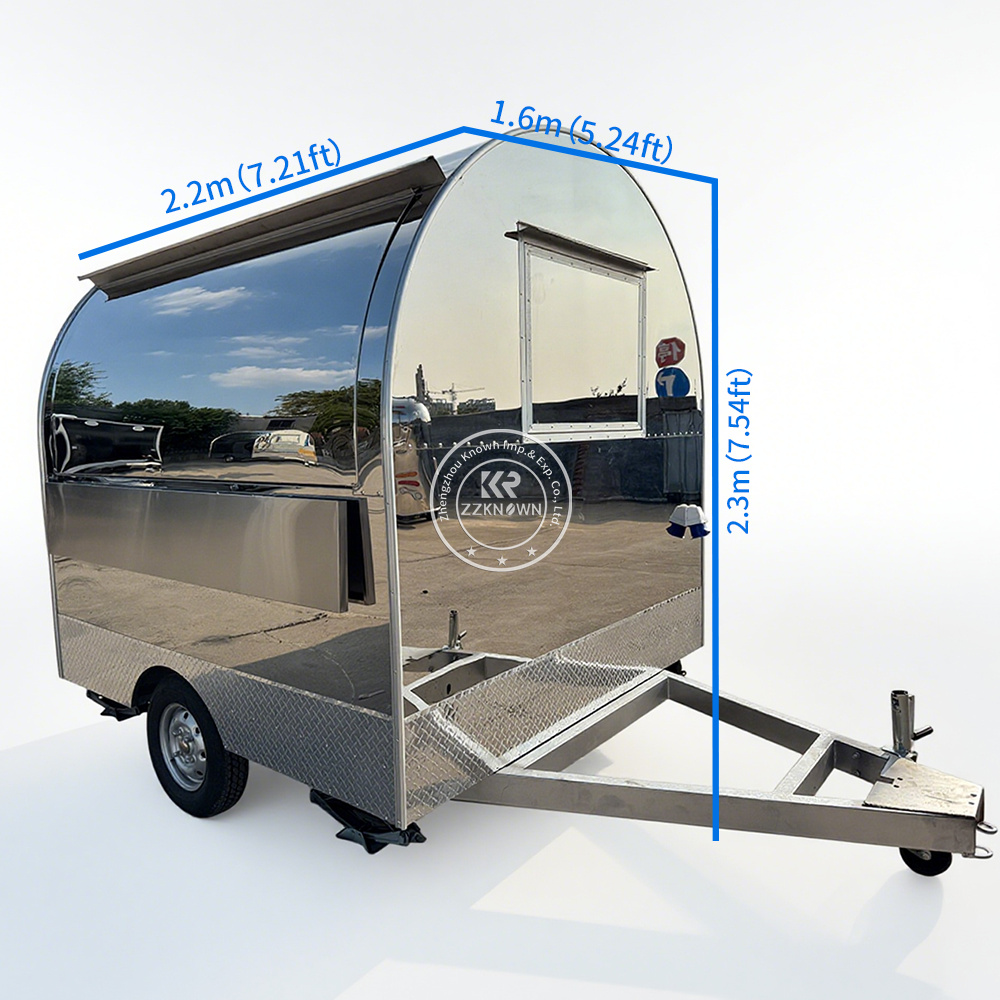
Can You Use a Garden Hose to Fill a Food Trailer? A Potable-Water Hose Guide
Can a food trailer use a garden hose? Learn how to choose a dedicated drinking-water hose, protect the fill inlet, store the line, prevent backflow, and plan a clean water-connection layout for your local permit.
How to choose a dedicated drinking-water hose, protect the fill connection, store the line and plan backflow control before your first event.
What are the key takeaways?
Can “food grade” be assumed from hose color?
No. A blue or white hose is a useful visual cue, but the manufacturer’s drinking-water suitability documentation matters more than color or marketing language.
Can one hose handle fresh water and wastewater?
No. Dedicate the drinking-water line to that job. Give waste service different equipment, connections and storage.
Is a capped inlet enough on its own?
No. The water source, outlet, required backflow control, hose, fittings, cap, tank and cleaning routine form one system.
Will the same drawing pass everywhere?
No. The FDA Food Code is a model. Country, state, province, county, city and event-site requirements can differ.
Why does a simple hose deserve its own buying guide?
Picture the first morning at a street-food festival. You have a beautiful trailer, the coffee machine is warming up, and the commissary’s fill point is across the lot. Someone reaches for the green hose used yesterday to wash the pavement. It fits. It carries water. So is it good enough?
That question appears small until you trace the water’s path. The hose touches the source outlet, the trailer inlet and every liter that later reaches handwashing, warewashing, beverages or food. If the hose has been used for cleaning chemicals, lay in a puddle beside a waste dump, or has unprotected ends, the tank can be contaminated before the first order. A drinking-water-rated hose by itself will not fix a dirty source or missing backflow protection, but it is a necessary part of a reliable fill process.
Based on ZZKNOWN’s production experience, water systems are easier to specify when buyers explain where the trailer will be filled and how it will be serviced—not only how many sinks they want. The hose length, source connection, inlet position, storage compartment and tank-access plan should be reviewed together before the body panels are finalized.
Why isn’t an ordinary garden hose the right default?
A normal garden hose may be designed for watering plants or washing vehicles rather than transferring drinking water. Its materials, previous use and storage conditions may be unknown. Even a new hose with an attractive package should not be treated as suitable simply because it fits a faucet. Read its manufacturer documentation for drinking-water use and check whether the local regulator has a specific material or marking requirement.
The 2026 FDA Food Code says a hose conveying drinking water from a mobile tank must be safe, durable, corrosion-resistant, nonabsorbent, resistant to deterioration, smooth inside, and clearly and durably identified for its use if it is not permanently attached (section 5-302.16). Its public-health explanation says hoses used to fill potable tanks should be dedicated and identified for that single purpose so they are not confused with other hoses. That is a more useful buying standard than “it looks clean.”
In a real local example, Albemarle Regional Health Services’ mobile-food-unit requirements explicitly say to fill tanks with potable water using a food-grade hose. Its pre-opening checklist calls for a food-grade hose and a cleanable storage container. These are North Carolina regional requirements, not a promise about what a buyer in London, Sydney, Toronto or Dubai must do.
What should you compare before buying a potable-water hose?
| Decision point | Ordinary multipurpose garden hose | Dedicated potable-water hose | What to verify before ordering |
|---|---|---|---|
| Intended use | Often irrigation or washdown; drinking-water suitability may be unclear | Manufacturer documents drinking-water use | Product data sheet, material designation and destination rules |
| History | May have carried cleaning chemicals or nonpotable water | Reserved only for drinking-water transfer | Label it and train staff not to borrow it |
| Inside surface | May not be specified for sanitation and repeated potable use | Choose a smooth, cleanable inner surface suited to the application | Manufacturer cleaning and sanitizing instructions |
| Length and diameter | Chosen for convenience, possibly excessive length | Sized for actual source-to-inlet distance and expected fill flow | Event-bay dimensions, pressure, fittings and hose rating |
| Ends and storage | Frequently left open on the ground | Protected ends and a cleanable, dedicated storage location | Compatible caps, cabinet or covered container |
| Identification | May look like every other hose on site | Durable “potable water only” identification | Label visibility after repeated washing and use |
This is a specification comparison, not a cost table. Hose price varies by length, material, certifications, couplings and market. A cheap line that cannot be documented or protected may be the most expensive choice once inspection delays and tank cleaning are considered.
How should the fill connection be arranged?
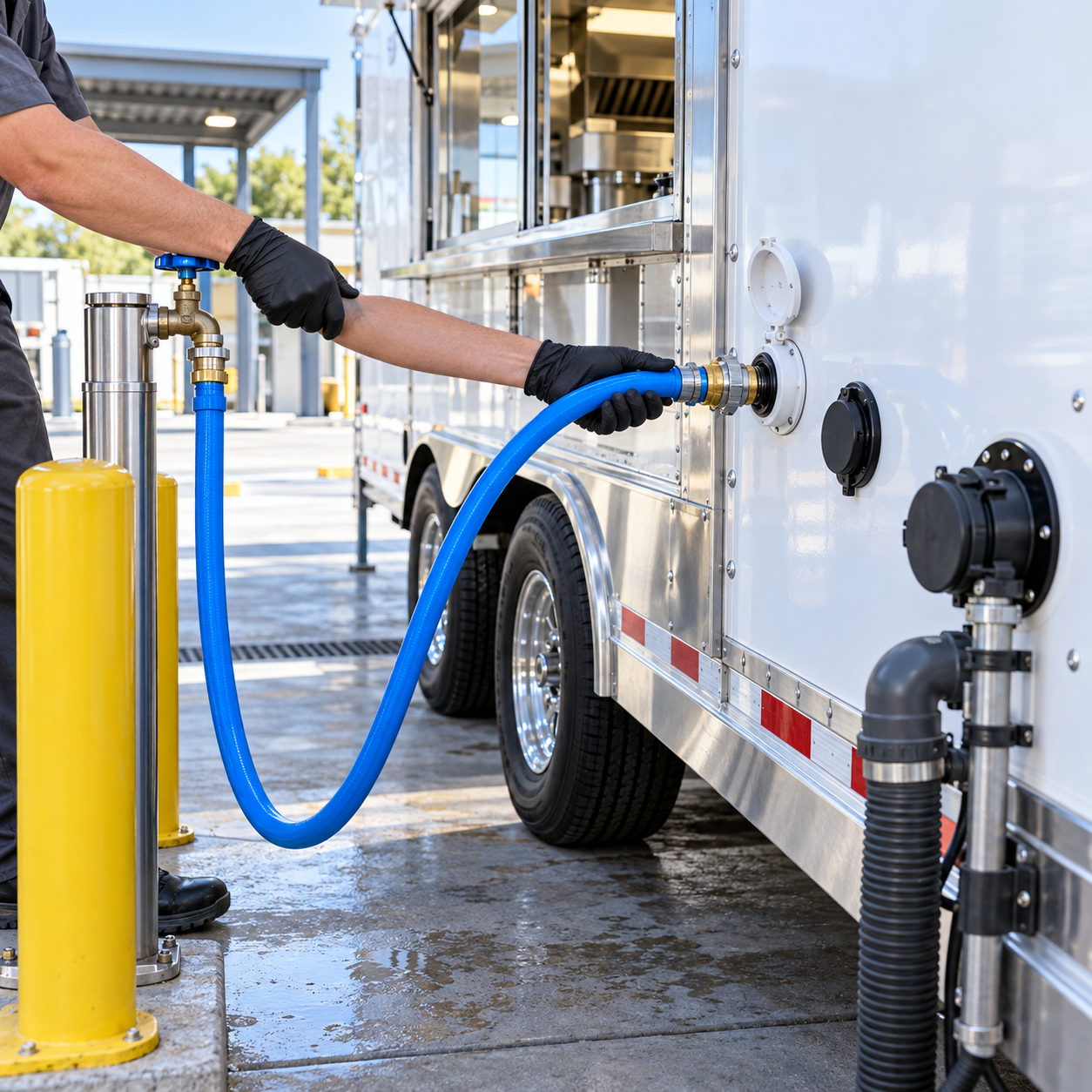
Start with a route that an operator can follow without guessing. The clean-water source feeds the approved backflow-control arrangement, then the dedicated hose, then the trailer’s protected potable fill inlet, and finally the fresh-water tank. The wastewater route is separate. Put this sequence on the layout drawing and mark the equipment the operator will actually touch.
Under FDA Food Code 2026 section 5-302.15, the tank inlet must be protected from contaminants such as waste discharge, road dust, oil and grease. Section 5-303.13 gives the model-code inlet a maximum inner diameter of 19.1 mm (3/4 inch) and calls for a connection size or type that prevents use for another service. Albemarle’s local guidance uses the same 3/4-inch-or-less idea. Do not copy a fitting size into a project without checking the exact local rule, physical couplings and manufacturer’s water-system drawing.
The fill point should be reachable when the trailer is parked in its real commissary bay. If a buyer can open the cap only by crawling under the chassis or moving a propane bottle, the drawing needs work. Likewise, the potable inlet should not be placed where a wastewater hose can be draped across it or where road spray regularly hits the opening.
What do the cap and hose-storage compartment actually do?
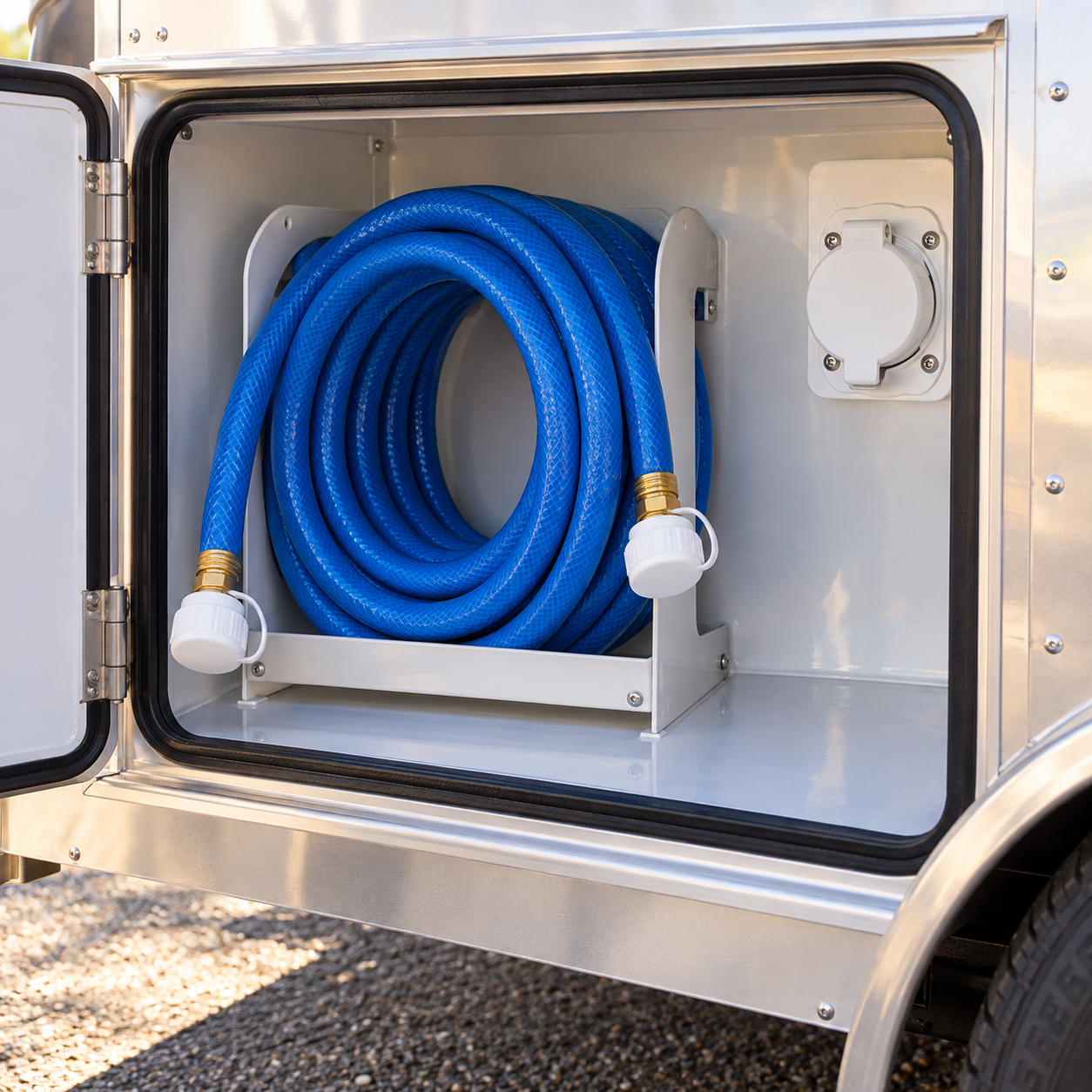
They keep environmental contamination away from parts that contact drinking water. FDA Food Code 2026 section 5-303.12 calls for a cap and keeper chain, closed cabinet, closed storage tube or other approved protective cover or device for the water inlet, outlet and hose. Section 5-304.13 says fittings should be protected when not in use. The details are mundane, which is exactly why crews can overlook them during a rushed shutdown.
Give the hose a cleanable compartment or container that is unmistakably for potable water. Cap both ends after draining and cleaning as directed by the hose maker. Store it away from the wastewater hose, used oil, cleaning chemicals, dirty tools and floor splash. A hose should not need to lie on the ground to fit in the box. If the storage space is so small that the hose kinks or its caps pop off, the design is not finished.
Where does backflow protection belong?
Backflow means water flows the wrong way, potentially carrying contaminants into the clean supply. The device or air-gap arrangement depends on the source, connection, pressure conditions and local plumbing rules. It is not enough to paste the words “backflow preventer” on a drawing. Ask the water provider or local authority which protection is required at the hose bibb and whether an additional device or installation detail is needed on the trailer side.
The FDA Food Code model addresses an air gap in section 5-202.13, device standards in section 5-202.14, and protection at points of use including hose bibbs in section 5-203.14. Section 5-304.12 requires the tank, pump and hose to be operated so backflow and other contamination are prevented. Albemarle’s regional document specifically requires a backflow-prevention device at one hose-connection bibb. The correct device type, certification, installation, inspection and testing belong to the applicable plumbing authority and qualified local professional.
How do you fill the tank at a commissary or event without contaminating it?
Make the procedure repeatable enough that a new employee can follow it. An approved source and clean hose matter, but so do the moments just before and after the connection. Use the site-specific procedure required by your regulator or water supplier; the sequence below is a practical design-and-training checklist, not a substitute for that procedure.
- Check the source. Confirm it is an approved potable-water point and that the required backflow protection is present and appropriate. Do not assume every outdoor spigot at a festival supplies drinking water.
- Inspect the hose. Check its identification, condition, fittings and caps. Remove a damaged or previously misused hose from potable service.
- Protect the ends. Keep couplings off the ground, out of puddles and away from waste handling. Follow the source operator’s flushing procedure if one applies.
- Connect clean to clean. Open the trailer inlet only when ready to connect. Avoid dragging the hose past wastewater equipment or grease bins.
- Fill and watch. Observe the inlet, overflow, tank level and any leaks. Do not leave a connection unattended when the site procedure requires supervision.
- Disconnect and protect. Close the source, relieve pressure as directed, drain the hose according to the manufacturer’s method, cap the ends and close the trailer inlet.
- Record exceptions. Note the source, operator, date and any damaged cap, questionable water, leak or unusual odor. Follow the local authority’s corrective-action instructions if contamination is suspected.
How should you label and sanitize the water line?
A durable label such as “POTABLE WATER ONLY” helps stop accidental reuse. Label the storage container too. Color coding can help a busy crew, but it is secondary to documented material suitability and clear identification. Keep the wastewater line separate and visibly different. Where other languages are used by staff, add a label they can understand.
For sanitizing, follow the hose and equipment makers’ instructions and the procedure your local authority accepts. FDA Food Code 2026 section 5-304.11 requires the water tank, pump and hoses to be flushed and sanitized before service after construction, repair, modification or a period of nonuse. It does not justify copying a random bleach recipe into every design. Chemical concentration, contact time, materials and rinsing requirements have to match the actual system and approved guidance.
Seasonal storage deserves a plan as well. A hose left with standing water in a hot compartment may develop odors and be hard to clean. In cold weather, a hose or fitting that freezes may crack. Drain and protect the line as its manufacturer instructs, inspect it before returning to service, and sanitize when required. The operator should know where the caps, replacement washers and spare approved hose are kept.
How do you avoid cross-connections with wastewater?
A cross-connection is any arrangement that could allow nonpotable liquid to reach a drinking-water system. In a mobile food business, that risk can be created by shared hoses, look-alike fittings, a fill line submerged in a contaminated container, or a potable hose stored with the waste hose. The preventive approach is both physical and procedural: different connection types, distinct compartments, protected ends, a clean servicing order, and staff training.
Albemarle’s mobile-unit guidance says servicing connections for waste disposal must differ in size or type from those used for potable-water supply. Its document also addresses the relative location of water and sewage systems. For a global buyer, the lesson is not to reproduce a North Carolina drawing everywhere; it is to ask whether your design makes a dangerous hookup possible. If the operator can accidentally connect the drinking-water hose to a waste fitting, redesign the fittings.
Our food trailer servicing-area design guide looks at the wider clean-water, wastewater and commissary workflow. This hose guide is the narrow companion: it focuses on the small transfer line, caps, inlet and source connection that crews handle every day.
What can a real ZZKNOWN model tell you about the water system?

Can the KN-YD230 be a starting point?
Yes—as a real product reference, not as a universal approved plumbing package. The KN-YD230 mobile coffee bar horse trailer page lists a 3 m × 2 m × 2.3 m body, a 24V/35W water pump and 25L/10L food-grade plastic clean/waste tanks in its published configuration. The page also cautions that materials and specifications vary by model.
Those numbers are the starting point for questions: Is that capacity enough for your menu and operating day? Where will the dedicated inlet sit? Is there clean hose storage? What fittings, protection and documentation will your local reviewer require? Do not assume a website photo proves an unshown inlet, hose or backflow device.
The KN-FR220H compact food trailer is another real published model whose product page describes a 120L fresh-water tank and 180L wastewater tank in one configuration. That contrast illustrates why hose and fill choices cannot be based on body style alone. Water demand, fill frequency, storage access and payload differ substantially. Confirm the exact current configuration with ZZKNOWN before ordering.
What should an engineer show on the water-connection drawing?
A good drawing should tell the manufacturer, buyer, operator and reviewer the same story. It should mark the source connection assumptions, required backflow-control point, hose specification and length, potable inlet and cap, tank and vent, pump, heater, fixtures, drain and wastewater outlet. It should also show cabinet access, separation from the waste route and the physical height of fittings. Include a note that the local authority and licensed plumbing professional will confirm the final compliance detail.
| Drawing item | What the buyer should provide | What to confirm before fabrication |
|---|---|---|
| Source and backflow control | Commissary/event water-point photo and local instructions | Accepted source, device or air-gap detail, installer and test requirements |
| Hose and couplings | Expected connection distance and site fitting | Documented drinking-water material, length, pressure/flow rating, identification and caps |
| Potable fill inlet | Preferred service side and parking orientation | Protected position, connection type, cap, cleanability and reach |
| Storage | Available side cabinet volume and operator routine | Cleanable protected space separate from waste and chemicals |
| Tanks and pump | Menu, crew, hours, sinks and refill frequency | Capacity, drainage, ventilation, access, payload and sanitizing method |
If the drawing is part of a larger food-safety package, see our HACCP-aware food trailer planning guide. For operational testing after build, use the food trailer pre-opening test guide. The model page, drawing and local review comments should agree before production is locked.
How were the facts and examples in this guide collected?
We used a source-first method. First, we checked the 2026 FDA Food Code PDF for sections 5-202.13, 5-202.14, 5-203.14, 5-302.15, 5-302.16, 5-303.12, 5-303.13 and 5-304.11–5-304.14, including its explanation of dedicated fill hoses. Second, we reviewed Albemarle Regional Health Services’ published mobile-food-unit requirements and pre-opening checklist as a clearly identified North Carolina example. Third, we checked ZZKNOWN’s public KN-YD230 and KN-FR220H product pages for real model names and published water-system parameters. We did not conduct water-quality testing, quote a hose supplier, or treat a generated illustration as project evidence.
The official documents establish a design reference, not an automatic permit in your market. A reviewer can ask for different components, documents or tests. Recheck current rules, manufacturer data and the approved drawing before purchasing or operating the trailer.
What do real buyers ask about potable-water hoses?
Can I use a brand-new garden hose if I wash it first?
Only if its manufacturer documents suitability for drinking-water use and your local authority accepts it. Cleaning does not change an unsuitable material into a potable-water-rated one. Dedicate an accepted hose to potable filling and identify it clearly.
Is an RV drinking-water hose automatically acceptable for a food trailer?
It may be a candidate, but “RV” on a package is not the final test. Check drinking-water material documentation, fittings, pressure and temperature ratings, cleaning instructions and your local regulator’s requirements.
Does a blue hose prove that it is food grade?
No. Color helps staff distinguish lines, but it does not prove material safety or prior use. Keep the product documentation and a durable potable-only label.
Do I need a backflow preventer at every event?
The exact device and location depend on the water point and adopted plumbing rules. Do not bypass a venue’s required protection. Ask the local water supplier, event operator or plumbing authority what is required for that connection.
Can the potable hose stay connected all day?
That depends on your approved operating plan, source conditions and local rules. If continuous connection is allowed, protect the hose from damage and contamination, confirm backflow control and avoid kinks or traffic routes.
Where should I store the hose between events?
In a cleanable, protected compartment or container, with both ends capped, separate from wastewater gear and chemicals. Let it drain or dry according to the manufacturer’s instructions before storage.
When do the hose and tank need sanitizing?
The FDA model calls for flushing and sanitizing after construction, repair, modification and periods of nonuse. Follow the applicable local rule and component manufacturers’ procedures; do not improvise a universal chemical recipe.
Can ZZKNOWN supply a ready-to-approve water connection?
ZZKNOWN can discuss a project-specific hose/inlet/storage layout and build to an agreed specification. No manufacturer can guarantee that a generic drawing will satisfy every destination authority. Share your menu, location, commissary connection and inspector comments before finalizing the design.
Want a water-connection drawing for your trailer?
Send ZZKNOWN your destination, menu, service duration, intended water-source photo and any health-department notes. Ask for a project-specific potable-water fill and hose-storage layout, with the fresh-water and wastewater routes shown separately.
Request a Water Connection DiagramExplore Food Trailer Models
Which official sources support this guide?
- U.S. FDA Food Code 2026, Chapter 5, sections on approved water plumbing materials, mobile tank inlets, hoses, covers, backflow and sanitization. FDA states that the Food Code is a model offered for adoption by jurisdictions.
- Albemarle Regional Health Services, Mobile Food Unit General Requirements, local North Carolina guidance on food-grade hoses, water inlets, protection, backflow and separate waste connections.
- Albemarle Regional Health Services, Mobile Food Unit Pre-Opening Checklist, which identifies a food-grade hose and cleanable storage container.