

Food Trailer Pre-Opening Inspection: How to Run a Full Operational Test
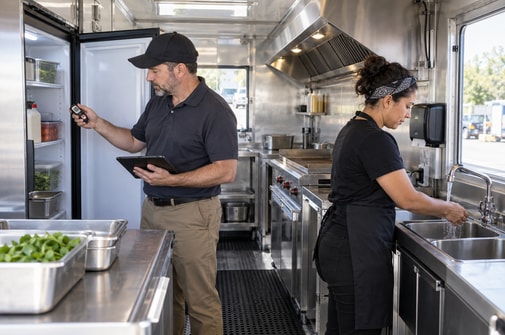
- An attractive finished trailer is not inspection-ready unless the systems function together.
- Test under realistic operating conditions, not just by flipping each switch for five seconds.
- Virginia's Blue Ridge Health District specifically requires refrigerators, steam tables, sinks, vent hoods and water heaters to operate at the pre-opening inspection.
- Record food temperatures, water and sink performance, sanitizer checks, power loads and corrective action.
- Do not claim that a factory test or product certificate guarantees a local permit.
Why is a pre-opening inspection more than a visual check?
Imagine the appointment starts at 9 a.m. The trailer paint is fresh, the stainless counters shine and the menu board looks great. Then the inspector opens the refrigerator. The digital display says “cooling,” but the cabinet is still warm because someone powered it up only ten minutes ago. At the hand sink, the pump runs, but no water comes out because the tank valve is closed. Neither problem is dramatic. Both can stop a launch.
A pre-opening inspection asks whether the operation you intend to run can actually protect food and people. Construction, equipment, water, waste, temperatures, cleaning and operating procedures must fit the approved plan. Your local inspector may not perform every test described below, and requirements change by menu and jurisdiction. A rehearsal still makes sense: it exposes weak links before they become an inspection-day surprise.
Virginia's official mobile foodservice permit guide is unusually direct. Its pre-opening step says the unit must be clean and that refrigerators, steam tables, sinks, vent hoods and water heaters must be operating. It also names working thermometers, sanitizer and test kit when a three-compartment sink is present, a hand sink with soap and disposable towels, and approved equipment. That is a regional example, not a universal global checklist, but it captures the meaning of “ready.”
What should you do before scheduling the appointment?
Read the approval letter and compare the built unit with the plans. If you moved a sink, changed a fryer, substituted a refrigerator or revised the menu, tell the authority instead of hoping the difference goes unnoticed. A factory drawing is a planning document; the relevant agency decides what must be installed and what it will accept.
Gather your permit application, approved plan set, equipment model list, commissary or service-area agreement where required, food-safety manager credentials and any fire, plumbing or electrical documents the local process calls for. Virginia's guidance requires plans to show equipment types and model numbers, materials, finishes and side views of electrical and plumbing installations. It also requires an approved service area for potable-water filling and wastewater disposal. The exact paperwork in your city may differ.
What does “fully operational” mean in a mobile kitchen?
It means each required system works in the combination and conditions in which you will actually use it. A refrigerator that runs on factory power but trips your event generator is not operational for that event. A sink that flows when the tank is full but sputters after 20 minutes of use is not ready for a full shift. A hood that spins but lacks its required filters or approved fire protection may still be incomplete.
For buyers, a good test follows the menu. A coffee trailer should test espresso-machine supply, milk refrigeration, ice and handwashing. A burger trailer should test cold holding, griddle or fryer, hot holding, hood, warewashing and grease-handling workflow. A dessert trailer needs each refrigeration zone checked separately. This is why ZZKNOWN starts with the menu and equipment schedule when discussing a custom food trailer.
| System | Quick switch-on test | Useful operational test | Evidence to keep |
|---|---|---|---|
| Refrigeration | Light and compressor come on | Pre-chill, measure cabinet and representative food temperatures; watch door-open recovery | Time-stamped temperature log, thermometer ID |
| Water and hand sink | Pump makes noise | Run hot/cold water at each required sink; confirm soap, towels, drainage and no leaks | Flow/leak checklist, heater setting |
| Warewashing | Faucet reaches sink | Wash–rinse–sanitize sequence or approved machine cycle; test sanitizer concentration | Test-strip result, procedure and equipment model |
| Hood and cooking | Fan spins, appliance heats | Operate planned appliances under ventilation; check filters, smoke capture and safe clearances | Equipment list, service and fire documents |
| Hot holding | Display lights up | Preheat and verify food temperature in normal service containers | Probe readings and corrective-action record |
| Power | Lights illuminate | Run realistic simultaneous load on intended supply without nuisance trips | Voltage, frequency, circuit and load sheet |
| Wastewater | Tank is installed | Fill/use sinks, check drain path, tank capacity, outlet and approved disposal arrangement | Service-area agreement and leak checklist |
How should you test refrigeration and food temperatures?
Power the trailer early enough for the refrigerators and freezers to stabilize. The Blue Ridge Virginia guide states that refrigerators must be set so food is maintained at 41°F or lower and freezers at 0°F or lower, with working thermometers in each unit. Treat those as Virginia example values; your adopted code and product requirements control in your market. A cabinet display is useful, but verify with a separate food thermometer or logger if your plan requires it.
Check every zone. A two-temperature refrigerator, ice cream display and cake display are three different systems, not one “cold storage” checkbox. Measure a representative product where safe, or use a suitable test load under your operating procedure. Note the reading, time, ambient conditions and door activity. If a cabinet is too warm, do not merely lower the setpoint and assume it is solved; inspect loading, airflow, door seals, condenser ventilation, electrical supply and the unit's actual cooling capacity.
For a deep dive into independent zones and alarms, read the food trailer temperature-monitoring guide. It explains why a single sensor cannot necessarily represent all cold compartments and why a temperature record is useful only when the operator knows what to do with an out-of-range reading.
How do you prove the hand sink and warewashing work?
Fill the fresh-water tank from the approved source and set up the wastewater path as you would on a normal day. Open every faucet, not just the one closest to the pump. Confirm that hot and cold water are available where the local rules require them, the water heater has recovered after repeated use, and wastewater remains contained. The handwashing sink should be accessible while equipment and supplies are in place, with soap and disposable towels ready.
If your approved plan includes a three-compartment sink, check the physical wash–rinse–sanitize workflow. Are the basins large enough for the utensils actually used? Does the faucet reach each compartment? Can the crew drain and refill without soaking a clean prep area? Is the sanitizer appropriate, and does the test kit give a readable concentration? Virginia specifically names a sanitizer/test kit when the three-compartment sink is present. Elsewhere, mechanical warewashing or an off-unit arrangement may be allowed or required—ask locally, do not substitute a dishwasher without written approval.
Run the sinks long enough to see whether the wastewater tank fills faster than expected. If the pump cycles oddly or the heater cannot keep up, record it for correction. The prior food trailer servicing-area guide explains why the onboard test must be connected to an approved daily water-fill and wastewater-disposal plan.
What should you check when the hood and cooking equipment run?
Start the hood, then run the exact cooking appliances on your menu where it is safe and permitted to do so. Observe whether steam and cooking fumes move toward the capture area rather than toward the serving window or crew. Verify clean filters, accessible controls, lighting and the installation details on the approved plan. Do not attempt a fire-suppression discharge as a casual DIY test; the qualified installer and fire authority control commissioning and any acceptance test.
Cooker, fryer, gas line, electrical circuit, hood and fire protection must be evaluated as one system. An appliance substitution can change ventilation and suppression requirements. For design coordination, see our make-up-air guide, fire-safety guide and LPG system guide. None of these articles is a substitute for a licensed local installer or fire inspection.
How do you test power without risking a shutdown?
Use the power supply you actually plan to use: the approved shore connection, generator or other arrangement, with the correct voltage and frequency. Read every equipment data plate and calculate both steady and startup loads. Refrigeration compressors, water heater, hood, air conditioner, POS and cooking equipment can overlap during a real rush. Run the normal combination and watch for voltage sag, breaker trips, excessive cord heating or equipment alarms. A qualified electrician should review concerns; do not bypass a breaker to “make the test pass.”
Do the same with backup power if it is part of your operating plan. A generator box on a product photo is not proof that any generator will safely run the trailer. Record the exact generator, inlet, transfer arrangement and permitted fuel storage. If your destination uses a different electrical standard from the source factory, specify it before fabrication.
What can a real ZZKNOWN model illustrate?
The real KN-QF500 ice cream and bakery trailer is a useful example because it has several systems that must work at once. Its published specification describes a 5 m × 2 m × 2.3 m dual-axle unit, 110V/60Hz U.S.-standard power, a 2 m dual-temperature refrigerator, ice cream display cabinet, cake display refrigerator and a removable generator box. These are product-page facts, not a claim that this unit passed a particular health inspection.
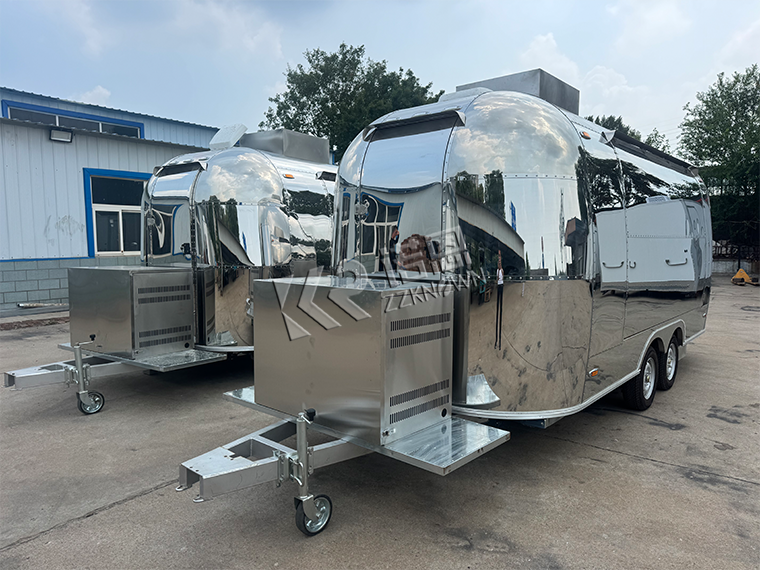
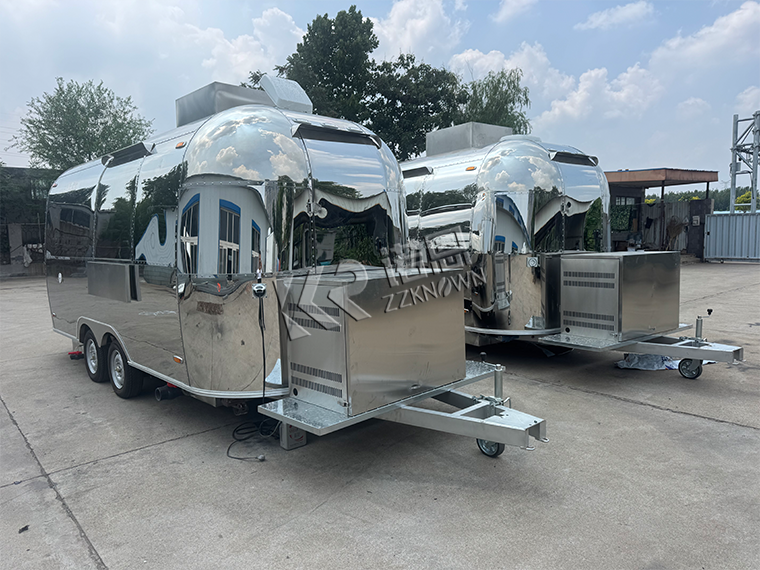
For a pre-opening rehearsal, the buyer would test every cold zone independently, start all units together on the intended power supply, run sinks and water heater, verify handwashing supplies, inspect drains and confirm the approved menu process. If the local regulator wants a hood, fire protection or different sink arrangement for a different menu, the new order should reflect that decision. The published KN-QF500 technical example provides further equipment context.
What should you record in a two-day rehearsal?
A one-hour run is better than nothing, but a two-day plan gives cold storage and recurring faults a chance to reveal themselves. On day one, complete construction and paperwork checks, connect utilities, fill tanks, start refrigeration and identify leaks or nuisance trips. On day two, perform a realistic service simulation with the planned crew and representative equipment load. The exact duration is a planning recommendation, not a legal minimum.
| Test stage | Record | If it fails | Who should review it? |
|---|---|---|---|
| Cold start | Cabinet temperatures and time to stabilize | Check power, airflow, seals and setpoint; re-test after repair | Equipment technician and operator |
| Simulated rush | Food probe readings, equipment load, door openings | Change workflow or equipment capacity; do not hide the result | Operator, health reviewer where needed |
| Repeated sink use | Hot/cold flow, heater recovery, tank levels, leaks | Correct pump, heater, plumbing or capacity | Plumber and trailer engineer |
| Cooking and hood | Appliances operated, hood status, observed capture | Stop unsafe operation; consult qualified hood/fire contractor | Mechanical/fire professional |
| Shutdown and service | Waste disposal, cleaning, restocking, temperature hold | Revise commissary process or access layout | Operator and health authority |
Use a simple log with date, location, unit ID, equipment model, result, person checking, corrective action and re-test. Photos can support a discussion, but they cannot replace measurements or official sign-off. When an agency specifies its own inspection forms, use those forms first.
Which common failures should you catch before the inspector arrives?
- Refrigerator powered on too late, with no stable temperature evidence.
- Thermometer missing, flat battery or disagreement with cabinet display.
- Fresh tank empty, pump dry, water heater off or hand sink blocked by supplies.
- Soap, towels, sanitizer or test strips missing or expired.
- Waste tank nearly full, outlet inaccessible or drain leaking.
- Appliance plugged into an improvised extension cord rather than the approved circuit.
- Hood filter missing, fan switch unlabeled or equipment moved outside its capture zone.
- Equipment brand/model different from the reviewed plan without notice.
- Commissary agreement or food-safety manager certification not available.
- Exterior decals or required permit documents not ready for the local process.
It is tempting to see these as “small” errors. The better view is that each one is a break in the operating chain. Finding it yourself a week early gives you time to fix it without the pressure of a missed opening date.
How were the claims in this guide checked?
Data collection method: On September 16, 2026, we reviewed Virginia Department of Health's Blue Ridge mobile permit instructions, the FDA's current 2022 Food Code page, Clark County Washington's public mobile-unit plan proposal, and Oregon's published food-sanitation rules for plan review/pre-operational inspection. We compared the public KN-QF500 model and project photos with the systems those official sources discuss. Operational-test suggestions are engineering and operator planning advice, not quotations from those rules.
Evidence boundary: Virginia values and steps are regional examples. FDA Food Code is a model that jurisdictions may adopt or modify. Product parameters may vary by order. No statement here promises local approval, exact test duration or a universal checklist. Confirm current requirements with the authority having jurisdiction, qualified trades and the final signed build specification.
What do real buyers ask before a pre-opening inspection?
1. Can I arrive with the refrigerator switched off?
That is risky. Virginia's official guidance expects refrigeration to operate and maintain the specified food temperature. Power the unit early enough to stabilize and follow your own authority's inspection instructions.
2. Does an empty refrigerator reading prove food will stay cold?
Not by itself. Real products, door openings, ambient heat and compressor loading change performance. Test representative conditions and use an approved food-temperature procedure.
3. Will the inspector test the handwashing sink?
It depends on local practice, but you should assume every required sink must function. Verify water, drainage, access, soap and towels before the appointment.
4. Can I use a household refrigerator if it reaches 41°F?
Not automatically. Virginia's Blue Ridge instructions state home-style equipment is not allowed and require approved NSF or equivalent equipment. Other jurisdictions have their own equipment standards; confirm before purchasing.
5. Should I run a fire-suppression discharge myself?
No. Commissioning and acceptance testing belong to the qualified installer and fire authority. Ask what documentation or functional check is required and arrange it professionally.
6. Can a factory test replace my local pre-opening inspection?
No. Factory testing is valuable evidence for the build, but local inspection evaluates the installed unit, approved menu, site utilities and jurisdiction-specific rules.
7. What if an appliance model changes after plan approval?
Tell the reviewing authority. A substitute can affect electrical load, refrigeration capacity, ventilation, fire protection and clearances. Update drawings and documents if required.
8. What should I send ZZKNOWN for an inspection-ready proposal?
Send your destination, menu, equipment models, local checklist, approved plan-review notes, power standard, service-area agreement and launch timetable. ZZKNOWN can prepare a project-specific 2D/3D layout and quotation for regulator review before production.
Where can you check the official sources?
- Virginia Department of Health — Applying for a Mobile Foodservice Permit
- U.S. FDA — Food Code 2022
- Clark County, Washington — Mobile Food Unit Plan Proposal
- Oregon Health Authority — Food Sanitation Rules
- U.S. FDA — State Retail and Food Service Codes Directory
Want a food trailer layout you can actually test?
Tell ZZKNOWN what you will cook, where you will operate and which pre-opening checklist your local authority uses. We can prepare a menu-based equipment layout and project-specific quotation with test access, power, refrigeration, water and ventilation planned before production.
Request a Layout and QuoteExplore Real Trailer Models