




Alabama Food Truck Inspection Rules 2027: What Changes on January 1?
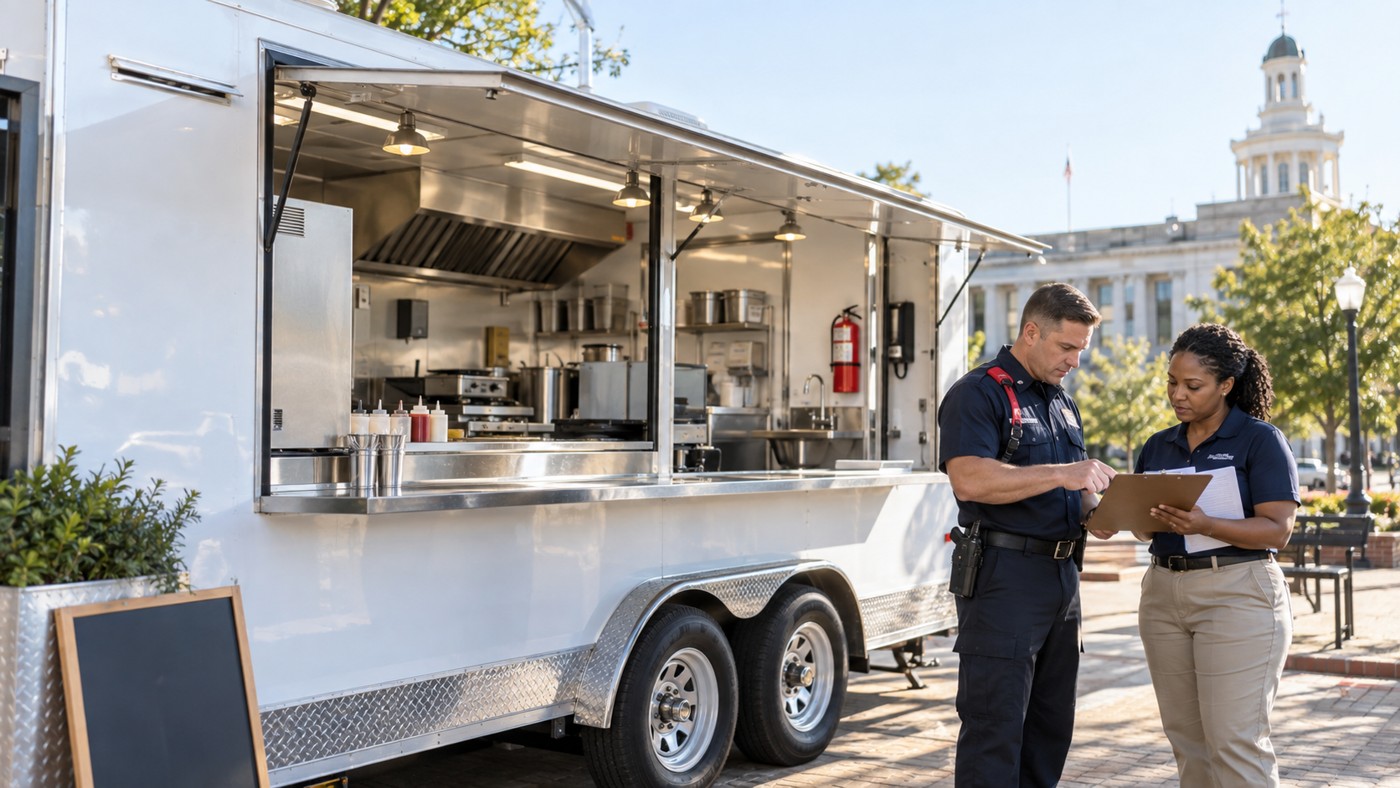
- The Act itself became effective July 1, 2026, but its new operating and certificate provisions apply on and after January 1, 2027.
- The health inspection is tied to the county where the unit's permitted commissary is located.
- The fire certificate must come from the State Fire Marshal or an authorized local fire department and is valid for six months.
- Officials may still inspect an operating unit and stop it for a significant health or life-safety violation.
- Local governments may still enforce other ordinances, including business-license requirements.
- Equipment or safety-system modifications may void the fire certificate, so update records before changing the kitchen.
What exactly changes on January 1, 2027?
Picture a barbecue trailer based at a permitted commissary near Birmingham. The owner books lunch in one county, a festival in another and a private event in a third. Under the older system, crossing a jurisdiction line could create another health or fire inspection requirement before the unit was allowed to operate there. That is the practical problem Alabama's new law is designed to reduce.
Act 2026-398, enrolled as SB197, says that on and after January 1, 2027, a mobile food unit holding a valid health inspection certificate and a valid fire inspection certificate under the Act is exempt from further health or fire safety inspections that a county, municipality or political subdivision would otherwise require as a condition of operating in that jurisdiction.
In plain English: one qualifying health certificate and one qualifying fire certificate are meant to travel with the unit across Alabama. You should no longer have to repeat the same entry inspection in every city just because the venue changes. However, the law does not make the trailer invisible to regulators. A county health department or certifying fire official may inspect the unit while it is operating and may order an immediate shutdown if a significant health or life-safety violation is found.
Is this a statewide food truck permit?
No. Think of the new system as statewide recognition of two inspection certificates, not a single document that replaces every government requirement. The Act expressly says local governments may still require compliance with other ordinances or regulations, including a business license. Depending on the location, a vendor may also need to deal with zoning, parking, event permission, fire-lane placement, sales tax, signage, hours of operation and private-property authorization.
This distinction matters when you budget and schedule a launch. A buyer might hear “statewide inspection” and assume one trip to an inspector clears every remaining step. That is not what the statute says. The safer planning question is: “Which repeated health and fire inspections does the new certificate replace, and which non-inspection permissions still apply at my destination?” Ask that exact question in writing.
| Requirement | Who is connected to it? | What changes in 2027? | What should the operator verify? |
|---|---|---|---|
| Health inspection certificate | County health department where the permitted commissary is located | Qualifying certificate is recognized for the Act's statewide inspection-reciprocity purpose | Certificate form, renewal period, commissary status and food permit steps |
| Fire inspection certificate | State Fire Marshal or an authorized local fire department | Qualifying certificate can replace repeated local entry fire inspections; certificate lasts six months | Authorized inspector, appointment process, tags, test records and expiration date |
| Operational inspection | County health department or certifying fire official | Still possible while the unit operates | Keep the unit continuously compliant, not just inspection-day ready |
| Business license | County or municipality | Not abolished by Act 2026-398 | City/county license, fees and renewal |
| Zoning, parking and event rules | Local government, event organizer or property owner | Not automatically replaced | Approved location, setbacks, fire access, operating hours and written site permission |
| Food permit and commissary relationship | Alabama public-health system and county department | The Act relies on a permitted commissary; it does not erase food-safety regulation | Current commissary agreement, daily servicing plan and permit status |
Where does the health inspection start?
The new law connects the health inspection to the county health department in the jurisdiction where the unit's commissary is located. That makes the commissary more than a mailing address. Under the Act, it is a food service establishment permitted by the Alabama Department of Public Health to which the mobile unit returns after operating for servicing and resupplying.
Alabama's existing mobile food establishment rule describes daily commissary use for supplies, cleaning and servicing. It also discusses an accessible handwashing sink with soap, towels and hot and cold water, unit identification, water and wastewater planning, food storage and a drawing submitted with plan review. Operators should watch for official updates that reconcile older county-by-county language with the 2027 statute.
The current Alabama mobile unit plan-review application asks for a commissary agreement, proposed plans drawn to scale, plumbing, lighting, electrical and ventilation schematics, tank sizes and locations, sinks, storage, servicing area, equipment specification sheets, a plan of operation and a proposed menu. If you are ordering a trailer now, those documents are a smart starting package even if the department later changes the certificate workflow.
What will the statewide fire inspection look for?
The Alabama State Fire Marshal must maintain a list of local fire departments authorized to conduct inspections under the new system and establish a uniform statewide fire-safety process. The State Fire Marshal regulations page already lists Act 2026-398 under Mobile Food Vendors, which gives buyers a reliable place to watch for new forms and implementation details.
The statute names minimum fire-inspection subjects. Hoods and hood-suppression systems must comply with NFPA 96 requirements referenced by the Act. Suppression systems must be serviced and tagged at least every six months, and hood cleaning must also be performed and tagged at least every six months. LP-gas systems must comply with NFPA 58 and the applicable IFC mobile-food provisions. The Act also calls for an annual LP-gas pressure test by a gas fitter certified by the Alabama Liquefied Petroleum Gas Board, compliant LP-gas plumbing and electrical appliances that comply with NFPA 70.
Those are not decoration-list items. They create a maintenance calendar. A beautiful hood with an expired service tag is a problem. A gas line without the required pressure-test record is a problem. An appliance added after inspection without updating the safety design can be an even bigger problem because the Act says a modification to an appliance, operating procedure or safety equipment may void the fire certificate.
If your menu uses fryers, griddles or other grease-producing equipment, coordinate the hood, suppression coverage, gas shutoff, electrical load and appliance position as one system. Our food trailer fire-safety guide and food trailer LPG system guide explain the engineering questions to discuss with qualified Alabama installers and your fire authority.
Which fire records should travel with the trailer?
Act 2026-398 requires the mobile food unit to maintain and make available equipment and maintenance records. Build a small inspection binder and a secure digital backup instead of searching through old emails while an inspector waits.
- Current fire inspection certificate and expiration date.
- Hood-suppression service tag and service report.
- Hood-cleaning tag and invoice or report.
- Annual LP-gas pressure-test record and the gas fitter's qualification details.
- Appliance model and serial-number list.
- Electrical load schedule and panel/circuit identification.
- LPG diagram showing cylinders, regulator, shutoff valves and appliance branches.
- Fire extinguisher service records, where required.
- Change log for appliance, fuel, electrical, ventilation and suppression modifications.
- Photos of labels and installed locations, used as supporting evidence rather than a substitute for official records.
How long is the fire certificate valid?
The law says the fire inspection certificate is valid for six months. Put the expiration date on your operations calendar and start arranging renewal before the final week. Do not assume that a six-month service tag, hood-cleaning tag and fire certificate will always share the same date; track each item independently.
The statute does not give the same simple six-month sentence for the health certificate in the text reviewed for this article. That is why we do not guess a statewide health-certificate term here. Ask the commissary county health department what form, renewal frequency and associated food permit schedule will apply to your unit.
Can an inspector still stop your food truck?
Yes. Reciprocity is not immunity. The Act allows a county health department or certifying fire official to inspect a mobile food unit at any time while it is operating. If a significant health violation or life-safety violation is discovered, the official may order the unit to cease operations immediately. It also preserves action where an official reasonably believes there is an immediate risk to public health or safety.
That means the real goal is continuous readiness. Water must be available after the festival rush, not only at the morning check. Cold holding must work during Alabama heat, not only inside a mild factory. Hood filters, suppression coverage and propane components must remain in their approved condition. Keep daily opening and closing checklists, temperature logs and maintenance records that your team actually uses.
What happens if you operate without both certificates?
On and after January 1, 2027, the Act states that an owner who operates—or allows operation—without the required valid health and fire inspection certificates commits a Class C misdemeanor. A second or later violation brings a 30-day prohibition on operating the mobile food unit. Because enforcement details matter, talk with an Alabama attorney or the responsible agency if you have a specific compliance question.
The practical lesson is simple: do not treat the new law as a relaxed-inspection shortcut. It makes valid certificates more portable, while also making it very clear that operating without both documents has consequences.
What should be decided before a manufacturer draws the layout?
Start with the menu, not the trailer shell. Fried chicken and coffee create very different ventilation, gas, electrical, refrigeration and warewashing demands. Send your manufacturer the destination, commissary county, planned operating cities, full equipment list and any written directions from the health and fire authorities.
Then ask for a layout that can be reviewed before metal is cut. The ZZKNOWN OEM/ODM process can support menu-based 2D or 3D planning, but the Alabama authorities—not the overseas manufacturer—decide whether the final configuration is acceptable.
| Design item | Buyer input needed | Drawing or record to request | Why it matters for inspection |
|---|---|---|---|
| Cooking line | Exact appliance models, fuel and menu | Dimensioned equipment layout | Connects hood coverage, suppression, clearances and workflow |
| LP-gas system | Cylinder arrangement and appliance demand | Gas schematic with valves and regulator details | Supports qualified installation, testing and maintenance review |
| Electrical system | Voltage, frequency and appliance ratings | Load sheet, panel schedule and outlet plan | Helps prevent undersized circuits and undocumented changes |
| Water and sinks | Menu, utensils, service duration and commissary plan | Fresh/waste tank sizes and plumbing schematic | Supports handwashing, warewashing and servicing review |
| Ventilation | Heat and grease output of cooking appliances | Hood size, exhaust route and make-up-air concept | Supports safe capture and fire-system coordination |
| Service access | Maintenance intervals and component locations | Access-panel and equipment-clearance plan | Makes inspection, cleaning and repair possible |
What can the real ZZKNOWN KN-FS410 illustrate?
The real ZZKNOWN KN-FS410 custom square food trailer is a useful planning example for an Alabama-style full kitchen. Its published product page describes a 4.1 m × 2.15 m × 2.35 m dual-axle trailer with a 110V/60Hz electrical system, separated breakers, 2+1 stainless-steel sink arrangement, 120-liter fresh-water tank, 180-liter wastewater tank, 2.3-meter hood, ceiling air conditioner, gas branches with individual valves, generator platform and equipment positions for a griddle, fryer, claypot stove, BBQ grill and refrigeration.
Those facts demonstrate the level of detail a buyer can bring to plan review. They do not mean the displayed model is automatically Alabama approved. The final menu, listed equipment, local code interpretation, suppression design, certified gas work, electrical work, documents and inspection determine acceptance.


What should Alabama buyers do between now and January 2027?
- Confirm the commissary. Verify that it is permitted in Alabama and ask the county health department how it will handle the new health certificate.
- Map every operating city. List business-license, zoning, parking and event requirements separately from health and fire inspections.
- Freeze the menu and equipment schedule. Late appliance changes can affect the hood, suppression, LPG, electrical load and certificate validity.
- Ask for the authorized fire-inspector process. Monitor the State Fire Marshal's list and appointment instructions.
- Build the record binder. Gather service tags, test reports, diagrams, equipment data and change records.
- Run a full operational test. Use actual shore power or generator conditions, fill water tanks, heat water, cool refrigerators and operate the cooking line safely.
- Calendar renewals. Track the six-month fire certificate, hood-suppression service, hood cleaning, annual LP-gas pressure test and any separate health schedule.
- Carry certificates to every venue. Keep physical and secure digital copies available for inspection.
How were the claims in this guide checked?
Data collection method: On September 17, 2026, we reviewed the Alabama Legislature's enrolled SB197 text, the Alabama State Fire Marshal regulations page, Alabama Department of Public Health food-and-lodging materials, the state mobile-unit plan-review application and Alabama Administrative Code Rule 420-3-22-.09. We compared those public requirements with the published KN-FS410 product specification and separated legal text from manufacturer planning advice.
Evidence boundary: Act 2026-398 is the controlling source for the new reciprocity framework described here. Existing administrative rules and forms may be updated during implementation. Product examples show design and documentation possibilities only; they do not prove local approval. Costs, processing time, inspection forms and health-certificate duration should be confirmed directly with the responsible agencies.
What do real buyers ask about Alabama's 2027 rules?
1. Will one Alabama inspection let me sell in every city?
The qualifying health and fire certificates address repeated health and fire inspections. They do not automatically grant permission to vend everywhere. Check business licenses, zoning, parking, event and property rules for each destination.
2. Which county performs the health inspection?
The Act says the county health department in the jurisdiction where the mobile unit's commissary is located conducts the health inspection and certification described by the law.
3. Can any fire department issue the statewide fire certificate?
No. The inspection must be conducted by the State Fire Marshal or a local fire department authorized under the Act. Use the State Fire Marshal's official list when it becomes available.
4. How often will I need a fire inspection?
The fire inspection certificate is valid for six months. Hood-suppression service and hood cleaning are also listed at six-month intervals, while the LP-gas pressure test is annual. Track each due date.
5. Can I change a fryer after the fire inspection?
Do not make the change casually. The Act says a modification or alteration of an appliance, operating procedure or safety equipment may void the fire certificate. Ask the certifying official and update drawings and system coverage first.
6. Does the new law remove the commissary requirement?
No. The law defines and relies on a permitted commissary. Existing ADPH rules also describe daily commissary servicing. Confirm the exact arrangement with your county health department.
7. Can an inspector enter my unit after I have both certificates?
Yes. Officials may inspect while the unit is operating, and they may stop operations for a significant health or life-safety violation or address an immediate risk.
8. What should I send ZZKNOWN before requesting a quote?
Send your menu, Alabama commissary county, operating cities, appliance models, fuel choice, power source, local plan-review packet, desired trailer size and launch date. ZZKNOWN can then prepare a project-specific layout and quotation for your local review.
Where can you read the official Alabama sources?
- Alabama Legislature — SB197 Enrolled / Act 2026-398
- Alabama State Fire Marshal — Regulations and Mobile Food Vendors
- Alabama Department of Public Health — Food and Lodging
- ADPH — Mobile Unit Plan Review Application
- Alabama Administrative Code — Rule 420-3-22-.09 Mobile Food Establishments
Planning to operate across Alabama?
Send ZZKNOWN your menu, equipment list, commissary county and the latest Alabama review documents. We can prepare a menu-based 2D/3D layout, utility plan and project quotation for discussion with your health and fire authorities before production.
Request an Alabama Layout and QuoteExplore Square Food Trailers