Published: October 22, 2026 | Last Updated: October 22, 2026 | Data scope: Global buyer planning, with U.S. FDA 2026 and local U.S. examples | Author: ZZKNOWN Editorial Team | Technical review: No named engineer is claimed as having reviewed this article. Final project and operating procedures need qualified local review.
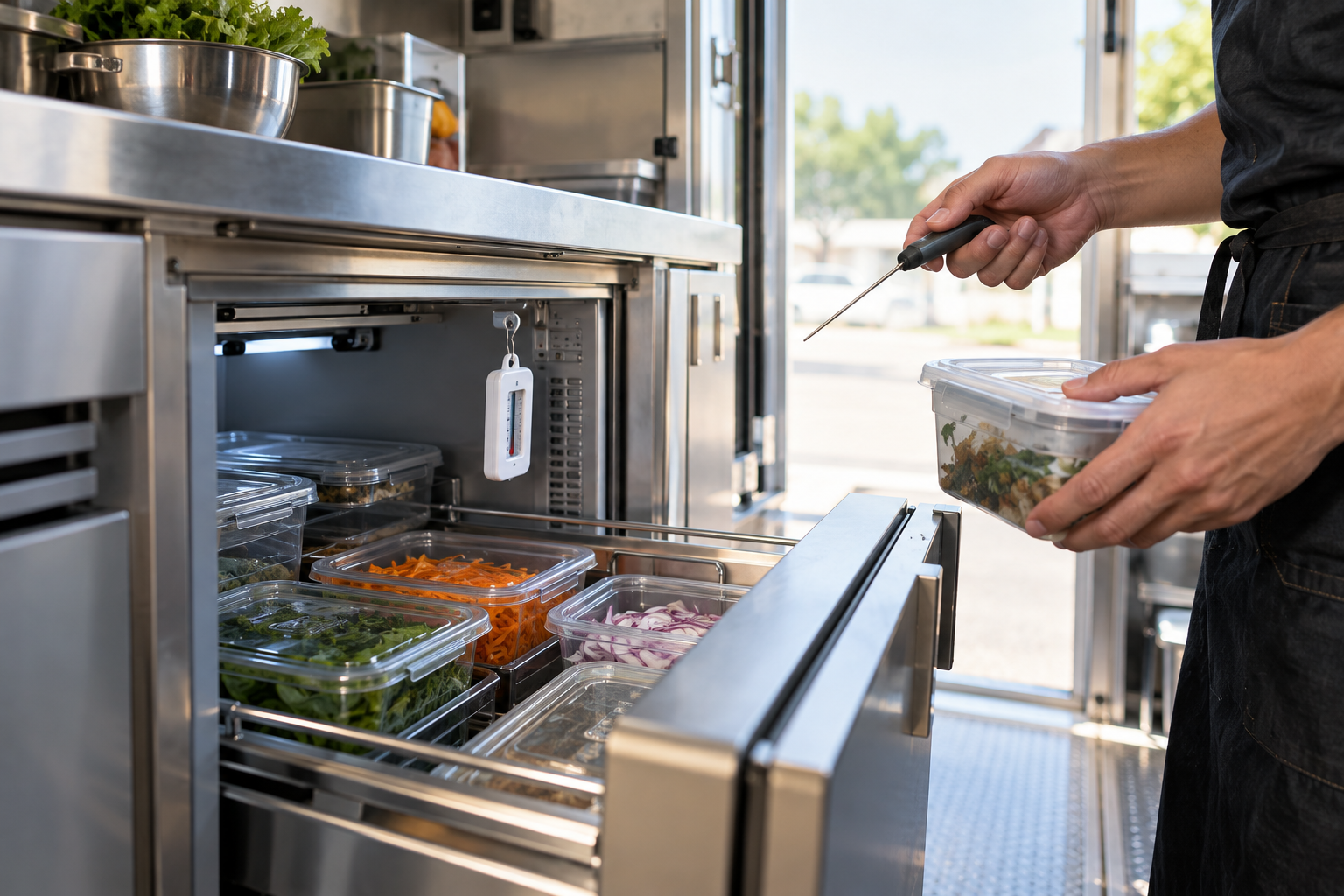
Direct answer: Put a readable refrigerator thermometer where it represents the warmest food-storage area, not beside the cold-air outlet. In a hot-holding unit, measure the coolest area. Use a separate, accurate food probe to check the food itself, because cabinet air and food temperature are not interchangeable. Check each independent compartment, document meaningful readings, and confirm the adopted rules with the authority where the trailer will operate.
Picture the start of a busy festival shift. The under-counter display says 37°F. The door has been opened every few minutes while the team builds sandwiches. A pan of chicken sits in the front corner, close to the gasket, and the cooling fan is at the back. The display may be telling the truth about its own sensor. It is not necessarily telling you the temperature of the chicken—or even the warmest spot inside that cabinet.
Now picture the opposite problem at the hot station. A steam table is switched on, the display glows, and the first tray looks fine. The tray farthest from the heating element may be cooler. Without a suitable food-probe check, the operator is guessing. The practical lesson is simple: decide which temperature each instrument measures before deciding whether a number is acceptable. This is the part that tends to be missed when buyers ask only for a “digital thermostat” in an equipment list.
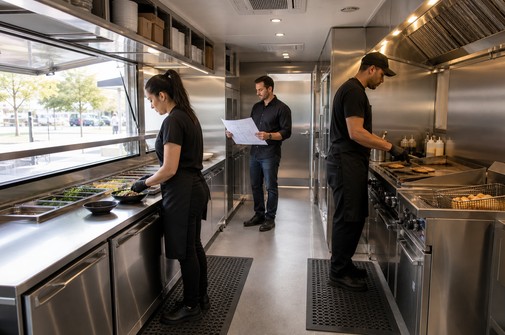
Based on ZZKNOWN's production-planning experience, thermometer access belongs on the layout drawing alongside door swing, refrigeration ventilation, hand-sink access, and the power schedule. A probe hidden behind cartons or a gauge visible only after unloading a drawer will be ignored during a rush. A thermometer that can be read and maintained without disrupting food storage is more useful than one added at the last minute.
The 2026 FDA Food Code is the newest FDA model edition as of this update. It is guidance for adoption by jurisdictions, not an automatic operating permit in every U.S. city and certainly not a worldwide regulation. Section 3-501.16 generally gives a 41°F (5°C) cold-holding limit and 135°F (57°C) hot-holding limit for TCS food, while listing exceptions. The site, menu, food type, and adopted local code still determine the actual requirement.
| What are you checking? | Official example | Which instrument answers it? |
|---|---|---|
| Cold-held TCS food | FDA 2026 model: generally ≤41°F / 5°C | A calibrated food probe verifies the product; a cabinet thermometer helps monitor the unit. |
| Hot-held TCS food | FDA 2026 model: generally ≥135°F / 57°C | A food probe checks the actual holding pan, including the coolest likely portion. |
| Frozen food | FDA 2026 model §3-501.11: maintain stored frozen food frozen; it does not set one universal freezer number here. | A freezer thermometer or logger tracks cabinet performance; check actual product condition. |
| Placement | FDA 2026 model §4-204.112: warmest part of refrigeration; coolest part of hot storage. | Position the sensor to represent food-storage conditions, and keep the display easy to read. |
These are U.S. model-code reference points, not guaranteed limits for every destination. The table is a planning comparison, not a certification or an equipment price quote. Read the official 2026 Food Code PDF and your destination authority's adopted rules before finalizing procedures.
Start with the actual loaded cabinet, not an empty showroom unit. The FDA 2026 Food Code §4-204.112 says the sensor in a mechanically refrigerated food-storage unit should measure air temperature or simulated product temperature in the warmest part. Its explanatory annex warns that placing the device in the coldest location may hide food stored above the required limit. That is why a dial touching the cooling coil or hanging directly in the supply-air stream is a poor witness for the rest of the cabinet.
The “warmest part” is not always a fixed left, right, top, or bottom shelf. It can change with the evaporator location, airflow path, door openings, product load, ambient heat, and whether a drawer is partly blocked. During commissioning, let the loaded cabinet stabilize, compare readings at likely warm spots, and record where the representative sensor is placed. Leave space around it so it is not buried behind cartons. Keep it away from direct contact with a cold metal wall, dripping condensation, or a splash-prone food container. Follow the thermometer and refrigerator manufacturers' installation instructions as well as local inspection guidance.
For a prep refrigerator, check both the enclosed cabinet and any upper refrigerated rail if they have different exposure or controls. A salad rail can warm faster when lids are open; a lower cabinet display does not verify the top pan. For drawer systems, note that drawers at different heights and distances from the refrigeration outlet can behave differently. If compartments can run at different setpoints, treat them as separate zones. Ask the local inspector whether a particular built-in display satisfies the visible-thermometer requirement or whether an additional hanging device is expected.
As a planning rule, yes: a reading for one cabinet should not be used to represent another. The 2023 Clark County mobile food unit plan proposal specifically asks whether all refrigerators have a hanging thermometer inside and says to obtain one before the preopening inspection if not. That is a local form, not a global command for the exact hardware style everywhere. The FDA model separately addresses installed devices in hot and cold holding equipment, with exceptions for designs where an ambient-air device is impractical. Confirm your actual destination's approach before buying or installing equipment.
Do not assume that a dual-temperature worktable has only one chamber. If one side is a freezer and the other a refrigerator, label them separately in the equipment schedule. The same applies to an ice-cream display, cake case, drink cooler, and refrigerated ingredient rail. A drink-only cooler holding non-TCS sealed beverages may not carry the same food-safety risk as a cabinet storing dairy or cooked meat, yet it still needs a realistic performance check for quality and maintenance. A menu-driven equipment map keeps this distinction clear.
The 2026 FDA model says stored frozen food should be maintained frozen; it does not turn one single freezer-air number into a universal rule in §3-501.11. Operators often use a manufacturer-specified setpoint for product quality, but that setpoint is not interchangeable with a legal food-temperature limit. Choose a freezer-rated thermometer or sensor, make its display accessible, and look for patterns such as an open door, a failed gasket, heavy frost, or slow recovery after restocking.
If a trailer has a combination refrigerator/freezer counter, do not rely on the refrigerator reading for the freezer side. Record both compartments and verify the food's condition when an abnormal reading appears. A frost-covered probe or a sensor next to the evaporator can look reassuring while the front of a freezer is struggling. Conversely, air can briefly fluctuate during defrost while the stored food remains frozen. The action should follow the product, time history, equipment instructions, and local food-safety procedure—not one isolated display number.
Under FDA model §4-204.112, the sensor in a hot food-storage unit is positioned to measure the coolest part of that unit. The reasoning mirrors refrigeration: the reassuring spot is not the one you need to test. In a hot cabinet or holding case, find the location least favored by heat flow. Then use a food probe to check the food itself, especially the pan or portion most likely to cool during service. A thermostat setting or glowing indicator light only tells you what the equipment is trying to do.
There are important design exceptions. The FDA model notes that an integral or permanently affixed air-temperature device is not practical for some equipment types, including heat lamps and certain steam tables. That does not make food checks optional. Your operating method must still show that TCS food is held to the adopted food-temperature rule, or follow an approved time-as-public-health-control procedure where applicable. Ask the inspector about the particular warmer, not the vague category “hot holding.”
Air changes quickly. Food changes more slowly, and not every container follows the same curve. A refrigerator door might be open for a minute while the food remains cold. A large hot pan might take time to come up to safe holding temperature even after the warmer reaches its setpoint. A newly loaded warm tray can also heat the air around itself without telling you whether the center has cooled properly. Neither a cabinet display nor a remote app can replace a direct food measurement when a safety decision is required.
Use a separate food thermometer suited to the food thickness and expected range. The 2026 FDA Food Code §4-302.12 calls for food-temperature measuring devices to be readily accessible and specifically requires a suitable small-diameter probe for thin foods such as patties and fish fillets. Clark County's mobile plan form asks for a metal digital thin-tipped stem thermometer for most potentially hazardous foods. Independence's 2026 form likewise asks whether a metal-stem food thermometer is provided. Those details matter if your menu includes thin burger patties, flatbreads with toppings, or small portions that a bulky probe cannot measure accurately.
Wash, rinse, sanitize, and dry the probe according to the instrument instructions and the site's approved procedure before checking a different food or ready-to-eat item. Insert the sensing area into the thickest suitable portion without touching the pan, bone, or a cold or hot metal surface. For thin foods, use a small-diameter probe and the technique specified by its manufacturer; a probe tip that is too large may average food and air or simply miss the center. Wait for the reading to stabilize. If a batch has several pans or layers, check a representative risky location rather than choosing the easiest item to reach.
Do not use one temperature to answer every process question. Cooking, cooling, reheating, cold holding, and hot holding have different criteria. This guide concentrates on placement and monitoring in a food trailer, not on every menu-specific cooking temperature. A final operating plan should identify which foods require checks, which limits apply, who checks them, and what happens when a value is outside the approved range.
The 2026 FDA Food Code §§4-203.11–4-203.12 distinguishes food probes from ambient-air devices. In the model, a food thermometer using Celsius or dual units must be accurate to ±1°C in its intended range; a Fahrenheit-only one to ±2°F. For ambient air and water devices, the corresponding figures are ±1.5°C or ±3°F. These are accuracy requirements for the devices, not permission to offset the food-holding limit. Select equipment with readable increments and a range suitable for the task.
FDA model §4-502.11 says food-temperature devices should be calibrated according to the manufacturer's specifications as necessary to ensure accuracy. Keep the instruction sheet or a short calibration procedure with the trailer's operating records. Check after drops, rough travel, battery replacement, suspicious readings, and at the frequency your local plan requires. If a thermometer cannot be calibrated or is visibly damaged, replace it. A technician should also compare the cabinet sensor to an independent reference during commissioning; a beautiful controller screen cannot fix a misplaced or inaccurate sensor.
Think of a log as a short story the next shift can understand. “Fridge okay” is almost useless. A better entry identifies the unit, actual reading, what was measured, time, person, and action. The table below is a blank working template, not a fabricated ZZKNOWN inspection record or a substitute for locally required forms.
| Date / time | Unit / zone | Air or food? | Reading | Checker | Action / recheck |
|---|---|---|---|---|---|
| ____ | ____ | ____ | ____ | ____ | ____ |
| ____ | ____ | ____ | ____ | ____ | ____ |
Agree on check times that fit the real operation: before loading, at opening, during demanding service, after a long door-open period or power interruption, and before closing if the local plan calls for it. Those are suggested decision points, not a claim that every jurisdiction mandates the same schedule. Record an abnormal result and the corrective action together. If product temperature is uncertain, isolate affected food and follow the approved food-safety procedure rather than resetting a controller and erasing the story.
No. A logger can catch an overnight outage or show slow recovery, but it does not automatically measure the middle of every food container. The built-in thermostat controls the equipment; a separate air sensor checks the cabinet; a food probe verifies products. An alarm is useful only if someone receives it, knows which unit it refers to, checks the affected food, and records the response. For a deeper discussion of alert thresholds, power loss, and remote history, see our food trailer refrigeration monitoring guide.
When planning an optional upgrade, ask whether each compartment needs a separate sensor, whether the display remains readable if power fails, whether the logger stores time-stamped data locally, and what happens if cellular service is unavailable. Keep the cable route cleanable and protected from door gaskets, sharp edges, and equipment heat. Do not install a probe through a cabinet wall without the equipment manufacturer's approval; insulation, vapor sealing, and electrical safety can be affected.
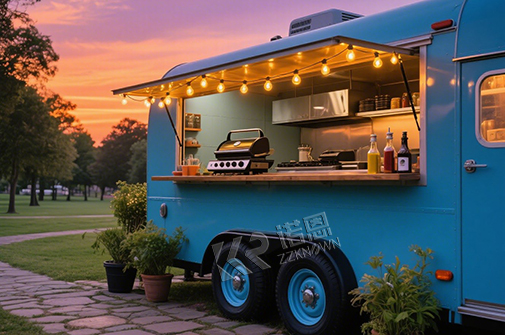
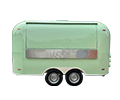
The ZZKNOWN KN-QF570 concession trailer for Germany is a useful equipment-map example. Its published 5.7 × 2.1 × 2.3 m layout includes a six-drawer refrigerator, a combined refrigerator/freezer counter, a refrigerated salad-prep counter, and a three-door drink refrigerator, alongside hot equipment. The product page lists a 220V/50Hz electrical configuration and a USD 11,250–21,200 EXW factory-price range; the final quote depends on equipment and other choices. Those are published project facts, not evidence that the pictured unit has any specific sensor brand, alarm, thermometer position, or approval in Germany.

For a new order with a similar menu, the buyer should list every cabinet and temperature zone on the layout, then specify which reading is built in, which is independently visible, and where staff will use and store the food probe. The equipment supplier and destination authority should review the final method. That is a more useful request than “include a thermometer” because it ties the instrument to an actual inspection and operating task.
Engineering planning note—not a signed technical review: Based on ZZKNOWN's production experience, put a temperature-point schedule on the same drawing as the refrigerator and hot-equipment schedule. For each numbered unit, show its model and power supply, intended food, cabinet control sensor, independent display or logger location if proposed, probe-storage location, cleaning access, and service access. Check that the displayed number is visible during normal use and that the sensing point remains in a representative area after the cabinet is stocked. Use the local authority's comments to finalize the plan.
A thermometer cannot rescue a refrigerator that is undersized for the menu, packed against its airflow openings, or exposed to a hot griddle without enough separation. Read our refrigeration-in-hot-weather guide and pre-opening operational test guide when reviewing the complete kitchen system. A factory test can catch problems, but it cannot grant a local food-service permit.
On October 22, 2026, we checked the official FDA 2026 Food Code page and PDF sections 3-501.11, 3-501.16, 4-203.11–12, 4-204.112, 4-302.12, and 4-502.11. We compared those model provisions with the City of Independence 2026 mobile food permit application and the Clark County mobile unit plan proposal. Finally, we reviewed the public KN-QF570 product description and image. We did not conduct laboratory testing, interview the buyer, inspect the unit, or claim a particular installed thermometer. Advice about sensor location and record design is a planning interpretation of the cited rules and common equipment questions, not a guarantee of inspection approval. Requirements outside these U.S. examples, including in Germany, must be checked locally.
Do not assume it is. The display may show its controller sensor, not the warmest food-storage area. Some local forms, such as Clark County's, specifically ask for a hanging thermometer inside each refrigerator. Provide the equipment model, sensor position, and local checklist to your inspector and ask what satisfies that jurisdiction.
There is no universal shelf. It depends on airflow, loading, door use, ambient heat, and the cabinet design. Test the loaded unit after it stabilizes, compare likely warm locations, and place the representative device according to the equipment instructions and local rules. Avoid the cold-air outlet simply because it produces a comfortable number.
A freezer-rated thermometer or logger is a sensible way to detect drift and recovery problems before product quality deteriorates. The FDA 2026 model says stored frozen foods remain frozen, while the local authority or product specifications may add practical targets. A reading does not replace checking product condition after a suspected failure.
One suitable, accurate food probe can be used for different food checks if its range and tip suit each task and it is cleaned and sanitized between uses as required. It cannot replace the cabinet's monitoring device, and a bulky probe may not measure thin food accurately. Consider a backup if a single instrument would leave the trailer unable to verify food safely.
Not automatically. The 41°F figure in the FDA model is generally a food cold-holding limit, not a universal cabinet-air alarm setting. Door openings and defrost can cause air spikes. Choose warning thresholds and delays based on loaded commissioning data, product risk, equipment behavior, and the approved corrective-action plan.
Follow the instrument maker's procedure and any local schedule, and check accuracy when readings look wrong or the device is dropped or damaged. FDA model §4-502.11 calls for calibration according to manufacturer specifications as necessary to ensure accuracy. Keep a simple record of the check and any replacement.
Send your destination city and country, menu, TCS ingredients, each proposed refrigerator/freezer/warmer model, service hours, ambient conditions, voltage and frequency, equipment layout, and the inspector's plan-review notes. Tell us whether you want a simple visible display, a logger, or optional remote alerts. We can mark candidate monitoring locations on a layout for local review; the operator and authority approve the final food-safety procedure.
Region reminder: The cited FDA document is a U.S. model code. The two permit forms are local examples from Missouri and Washington. They are not worldwide rules or current legal advice for your destination; confirm the adopted code, equipment list, and inspection process before operation.
Tell ZZKNOWN your menu, destination, cabinet and warmer list, staff workflow, and local inspection checklist. We can prepare a zone-by-zone equipment layout concept and an itemized quotation that identifies practical display, probe-storage, and optional monitoring points. That conversation is far easier before cabinet openings and wiring paths are fixed than after the trailer arrives.
Send your menu and request a thermometer-ready kitchen layout and quote →
Explore ZZKNOWN custom food trailer design or revisit our monitoring-system guide if you also need alarms and history.