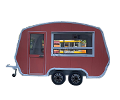
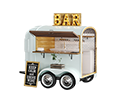
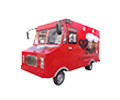
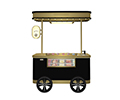
Direct answer: There is no single most profitable food truck concept for every market. Profit depends on selling price, ingredient and packaging cost, waste, service speed, staffing, location fees and fixed costs. Burgers, tacos, pizza, coffee, smoothies and ice cream can all work when the menu is focused and the trailer layout matches the equipment and number of operators.
Data scope: General planning guidance for the United States, Europe, Australia and other export markets. Local costs and approval rules vary. Last updated: September 11, 2026.
This guide compares concepts using factors that a buyer can verify before ordering: ingredient variety, waste exposure, preparation steps, service speed, staffing, utility demand, storage and major equipment. It combines ZZKNOWN production experience with a break-even method. It does not use unsupported universal profit margins or promise a return on investment.
For startup-cost and break-even planning, review the U.S. Small Business Administration business-planning resources. Ingredient costs can change over time; the USDA Food Price Outlook is one official reference for U.S. food-price trends.
| Concept | Main equipment | Planning advantage | Cost or layout risk to check |
|---|---|---|---|
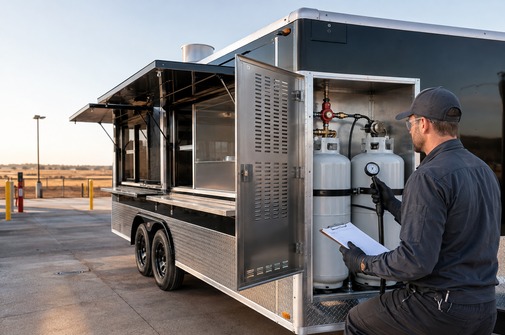
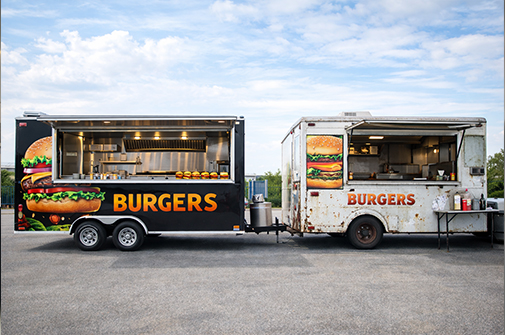
| Burgers and grilled food | Griddle or grill, fryer, hood, refrigeration | A focused cooking line can support repeatable preparation | Ventilation, fire-safety review, gas or electrical load and raw/cooked separation |
| Tacos and street food | Griddle, hot holding, refrigeration, prep counter | Components can be organized into a compact assembly line | Too many fillings increase stock, cold storage and waste |
| Pizza | Pizza oven, dough preparation, refrigeration | A limited pizza menu can simplify purchasing | Oven size, heat, ventilation, fuel and preparation space |
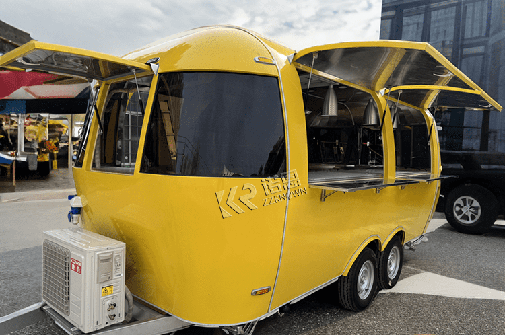
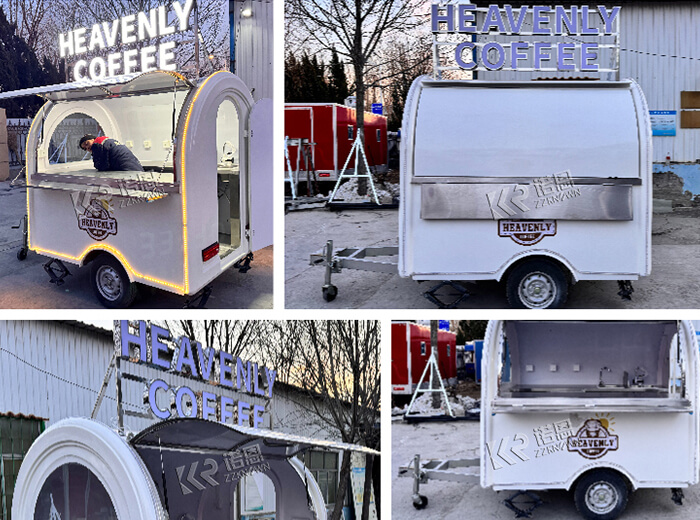
| Coffee and beverages | Coffee machine, grinder, refrigeration, sinks | A compact service counter may suit a smaller trailer | Peak electrical demand, clean water, waste water and cup storage |
| Smoothies and cold drinks | Blenders, refrigerator, freezer, sinks | No large hot-cooking line may be required | Simultaneous blender and refrigeration load, cleaning and cold storage |
| Ice cream and desserts | Freezer, display or service counter, storage | The workflow can be centered on cold storage and fast service | Climate, freezer capacity, product handling and seasonal demand |
Start with contribution margin rather than a general industry margin:
Contribution margin per order = Selling price − variable cost per order
Monthly break-even orders = Monthly fixed costs ÷ contribution margin per order
Illustrative example only: if an average order sells for $8 and ingredients, packaging and transaction fees total $3, contribution margin is $5. If monthly fixed costs are $5,000, the model needs 1,000 orders that month to break even. Replace every figure with quotations, wages, rent, permits, insurance and sales assumptions from your own market.
Before estimating total investment, use the food trailer cost guide. Separate the ex-factory trailer price from equipment, inland transport, ocean freight, insurance, duties, taxes, customs clearance and destination charges.
These examples describe information documented on linked ZZKNOWN project pages. They show what was designed or supplied; they do not prove revenue, profit margin, business performance or destination-specific approval.
| Evidence | Project | Destination and size | Documented configuration | Planning lesson |
|---|---|---|---|---|
| Named customer project | San Diego ice cream trailer | San Diego, USA; size not stated | Freezer and service-counter positions, storage, fiberglass surfaces and non-slip flooring | Plan cold storage and the serving route before fixing counters. |
| Named customer project | California mobile bar trailer | California, USA; 2500 × 2000 × 2300 mm | Layout planning for a two-person team | A compact unit needs clearly separated service, preparation and storage positions. |
| Documented project | 3.5m smoothie trailer | Destination not stated; 3.5 × 2 × 2.35 m | 110V/60Hz sockets, refrigerator, freezer, blender space, sinks, counters and shelving | Calculate simultaneous refrigeration and blender loads. |
| Named customer project | Tyana Leek coffee trailer | USA; body approx. 220 × 200 × 230 cm | KN-FR-220B, 110V/60Hz, coffee machine, refrigerator/freezer, sinks, worktops, storage and generator | Check total power and counter space in a compact coffee layout. |
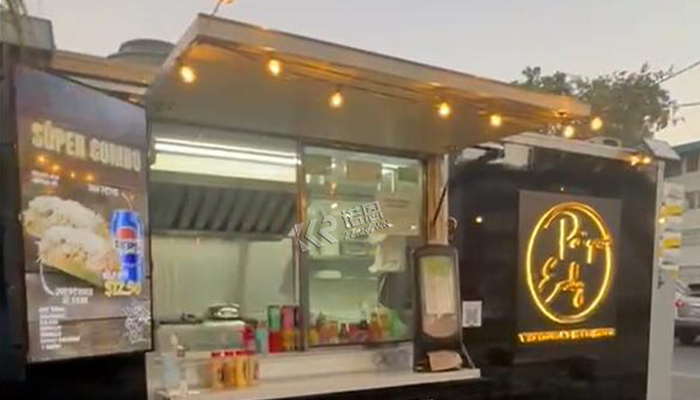
| Named customer project | Tswagstra Miami fast food trailer | Miami, USA; 400 × 200 × 230 cm | KN-FS400, dual axle, fryer, grill, griddle, bain-marie, warming display, sinks and storage | A multi-appliance hot-food menu needs sufficient cooking, ventilation and utility zones. |
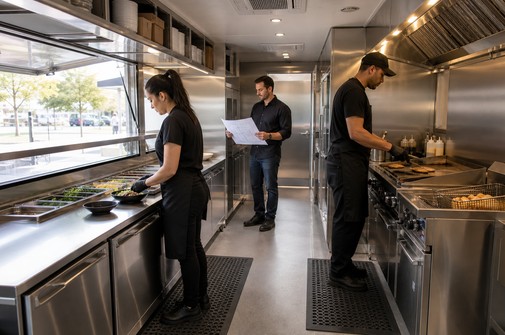
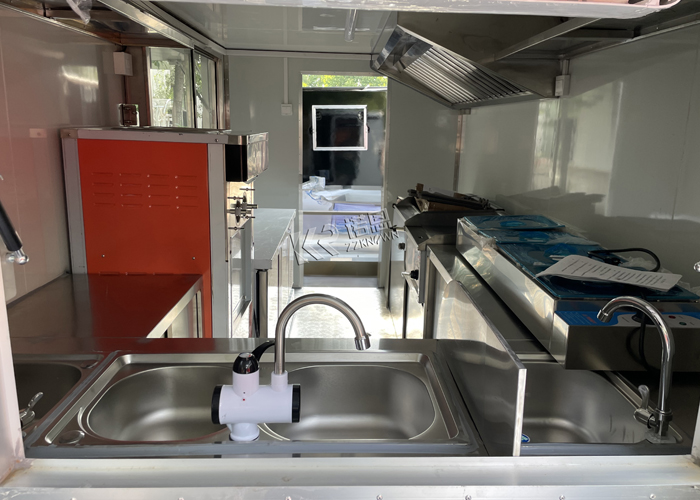
A layout cannot guarantee profit, but it can affect unnecessary movement, equipment duplication and the number of people who can work without blocking one another. Start with your menu and operating sequence: storage → preparation → cooking or blending → holding → serving → washing.
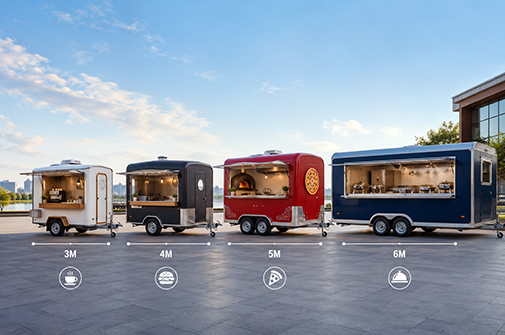
Compare dimensions in the 3m, 4m, 5m and 6m food trailer size guide, then use the food trailer layout guide by menu and staff.
Shortlist two or three concepts that fit your local demand and operating skills. For each one, prepare a menu, expected order volume, local selling prices, supplier quotations, staffing plan and event or parking costs. Then compare break-even orders and equipment requirements. The best option is the one that remains workable under conservative sales assumptions—not the one with the largest advertised margin.
Explore square food trailers, round-roof food trailers and additional real customer projects.
No food is automatically the most profitable. Compare contribution margin, preparation time, waste, local demand and the number of orders the team can serve.
They may need less hot-cooking equipment, but refrigeration, ice, water, cups, power and location costs still need to be calculated.
Use the smallest menu that serves a clear customer need and can be produced consistently. Add items only after checking storage, preparation and service capacity.
No. A larger trailer provides more equipment and storage space but can also increase purchase, towing, shipping and operating requirements.
ZZKNOWN can help define trailer and equipment costs. Revenue, wages, ingredient prices, permits, taxes, rent and demand must come from the buyer's local business plan.
No. They document project configurations. Vehicle registration and health, fire, gas and electrical approval remain subject to the destination authorities.
Provide the menu, destination, preferred trailer size, number of operators, equipment list, voltage or gas preference and branding requirements.
Send ZZKNOWN your menu, destination market, preferred size, operating team and required equipment. Our team can review the workflow and prepare a 2D or 3D layout and ex-factory quotation for discussion before production.
Author: ZZKNOWN Content Team
Technical review: ZZKNOWN Food Trailer Design and Production Team
Published: March 25, 2025
Last updated: September 11, 2026
Editorial note: Financial examples are illustrative calculations, not forecasts. Product configuration and available documentation depend on the agreed quotation, contract, model and destination.