

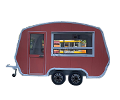
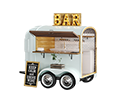

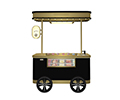
Short answer: yes—but usually as part of a smart hybrid power system.
Roof-mounted solar can be excellent for lights, a POS system, a water pump, refrigeration, fans, charging, and some small appliances. High-demand electric fryers, griddles, pizza ovens, espresso machines, and air conditioners often need shore power, gas, a generator, or a carefully sized battery bank as backup. The winning setup starts with your menu and real appliance loads, not with a guess about how many panels look good on the roof.
Picture this. You arrive at a weekend market before sunrise. The coffee trailer beside you starts a loud generator. A second vendor spends ten minutes searching for an outlet. Your trailer, meanwhile, has charged batteries, quiet LED lighting, a cold refrigerator, and enough stored energy to prepare for opening. As the sun rises, the panels begin replacing some of the power you use.
That is the dream behind a solar powered food trailer. But a food trailer is a commercial kitchen, not a camper with a phone charger. Power demand changes dramatically between cold drinks, coffee, ice cream, burgers, fried chicken, and pizza.
This guide will help you make a practical decision. We will walk through load calculations, panels, batteries, inverters, costs, weather, backup power, and the questions to ask a manufacturer. If you are still choosing the trailer itself, start by comparing custom food trailers and then match the power system to the menu you actually plan to serve.
Can a Food Trailer Really Run on Solar Power?
Yes, a food trailer can run partly—or in selected cases mostly—on solar power. The answer depends on three numbers: how many kilowatt-hours you use each day, how much power your equipment may demand at one moment, and how much solar energy your roof and location can realistically produce.
A small beverage, dessert, or light-service trailer has a much easier path to solar operation than a trailer built around electric fryers and ovens. Solar panels produce energy gradually. Cooking equipment can demand a large amount immediately. Batteries bridge that gap, while an inverter converts stored DC electricity into the AC electricity used by most commercial appliances.
Reality check: “Solar powered” does not have to mean “solar only.” For many mobile food businesses, the most reliable design combines solar and batteries for everyday base loads with shore power, gas, or a generator for peak cooking demand and long periods of bad weather.
Why Are More Mobile Food Businesses Considering Solar?
Operators are not interested in solar just because it looks modern. They are trying to solve everyday business problems: noisy generators, fuel trips, outlet fees, limited vending locations, and the risk of losing refrigeration when a power source fails.
- Quieter service: Batteries can run essential loads without a generator constantly operating beside customers.
- More location flexibility: A trailer can prepare or trade where a suitable outlet is unavailable, subject to local vending rules.
- Lower generator runtime: Solar may not replace the generator, but it can reduce the hours the generator must run.
- Backup for critical loads: A correctly designed battery system can keep refrigeration, lighting, and the POS system operating during a short outage.
- A visible sustainability story: A genuine solar system gives customers something useful to notice—provided the marketing claim matches what the system really powers.
The U.S. Department of Energy explains that pairing solar with storage helps match energy production with the time electricity is needed. That principle is especially relevant to a mobile kitchen: sunlight changes hour by hour, while your refrigerator and service schedule do not. You can read the department’s overview of solar energy and storage for more background.
What Should You Calculate Before Choosing Solar Panels?
Start with a load audit. Write down every electrical appliance, its rated watts, how many units you will use, and how long each unit is active during a normal service day. Then identify equipment that starts with a brief surge, such as a compressor, pump, or motor.
Daily energy formula
Watts × active hours × quantity ÷ 1,000 = kilowatt-hours per day
Do not confuse watts with watt-hours. Watts describe how much power an appliance needs at a moment. Watt-hours or kilowatt-hours describe how much energy it uses over time. Your inverter must handle the simultaneous power demand. Your battery and solar array must supply the total energy demand.
Also separate “must run” loads from “nice to have” loads. Refrigeration, safe lighting, a water pump, and the POS may be essential. Decorative lights, a second blender, or an electric water heater may be optional when energy is limited.
How Much Electricity Does Your Menu Actually Use?
Your menu is the biggest clue. A cold-drink stand may have a refrigerator, blender, water pump, POS system, and lights. A burger trailer may add an exhaust fan, freezer, griddle, and fryer. A pizza concept may need an oven that changes the entire power strategy.
Here is an illustrative coffee-trailer worksheet. It is not a final system design: appliance labels, compressor cycles, thermostat settings, weather, and customer volume all change the result.
| Example Load | Planning Watts | Active Hours | Daily Energy |
|---|---|---|---|
| LED lighting | 80 W | 8 | 0.64 kWh |
| POS and router | 60 W | 8 | 0.48 kWh |
| Water pump | 120 W | 0.5 | 0.06 kWh |
| Undercounter refrigerator (average planning load) | 250 W | 8 | 2.00 kWh |
| Espresso machine (heating cycles combined) | 3,000 W | 2.5 | 7.50 kWh |
| Blender | 1,200 W | 0.5 | 0.60 kWh |
| Illustrative subtotal before losses and reserve | 11.28 kWh | ||
Notice how one heating appliance dominates the example. That is why copying a solar kit from another trailer rarely works. Measure your equipment when possible, use the manufacturer’s nameplate and documentation, and include an engineering margin for conversion losses, startup surges, hot weather, battery reserve, and future equipment.
Which Food Trailer Appliances Can Solar Power Reliably?
| Best Fit for Solar + Battery | Often Better in a Hybrid System | Usually Poor for Roof Solar Alone |
|---|---|---|
| LED lights, POS, router, cameras, small fans, phone charging, water pump | Commercial refrigerator, freezer, blender, ice maker, small air conditioner | Electric fryer, electric griddle, large oven, heavy HVAC, multiple high-power heaters |
| These loads are generally modest and predictable. | These loads may cycle or surge and need careful inverter and battery sizing. | These loads can consume energy faster than a practical trailer roof can replace it. |
This does not mean an electric cooking trailer is impossible. It means you should be honest about the energy source. A hybrid trailer may use gas cooking to reduce electrical demand while solar supports refrigeration and service equipment. Another trailer may use shore power during service and solar while parked. The design should follow your location, menu, local regulations, and operating schedule.
What Components Does a Reliable Solar Setup Need?
A dependable system is more than panels and a battery. Its components must work together and tolerate road vibration, moisture, heat, and repeated connection cycles.
create DC power
manages charging
stores energy
supplies AC power
feeds equipment
- Panels and mounting: The roof plan must leave safe space for vents, exhausts, air conditioning, hatches, wiring paths, and maintenance.
- Charge controller: It must match the panel voltage, current, battery type, and expected operating conditions.
- Battery bank: Look at usable energy, discharge limits, temperature range, battery-management protection, warranty, weight, and service access.
- Inverter/charger: Check continuous output, surge output, voltage, frequency, grounding strategy, and compatibility with shore or generator power.
- Protection: Fuses, breakers, disconnects, cable sizing, ventilation, labeling, and secure mounting are not optional extras.
- Monitoring: A clear battery state-of-charge display helps staff make better decisions during service.
How Many Panels and How Much Battery Storage Do You Need?
There is no trustworthy answer based only on trailer length. A four-meter roof may also hold an exhaust fan, air conditioner, sign, vent, and service access zone. Shade from one roof object can reduce production. Panel wattage also varies by model and market.
Use this sequence instead:
- Calculate daily energy demand in kilowatt-hours.
- Decide which loads must continue without sun.
- Choose the number of hours or service days of reserve you need.
- Use the battery maker’s usable-energy and discharge specifications.
- Estimate local solar production for the months and cities where you will operate.
- Confirm the panel layout on a real roof drawing.
- Size the inverter for simultaneous loads and startup surges.
The National Renewable Energy Laboratory’s PVWatts Calculator is a useful starting point for location-based solar estimates. NREL notes that its output range draws on long-term historical weather information, which is a reminder that a single sunny-day test is not a business plan.
How Do Weather and Location Change Solar Output?
A system that feels comfortable in a sunny, mild climate may struggle during a cloudy winter or an extremely hot summer. Sun angle, cloud cover, dust, shade, panel temperature, parking direction, and operating season all matter.
The Department of Energy’s guide to solar photovoltaic performance explains that temperature and reflection affect conversion efficiency. This matters on a trailer roof because panels can become hot, and the trailer may park near trees, buildings, light poles, or event tents.
Plan for the difficult month, not just the best month. If your business travels, calculate more than one location. On low-energy days, preserve battery power for essential refrigeration and service loads.
Should You Use Solar, Shore Power, a Generator, or All Three?
| Power Strategy | Best Use | Main Limitation |
|---|---|---|
| Solar + battery | Quiet base loads and light-service menus | Roof area, weather, battery capacity, and high upfront cost |
| Shore power | Regular pitches with a verified outlet | Not always available; supply quality and connector standards vary |
| Generator | Peak loads, long service, and emergency backup | Fuel, noise, exhaust, maintenance, and event restrictions |
| Hybrid system | Most serious mobile operations with mixed loads | More design coordination and staff training |
For many buyers, hybrid is the practical answer. A square food trailer may offer a straightforward roof and utility layout. An Airstream food trailer has a curved roof that requires a different mounting plan. A compact round roof food trailer may have less roof area, so battery and backup decisions become even more important.
How Much Does a Solar-Powered Food Trailer Cost?
A responsible supplier should not quote a universal solar price without your load list, roof plan, market voltage, operating location, and backup strategy. Global component prices, duties, certifications, labor, and freight change too much for one number to be honest.
| Cost Category | What the Quote Should State |
|---|---|
| Solar array | Panel model, quantity, rated watts, mounting method, wiring, and roof drawing |
| Battery storage | Nominal and usable kWh, chemistry, BMS, warranty, weight, and temperature limits |
| Power electronics | Controller, inverter continuous/surge rating, charger, monitoring, and changeover method |
| Safety and installation | Cables, breakers, fuses, disconnects, grounding, enclosures, testing, and labels |
| Backup integration | Shore inlet, generator connection, fuel system if applicable, and priority logic |
| Trailer impact | Added weight, axle capacity, balance, roof reinforcement, freight, and market compliance |
Compare quotes by specification, not by the phrase “solar package.” Ask for a load schedule and single-line electrical concept before comparing totals.
When Does Solar Actually Save Money?
Solar saves money only when it replaces a cost you would otherwise pay. That cost might be grid electricity, generator fuel, generator maintenance, event power fees, or business lost during an outage. The simple starting formula is:
Annual energy value = solar energy actually used × your local electricity or fuel-replacement cost
Use local numbers. As one U.S.-only reference, the Energy Information Administration reported an average commercial retail electricity price of 13.41 cents per kWh for 2025, while prices varied widely by location and customer type. That figure is not a global rate and may not resemble your utility bill or generator cost. Check the current EIA electricity price explanation, then replace the example with your real local tariff and fuel use.
Also value reliability and noise honestly. Quiet operation may help at a wedding, resort, school, or premium market. For a fixed container café, a larger stationary array may be easier than fitting everything onto a trailer roof. The right business case is specific to how and where you trade.
Which Food Businesses Are the Best Fit for Solar?
Solar is easiest when the menu relies on efficient refrigeration, modest pumps, electronics, and short-use appliances instead of continuous electric heat. Strong candidates include:
- Cold beverages, lemonade, juice, and smoothies
- Prepackaged desserts and light-service ice cream carts
- Coffee concepts using a hybrid plan for the espresso machine
- Farm stands, produce trailers, and branded sampling units
- Mobile retail or event trailers with lights, displays, POS, and refrigeration
A cooking-heavy business can still benefit, but solar may support the “hotel load”—refrigeration, controls, lighting, pumps, and communications—while gas or another source supplies cooking energy. This division often gives a better balance of roof space, battery weight, cost, and operating reliability.
What Mistakes Should First-Time Buyers Avoid?
- Buying panels before auditing the menu. The load list should drive the system.
- Using rated panel watts as guaranteed output. Real production changes with location, weather, shade, heat, and mounting.
- Ignoring surge power. A battery may hold enough energy while the inverter still cannot start a compressor.
- Forgetting roof competition. Exhausts, vents, air conditioning, signs, and access need space.
- Hiding battery weight. Batteries, mounting, and reinforcement affect payload, axle selection, balance, and towing.
- Skipping backup power. Weather does not care that you have a fully booked event.
- Mixing voltage or frequency standards. Match the trailer, inverter, sockets, and appliances to the destination market.
- Treating electrical safety as a kit accessory. Protection, grounding, isolation, and local inspection require qualified design and installation.
How Does ZZKNOWN Plan a Solar-Ready Food Trailer?
At ZZKNOWN, we start with the menu and appliance list—not the number of panels. That order matters. First we need to understand what you sell, how many staff members work inside, where you operate, which appliances are essential, and which market standards apply.
From there, a practical solar-ready discussion should coordinate the kitchen layout, roof equipment, battery compartment, ventilation, axle capacity, wiring routes, shore connection, and generator option. A beautiful rendering is useful, but the power plan must also make sense on a load sheet and a roof drawing.
Buyers who need a one-off layout can review ZZKNOWN OEM/ODM customization. The goal is not to force every food trailer into the same package. It is to build a mobile business unit whose kitchen, structure, and utilities work together.
What Should You Ask Before Ordering?
- Can you show the appliance load schedule and design margin?
- What can run at the same time without overloading the inverter?
- How many usable battery kilowatt-hours are included?
- How is the battery protected from heat, water, vibration, and unauthorized access?
- What is the panel model, total rated wattage, and expected roof layout?
- What happens when the battery is low or the weather is poor?
- Can shore power or a generator charge the battery and run loads safely?
- How much weight does the complete system add, and where is it located?
- Which documents, manuals, diagrams, and labels are provided?
- Who will confirm compliance with electrical, fire, food-service, road, and vending rules at the destination?
What Else Do Buyers Ask About Solar Food Trailers?
Can a solar food trailer work on cloudy days?
Yes, but production will usually be lower. The battery reserve and backup-power plan should be sized for the weather and service reliability you need.
Can the trailer operate at night?
Yes. Night operation uses energy stored in the battery or supplied by shore power or a generator. Solar panels alone do not produce power after sunset.
How long will the battery last?
Runtime depends on usable battery energy and the loads operating at that moment. Service life depends on chemistry, temperature, charging, depth of discharge, cycle count, and the manufacturer’s warranty. Compare documented specifications rather than a general promise.
Can solar power a commercial refrigerator or freezer?
Often yes, when the inverter handles compressor startup and the battery has enough reserve. Hot ambient temperature, frequent door opening, and poor ventilation can increase energy use.
Can solar run an espresso machine?
It can be possible, but heating elements create a large load. Many coffee trailers use a hybrid strategy so the espresso machine does not consume the battery reserve needed for refrigeration and service.
Can solar run an electric fryer or griddle?
Technically possible systems can be built, but a normal trailer roof often cannot replace that energy fast enough for long commercial service. Gas, shore power, or generator support is usually more practical.
Can solar run the air conditioner?
Sometimes, depending on the unit, climate, insulation, battery, and other loads. Air conditioning can become one of the largest energy users on a hot day, so it needs a separate calculation.
Do I still need a backup generator?
If missing a service day would be expensive, backup power is sensible. The generator may run only during peak demand or poor weather instead of operating continuously.
Will the solar system make the trailer too heavy?
Panels, batteries, reinforcement, enclosures, and electronics all add weight. The manufacturer must include them in payload, axle, balance, and towing calculations from the beginning.
Can ZZKNOWN customize a solar-ready layout for my market?
ZZKNOWN can discuss customized structure, kitchen layout, voltage, sockets, utility compartments, roof planning, and optional power integration. Final local approvals should always be confirmed with the relevant authorities and qualified professionals in the destination market.
What Is the Smartest Next Step?
Build a one-page load list before you buy hardware. Include the menu, appliance models, quantity, voltage, rated watts, expected hours, location, service season, and backup preference.
Then share it with ZZKNOWN so the trailer layout and power strategy can be discussed together. A solar food trailer works best when the business plan, kitchen, roof, battery, and backup system are designed as one project—not as separate purchases.