At some point, almost every cold chain business faces the same question:
“Should we keep renting refrigerated trailers… or finally buy our own?”
It sounds like a simple financial decision.
But honestly, it’s much more complicated than that.
Because the right answer depends on things like:
And here's what makes it tricky:
A decision that works perfectly for one business can be completely wrong for another.
At ZZKNOWN, we've worked with catering companies, seafood distributors, fleet operators, logistics startups, supermarket suppliers, and cold storage rental businesses across multiple countries. Some companies save enormous amounts of money by owning their refrigerated trailers.
Others regret buying too early.
And some businesses make the smartest move of all:
They combine rental and ownership strategically.
This guide breaks the whole decision down in practical terms — not accounting jargon — so you can evaluate what actually makes sense for your business.
Think of this like sitting down with someone who has already made both good and bad fleet decisions and is trying to save you from expensive mistakes.
Because cold chain demand is growing fast.
Food delivery, frozen distribution, pharmaceutical logistics, and temperature-sensitive transportation are all expanding globally.
But at the same time:
That means fleet planners and financial directors are under pressure to optimize both operational efficiency and capital allocation.
And refrigerated trailers are not cheap assets.
A commercial reefer trailer can represent a major financial commitment.
So choosing the wrong strategy affects much more than just monthly payments.
People often use these terms interchangeably.
But financially, they’re very different.
Rental is generally:
Rental works well for:
For example:
A seafood distributor may rent additional refrigerated trailers during peak holiday seasons when demand spikes suddenly.
Leasing sits somewhere between renting and buying.
Typically:
Leasing often appeals to businesses that want:
Ownership means:
But ownership also means:
Usually?
Buying.
But only if the trailer is used consistently enough.
This is where many businesses miscalculate.
Because rental costs accumulate surprisingly fast.
Let’s use a simplified example.
Suppose a business rents a refrigerated trailer for:
Over three years:
1800×36=648001800 \times 36 = 648001800×36=64800
That’s enough to purchase some new reefer trailers outright.
This is why long-term heavy users often transition toward ownership.
Because flexibility has value.
Especially in industries with unpredictable demand.
Rental avoids:
And for some businesses, preserving cash flow matters more than minimizing lifetime cost.
Let’s start with the positives.
Once the trailer is paid off, ownership costs drop significantly.
The trailer becomes part of your company assets.
That improves balance sheet strength for some businesses.
Frequent-use operations often recover investment surprisingly quickly.
Owners can customize:
No rental availability concerns during busy seasons.
This matters more than many companies initially realize.
Ownership isn’t automatically better.
There are trade-offs.
Commercial refrigerated trailers can cost tens of thousands of dollars.
That affects liquidity.
Owners handle:
Equipment value declines over time.
Especially if technology changes or market conditions shift.
Because leasing creates predictability.
Monthly expenses are easier to forecast.
And many lease structures reduce upfront financial pressure.
Businesses preserve working capital.
Companies can expand capacity faster.
Some lease agreements include servicing support.
Newer equipment can replace aging units more regularly.
Over long periods, leasing may cost more than ownership.
And some contracts include:
Always review contracts carefully.
This is where financial strategy becomes extremely important.
And honestly, many operational managers overlook it completely.
Because buying and renting affect financial statements differently.
Buying is generally considered:
That means:
For some companies, this supports long-term asset growth.
Rental and many lease structures are treated as:
That means:
This can benefit companies prioritizing short-term financial flexibility.
Absolutely.
Some businesses intentionally prefer OpEx-heavy structures to preserve capital and simplify accounting.
Others prioritize long-term asset ownership.
This is why financial directors and fleet managers should coordinate closely before making decisions.
A massive one.
In fact, seasonality is one of the strongest arguments for refrigerated trailer rental.
Common examples include:
| Industry | Peak Season |
|---|---|
| Ice cream distribution | Summer |
| Seafood supply | Holidays |
| Beverage logistics | Summer events |
| Catering businesses | Wedding season |
| Agricultural cold chain | Harvest periods |
Buying permanent fleet capacity for temporary demand spikes often creates underutilized assets during slower months.
Because businesses can:
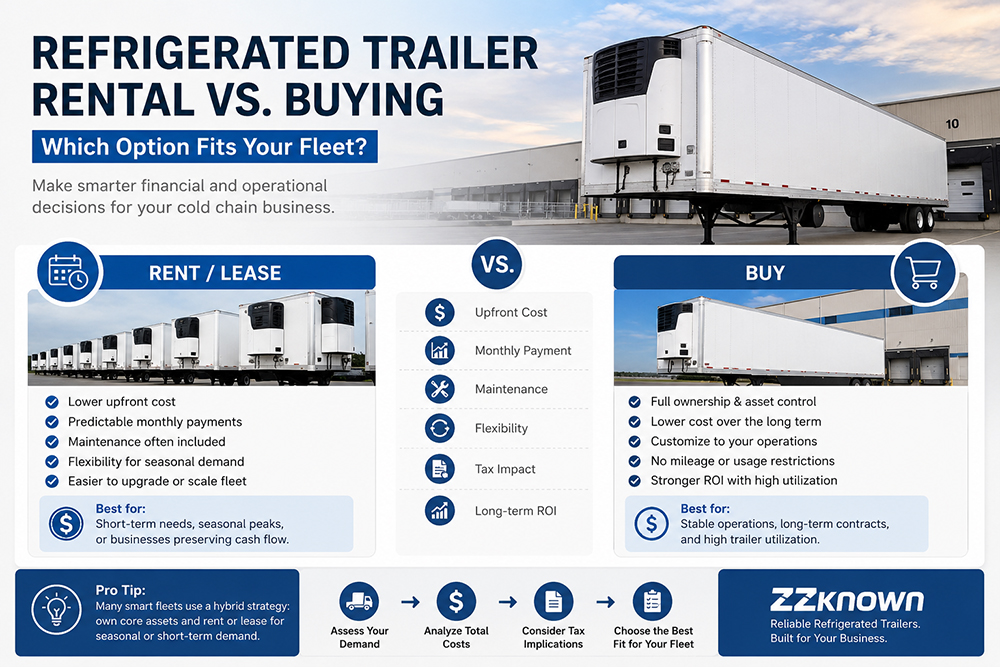
Many successful cold chain operators use a hybrid strategy:
Honestly, this is often one of the smartest approaches.
Here’s a simple example.
| Fleet Component | Purpose |
|---|---|
| Owned trailers | Daily base operations |
| Rental trailers | Seasonal spikes |
| Leased units | Medium-term expansion |
This structure balances:
This is where a decision matrix becomes useful.
| Business Situation | Best Option |
|---|---|
| Short-term project | Rental |
| Seasonal demand | Rental or hybrid |
| Startup with limited cash flow | Leasing |
| Stable daily operations | Buying |
| Rapid fleet expansion | Leasing |
| Long-term cold chain contracts | Buying |
| Testing new markets | Rental |
| Large logistics fleet | Hybrid strategy |
There’s no universal answer.
The right strategy depends on operational reality.
Before making a decision, ask:
Daily use strongly favors ownership.
Unpredictable demand favors flexibility.
Limited liquidity may favor leasing or rental.
Ownership requires service capability.
Rapid scaling may require flexible fleet expansion.
We’ve seen several repeatedly.
Some startups purchase expensive fleets before demand stabilizes.
Then equipment sits unused.
Other businesses spend years renting and unknowingly pay enough to have purchased multiple trailers.
Ownership cost isn’t just purchase price.
Operating expenses matter heavily.
Aggressive expansion assumptions can create idle fleet problems later.
Businesses sometimes lack enough backup capacity during busy periods.
One catering company initially rented refrigerated trailers for every major event season.
At first, this made perfect sense.
But after three years of continuous rentals, they calculated their total spending and realized they could have purchased two trailers outright.
They eventually shifted toward partial ownership and dramatically reduced long-term costs.
Another cold chain startup made the opposite mistake.
They purchased a large fleet immediately based on optimistic growth projections.
Unfortunately, contracts grew slower than expected.
Several trailers remained idle for months, creating financial pressure.
The lesson?
Fleet strategy should match actual operational demand — not just optimism.
Because flexibility matters more today.
At ZZKNOWN, we've noticed many larger operators now combine:
This reduces risk while preserving scalability.
And honestly, it often creates the best balance between financial efficiency and operational flexibility.
Short-term, renting is usually cheaper. Long-term heavy usage generally favors ownership.
Lower upfront costs, predictable payments, easier fleet scaling, and potential maintenance support.
Rental works best for seasonal demand, temporary projects, and businesses testing new markets.
For businesses with stable daily operations, ownership often delivers strong long-term ROI.
Either overcommitting to ownership too early or renting for so long that costs exceed purchase value.
Many growing fleets benefit from hybrid strategies combining owned, leased, and rented trailers.
The truth is:
There’s no perfect universal answer.
The smartest decision depends on:
But here’s the key takeaway:
Don't make the decision based only on monthly cost.
Think about:
Because the right refrigerated trailer strategy doesn’t just reduce expenses.
It helps your fleet operate more efficiently, scale more intelligently, and stay profitable long-term.