Imagine this: It is 3:00 a.m. on a sweltering Tuesday in July. Your refrigerated trailer is backed up to a dock door at a distribution center, its interior stacked to the ceiling with thousands of dollars’ worth of fresh organic poultry and dairy products. A receiving clerk climbs into the trailer, casually inserts a digital probe thermometer into a case of chicken, and immediately frowns.
“The core temperature reading is 45°F,” he says, backing out of the trailer. “Even though your refrigeration unit’s display shows an ambient temperature of 36°F, this shipment has clearly suffered from ‘heat abuse.’ We are rejecting the entire load.”
If you are a food safety manager or a logistics compliance specialist, the scenario described above is undoubtedly your worst nightmare. In a matter of minutes, a minor discrepancy in data can instantly transform an active shipment into a costly legal liability and a potential public health hazard—triggering a relentless “blame game” among the shipper, carrier, and receiver.
In modern cold chain logistics, simply keeping a trailer “cold” is no longer enough to pass muster. Faced with rigorous amendments to the *Food Safety Modernization Act* (FSMA) by the U.S. Food and Drug Administration (FDA)—alongside the uncompromising structure of the *Hazard Analysis and Critical Control Points* (HACCP) framework—transportation operations are now under unprecedented scrutiny.
In the following sections, we will navigate the FDA’s intricate web of food transportation regulations, break down a highly practical HACCP inspection checklist for food transport trailers, and explore how to construct a watertight compliance ecosystem—ensuring that when faced with a sudden federal regulatory audit, you can not only pass with ease but truly excel.
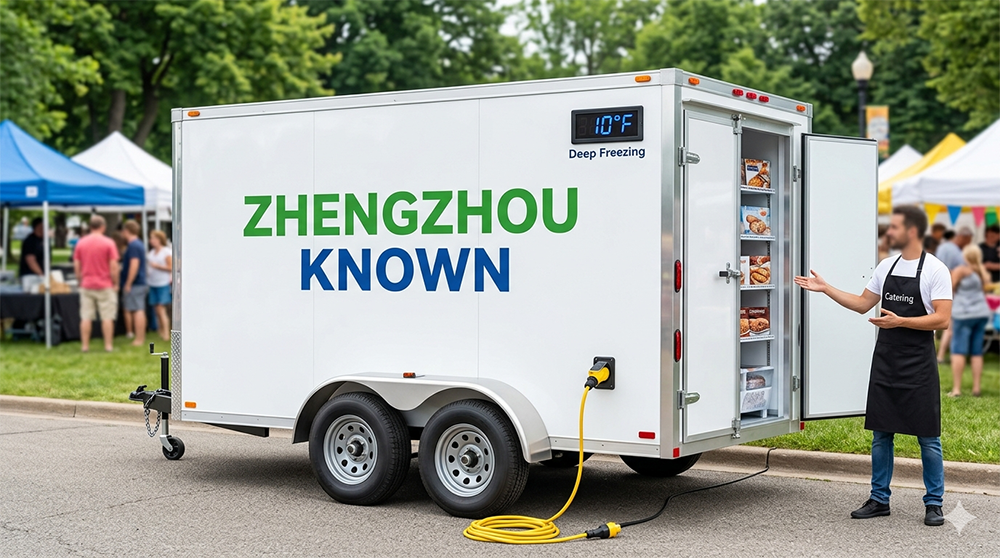
When people talk about food transport compliance in the United States, they usually throw around a lot of confusing acronyms. But if we peel back the bureaucratic language, everything points back to one foundational federal law: the Sanitary Transportation of Human and Animal Food rule under FSMA (codified at 21 CFR Part 1 Subpart O).
The FDA doesn't just look at the truck driver. The law explicitly spreads legal responsibility across four distinct roles in the logistics ecosystem:
[The FSMA Compliance Chain]
 ├── Shippers (Sets temperature specifications & sanitization rules)
 ├── Loaders (Verifies pre-cooling and trailer cleanliness before loading)
 ├── Carriers (Maintains physical equipment & executes the transport)
 └── Receivers (Assesses potential temperature abuse upon arrival)
If your company operates its own fleet of local delivery trailers, mobile cold rooms, or regional distribution reefers, you frequently occupy multiple roles simultaneously. This means the full weight of compliance rests squarely on your shoulders.
The FDA evaluates your over-the-road compliance based on four core operational categories. If you lack documented proof in even one of these areas, your equipment can be legally deemed "adulterated"—meaning it is treated as contaminated, even if the food looks completely fine.
| Regulatory Pillar | Mandated Requirement | Critical Focus for Fleet Operators |
| Vehicle & Equipment Design | Must be easily cleanable and capable of maintaining precise temperature control under stress. | Insulation thickness, food-grade interior panels, and automated defrost functionality. |
| Transportation Operations | Must take active measures to prevent cross-contamination and temperature excursions. | Physical separation of raw vs. ready-to-eat foods; verification of stable pre-cooling. |
| Training Documentation | Carrier personnel must be certified in sanitary transportation practices. | Documented training logs kept on file for all drivers, loaders, and dock workers. |
| Record Retention | Written agreements, cleaning logs, and continuous sensor data must be easily accessible. | Retaining all operational cold-chain records for a minimum of 12 months. |
Let’s answer an essential question that trips up a lot of operations managers: Does the FDA require expensive, real-time satellite telematics on every single trailer?
The direct answer is no. The FDA does not mandate a specific brand or type of technology. However, the law explicitly states that the carrier must be able to demonstrate temperature maintenance upon request from either the shipper, the receiver, or an FDA investigator.
If you are relying on a driver manually writing down numbers on a clipboard once every four hours, you are playing Russian roulette with your compliance.
The digital readout on the front of a reefer unit tells you the temperature of the air blowing out of the cooling unit evaporator. It does not prove that the stagnant air at the very back of a tightly packed trailer isn't trapped in a dangerous heat pocket.
To meet HACCP standards, your temperature tracking protocol should follow a multi-point verification strategy:
Pre-Cooling Verification: Never load perishable goods into a trailer that has not been pre-cooled. Loading personnel must verify that the interior of the trailer has reached its target operating temperature (e.g., 36°F for refrigerated goods, -4°F for frozen goods) before the first pallet of goods enters the trailer compartment.
Independent Data Logging: Place independent, calibrated data loggers directly inside the cargo zone—specifically at the primary Critical Control Point (CCP), which is typically near the rear doors where heat infiltration is highest.
Continuous Electronic Auditing: Use automated data loggers that generate tamper-proof electronic reports (complying with 21 CFR Part 11). These records show a continuous, unbroken timeline graph of the entire trip, accounting for temporary spikes during automated defrost cycles.
A few years ago, I was managing logistics for a regional cold chain distributor. We had an unexpected maintenance surge, so we brought in a backup refrigerated trailer to handle a Friday morning delivery run of liquid liquid eggs and premium dairy bases for a bakery chain.
The trailer was clean, the cooling unit was modern, and the driver was experienced. But there was one subtle, hidden mechanical flaw: the rubber air-delivery chute running along the ceiling inside the trailer had a large tear right down the middle.
Because the chute was ripped, the cold air coming out of the evaporator was dumping straight down onto the front two pallets instead of traveling all the way to the rear of the unit. The front pallets were practically frozen solid, while the rear of the trailer became a stagnant pocket of humid, warm air.
When the trailer arrived at the customer's central dock, their quality control officer pulled the temperature data. The rear zone had hovered around 48°F for over three hours—well inside the pathogen growth danger zone (41°F to 135°F).
The receiver rejected the back half of the trailer immediately. We had to destroy over $14,000 worth of premium dairy inventory solely because of a simple piece of torn rubber that would have taken ten minutes to fix.
That painful lesson completely changed how we handle equipment verification. It's why our fleet partners now prioritize manufacturing quality above everything else. When spec'ing assets from a high-quality commercial builder like ZZKNOWN, we look closely at air distribution integrity, seamless food-grade interior liners, and uniform thermal efficiency to prevent hidden micro-climates from developing inside the cargo box.
To make sure your fleet never experiences an expensive product rejection or an enforcement action, you need a repeatable, standardized system.
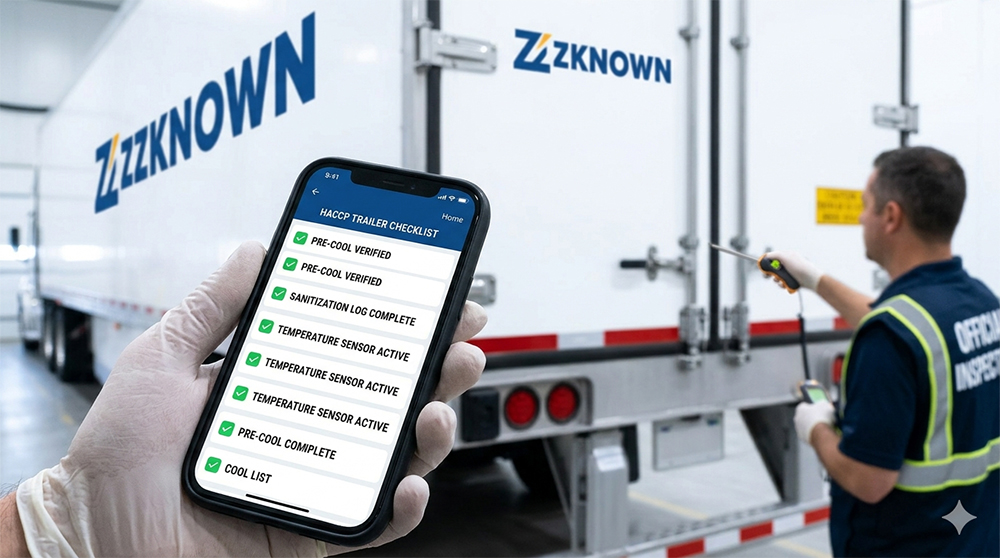
Here is the operational HACCP food trailer checklist that your loading and driving teams should execute before, during, and after every transport leg:
[ ] Structural Integrity: Check that door seals and gaskets are completely airtight with no visible cracks, dry rot, or gaps.
[ ] Airflow Chute: Verify the ceiling air delivery chute is securely attached and free of obstructions, rips, or sagging.
[ ] Physical Cleanliness: Ensure walls, floors, and corners are free of visible dirt, debris, standing water, ice buildup, or organic stains from prior loads.
[ ] Odor Test: Sniff the interior environment. Any strong chemical, musty, or off-odors indicate inadequate sanitization or chemical cross-contamination risks.
[ ] Drain Lines: Confirm that floor drains are completely clear of debris and functioning properly so wash water can escape.
[ ] Wash Down: Wash the interior walls and floors using a food-grade, EPA-registered sanitizing agent.
[ ] Chemical Clearance: Rinse thoroughly with potable water if required by the chemical manufacturer, ensuring no chemical residue remains to contaminate food contact packaging.
[ ] Drying Time: Allow the trailer interior to air-dry completely before closing the doors and initiating the pre-cool cycle.
[ ] Pre-Cool Cycle: Run the reefer unit until the internal ambient temperature stabilizes at the target setpoint specified on the bill of lading (BOL).
[ ] Data Logger Activation: Initialize and place a calibrated electronic data logger at the rear of the cargo area.
[ ] Airflow Spacing: Ensure cargo is loaded with at least 2 inches of clearance from side walls, 6 inches of clearance from the ceiling chute, and that pallets are loaded onto floor racks to allow air to circulate freely underneath the cargo.
An unexpected regulatory audit by a state Department of Transportation (DOT) officer or an FDA investigator is an intense experience, but it doesn't have to be a stressful one. Auditors are looking for one thing: the gap between what your written standard operating procedures (SOPs) say you do, and what your physical documentation proves you actually did.
If an auditor steps onto your loading dock tomorrow, follow this protocol to stay in control:
Do not make an investigator wait while you hunt through messy filing cabinets or look for spreadsheets on an old desktop computer. Keep an audit-ready compliance binder or a dedicated cloud folder that contains:
Your written sanitary transportation procedures (as required by 21 CFR § 1.908).
An unbroken 12-month history of trailer sanitization logs linked directly to specific vehicle identification numbers (VINs).
Employee training certificates demonstrating that your loaders and operators have successfully completed recognized food safety and sanitary transport courses.
Be prepared to explain your corrective action plans. If an auditor asks, "What does your driver do if the temperature spikes above $42^\circ\text{F}$ during transit?", your team must have a clear, immediate answer:
"The driver pulls over safely, checks the unit for mechanical codes, contacts dispatch immediately, logs the duration of the excursion using our digital tracking system, and holds the load for a formal quality control evaluation before it is delivered to the receiver."
Showing that you have a proactive, disciplined process for handling issues tells an auditor everything they need to know about your company's safety culture.
The FDA defines the temperature danger zone for time/temperature control for food safety (TCS food) as the range between 41°F and 135°F (5°C to 57°C). Within this spectrum, dangerous foodborne pathogens like Salmonella, Listeria monocytogenes, and E. coli can multiply rapidly, potentially doubling their population in under twenty minutes.
There is no fixed calendar rule (like "once every three days"). Under HACCP guidelines, a trailer must be cleaned and sanitized whenever there is a risk of cross-contamination. For example, you must sanitize the unit immediately after hauling raw unwashed produce or raw meats before you can safely load fully enclosed, ready-to-eat cooked foods or baked goods.
No. While there are specific financial exemptions for very small businesses with less than $\$500,000$ in average annual revenue, the structural intent of the law remains broad. If you are transporting food that requires temperature control to prevent it from becoming unsafe, your operations must utilize sanitary practices, keep accurate records, and use equipment that functions reliably.
Under 21 CFR § 1.912, all records required under the Sanitary Transportation rule—including written procedures, carrier training records, and temperature tracking reports—must be retained for at least 12 months from the date the transport took place.
Navigating federal food safety laws can feel overwhelming at first, but it ultimately comes down to standardizing your daily habits. By implementing a clear checklist, investing in high-quality trailer infrastructure from reliable names like ZZKNOWN, and backing up your operations with tamper-proof data logs, you do more than just protect your business from costly rejections and legal penalties. You build a strong reputation as a trusted, elite operator in the modern logistics landscape.
For a deeper visual understanding of how federal agencies enforce these cold chain standards on the road, you can watch this educational review of the Sanitary Transportation Rule. This overview highlights how the FDA expects shippers, loaders, and carriers to collaborate closely to protect food quality and ensure public safety across the entire transport network.