





ZZKNOWN Engineering Guide
Food Trailer Make-Up Air Explained: Why Your Exhaust Hood Needs Balanced Airflow
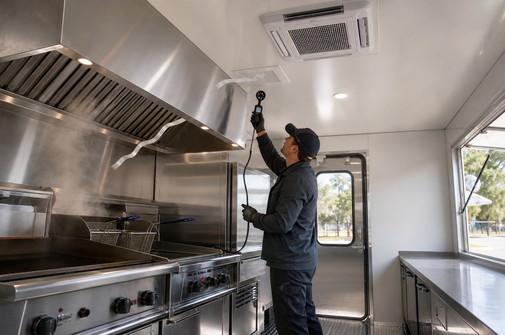
The scene usually starts the same way. A new trailer looks excellent, the fryer and griddle are hot, and the exhaust hood sounds powerful. Then the operator reaches for the entry door and it feels strangely heavy. Air whistles around the serving window. The hood is running, yet a little smoke rolls into the aisle when someone opens the door. Meanwhile, the air conditioner seems to be losing a race it cannot win.
That is not automatically a “bad hood” problem. Very often, it is an air-balance problem. The exhaust fan is taking thousands of cubic feet of air out of a compact mobile kitchen, but nobody has given that air a controlled way back in.
Based on ZZKNOWN's production experience, buyers naturally focus first on hood length, fan power, and air-conditioning capacity. Make-up air is easier to miss because it is less visible. Yet it connects all three systems. This guide explains the idea in plain English so you can ask better questions before the walls, hood, ducts, equipment, windows, and roof openings are fixed in place.
What should you remember before reading the details?
- Every cubic foot exhausted must be replaced from somewhere. The goal is to decide where that replacement air enters instead of letting cracks, doors, and serving windows decide for you.
- More supply air is not always better. High-velocity air aimed across the hood can push the cooking plume out of the capture zone.
- Exhaust CFM is not a universal number. Hood listing, size, overhang, appliance duty, fuel, installation geometry, and local rules all matter.
- Make-up air and air conditioning are different jobs. Replacement air may be heated, cooled, dehumidified, or untreated; the climate determines what is sensible.
- Commission the finished trailer. A drawing is the starting point. Airflow measurements, smoke observation, controls, doors, windows, and gas appliances must be checked together.
- Your local authority has the final word. A factory layout recommendation is not a mechanical permit or approval for every destination.
Where do the data and recommendations apply?
This guide is written for global buyers and was updated on August 28, 2026. The technical references include guidance from the U.S. Department of Energy, the UK Health and Safety Executive, ASHRAE, and an ICC-hosted mechanical-code example. They are useful design references, but they do not create one global rule.
Mechanical, fire, fuel-gas, energy, health, and vehicle requirements can differ by country, state, province, city, event venue, and trailer classification. Even in the United States, jurisdictions adopt and amend different code editions. Buyers should have the final equipment schedule, hood data, duct route, exhaust discharge, make-up-air intake, fire-suppression plan, and balance schedule reviewed by the authority having jurisdiction and qualified local contractors.
What is make-up air in a food trailer?
Make-up air, often shortened to MUA, is air intentionally brought in to replace air removed by the exhaust system. In a small food trailer, it may arrive through a dedicated outdoor-air fan and duct, a hood-integrated supply plenum, a properly planned transfer-air path, another mechanical supply system, or a designed combination.
The word intentional matters. If a 2,000 CFM hood runs in a sealed trailer with no planned replacement path, air will still try to enter. It may rush through the serving window, pull around a poorly sealed door, reverse another exhaust path, or enter through any opening it can find. That uncontrolled infiltration is not the same as a designed make-up-air system.
ASHRAE defines make-up air in kitchen applications as outdoor air deliberately supplied near an exhaust hood to replace exhausted air. The official ASHRAE terminology page also makes a useful distinction: make-up air may or may not be conditioned.
Where does the air removed by the hood actually go?
A commercial kitchen hood captures the rising thermal plume from cooking equipment. That plume can carry heat, steam, smoke, odors, and—where grease-producing appliances are involved—grease-laden vapor. The exhaust fan then moves that contaminated air through filters and ductwork to a discharge point outside.
Imagine the trailer as a bottle with a fan pulling air out of the neck. The air inside cannot simply disappear. The fan lowers the indoor pressure relative to outdoors, and the pressure difference pulls replacement air through available paths. A balanced design gives that replacement air a clean intake, enough opening area, sensible distribution, and controls that operate with the exhaust system.
The U.S. Department of Energy's commercial kitchen ventilation guidance notes that inadequate make-up air can produce suction at kitchen doors and poor containment of cooking effluent. The UK HSE likewise asks designers to identify a suitable clean source of make-up air and account for kitchen use, cooking equipment, combustion needs, hygiene, heat, and the building's physical limits.
What causes negative pressure inside a food trailer?
Negative pressure means the air pressure inside is lower than the pressure outside or in an adjacent space. A slight, controlled negative relationship can help keep cooking odors from moving into cleaner spaces. Excessive negative pressure is the problem.
The most common cause is simple subtraction: the hood exhaust, toilet exhaust, or another fan removes more air than the mechanical supply and planned transfer paths replace. A tightly built trailer can make the effect feel stronger because there are fewer accidental leakage paths. Wind, open service windows, roof fans, air-conditioning fan modes, filter loading, and door position can change the real balance from one service period to the next.
Fuel-burning appliances add another reason to be careful. Air balance can affect combustion and flue performance. The UK HSE's official catering-kitchen ventilation guidance specifically tells designers to consider combustion-air and flueing requirements for gas appliances and to assess whether ventilation and gas supplies should be interlocked.
Which door and serving-window symptoms point to an air-balance problem?
One symptom by itself does not prove the cause, but the following pattern deserves investigation:
- The entry door becomes noticeably harder to open only when the hood is running.
- A strong inward draft or whistle appears around the service window, door gasket, plumbing penetration, or cable opening.
- Smoke and heat capture looks acceptable until a door or service window moves.
- The hood seems to spill fumes during busy cooking even though the filters are clean.
- Pilot flames, burners, or other combustion equipment behave differently when exhaust fans start.
- Operators feel a cold or hot jet of outdoor air at their legs or shoulders.
- The air conditioner runs continuously but comfort collapses during cooking.
- Odors travel toward the customer window instead of staying within the hood's capture zone.
A tissue strip can show airflow direction, but it cannot measure final system performance. Commissioning should use suitable instruments to verify exhaust, supply, and transfer flows; observe capture and containment under representative cooking conditions; and confirm that doors, windows, controls, and fuel-burning appliances behave safely.
How should exhaust CFM and supply airflow be compared?
CFM means cubic feet per minute. It tells you how much air a fan moves, not whether the entire system is balanced. The useful first-pass relationship is:
Here is a deliberately simple planning example—not a design value for your trailer. Suppose a hood exhausts 2,000 CFM. A dedicated make-up-air system supplies 1,600 CFM. The remaining 400 CFM must come from another planned source such as conditioned supply or transfer air, plus any accepted infiltration. Whether that relationship is appropriate depends on the hood listing, adjacent pressure relationships, local code, combustion systems, and measured commissioning results.
| Illustrative item | Example airflow | What the number means |
|---|---|---|
| Hood exhaust | 2,000 CFM | Total example air removed through the cooking hood. |
| Dedicated make-up air | 1,600 CFM | Example outdoor replacement air supplied by a dedicated system. |
| Planned transfer/HVAC contribution | 400 CFM | Example balance supplied by another approved path. |
| Unplanned deficit | 0 CFM in the simplified schedule | The real trailer still requires field measurements; wind and operating modes can change the result. |
Do not choose exhaust CFM by trailer length alone. A 13-foot trailer with a coffee machine and electric oven is not the same ventilation problem as a 13-foot trailer with fryers, a charbroiler, and a griddle. Exhaust requirements may be determined by a listed hood's installation instructions, appliance duty, hood type, hood length and depth, overhang, mounting height, side panels, cross drafts, and code calculation methods.
An ICC-hosted example, the 2022 New York City Mechanical Code, Section 508, requires make-up air during commercial kitchen exhaust operation, calls for total make-up air from all sources to be approximately equal to total building exhaust, and says the supply must not reduce exhaust effectiveness. Treat this as an official regional example—not a rule automatically adopted at your destination.
Where should make-up air enter a concession trailer?
The best location is not simply “as close to the hood as possible.” Air must arrive where it can replace exhaust without blowing the cooking plume away from the filters, creating a cold draft on staff, disturbing gas flames, or short-circuiting directly into the hood before it has served the space.
Common strategies include ceiling diffusers positioned away from the hood face, low-velocity perforated supply, back-wall supply arrangements, dedicated grilles, or listed hood-integrated designs. Each has a practical trade-off. The smaller the outlet area, the faster the air tends to move for a given CFM. High velocity across the hood opening can be worse than too little local air because it breaks capture and containment.
Based on ZZKNOWN's production experience, the intake, duct route, diffuser, hood, AC evaporator, lights, suppression piping, roof fan, serving window, door swing, and tall equipment all compete for the same limited surfaces. This is why the airflow conversation belongs in the layout stage, not after the stainless walls are finished.
Should make-up air be tempered or untempered?
Untempered make-up air enters without dedicated heating or cooling. It is mechanically simpler and may suit mild climates or short seasonal service, but it can create uncomfortable drafts and a large heating or cooling burden.
Tempered make-up air is heated, cooled, dehumidified, or treated enough to reduce the difference between outdoor and indoor conditions. “Tempered” does not always mean fully conditioned to the same setpoint as the dining room in a restaurant. The right treatment depends on climate, run time, energy source, humidity, electrical capacity, freeze risk, and local energy rules.
| Planning option | Relative first cost | Operating/comfort effect | Best-fit questions |
|---|---|---|---|
| Designed passive or transfer-air path | Lowest to low | Limited control; may create drafts or depend on another conditioned space | Is it allowed? Is the opening large enough? Is the air clean and protected from pests/weather? |
| Dedicated untempered mechanical MUA | Low to medium | Good airflow control, but outdoor heat, cold, and humidity enter the trailer | Is the climate mild? Are service hours short? Can staff tolerate the supply temperature? |
| Heated make-up air | Medium to high | Improves cold-weather comfort and reduces freeze concerns | Which heat source is approved? What are the fuel/electrical loads and interlocks? |
| Cooled/dehumidified make-up air | High | Better hot or humid climate control; adds power, condensate, weight, and maintenance | What are outdoor design conditions, latent load, generator/shore-power limits, and service duration? |
| Listed integrated hood supply | Varies by system | Compact coordination, but performance depends on the exact listed configuration and discharge pattern | What does the hood label allow? Will the supply disturb capture or operators? |
These are relative categories, not installed-price promises. Cost varies with airflow, heating or cooling capacity, controls, fan type, filters, ductwork, roof penetrations, suppression coordination, electrical or gas service, certification, shipping, and local labor. Ask for a project-specific quote after the air schedule and equipment list are fixed.
How does make-up air interact with the trailer's air conditioner?
An air conditioner recirculates and conditions indoor air; a make-up-air system replaces exhausted air. They may be coordinated, but one does not automatically perform the other's job.
If a hood exhausts a large volume of conditioned air every minute, the AC must handle heat from equipment and people plus the outdoor air entering to replace exhaust. On a humid summer day, that outdoor air carries both sensible heat and moisture. Simply adding a larger AC unit without controlling the replacement-air path can leave the trailer drafty, humid, and still poorly balanced.
The Department of Energy advises that the hood, ductwork, exhaust fan, and make-up air be coordinated between food-service and mechanical design. Its commercial kitchen design page also recommends minimizing required exhaust through proper equipment layout and hood design before considering more complex controls.
If you are also planning cooling, compare this guide with ZZKNOWN's food trailer rooftop air-conditioner installation guide. The roof must carry the AC, exhaust fan, ducts, weather flashings, and sometimes a make-up-air intake without creating service conflicts or pulling exhaust back into the intake.
What changes in a hot or humid climate?
In hot climates, untempered outdoor air can make the cook line feel punishing even when the AC nameplate looks large. In humid climates, moisture control becomes as important as temperature. Condensation can form on cold surfaces, operators feel sticky, and the AC may run continuously without reaching a comfortable condition.
Start with outdoor design temperature and humidity, operating hours, door and window schedules, cooking load, body insulation, solar exposure, and available electrical power. Then decide whether make-up air should be cooled, dehumidified, partially treated, or delivered in a way that protects staff comfort without disturbing hood capture. Evaporative cooling can help in some dry climates, but it is not a universal solution for humid locations.
What changes in a cold climate?
Cold outdoor air can create drafts, cool food, affect staff comfort, and increase freeze risk around water systems. A high-volume untempered supply pointed at an operator is rarely a friendly design. Heated make-up air, better distribution, insulation, freeze protection, and controls may be required.
The HSE guidance says that balancing incoming cool air with extracted hot air can help prevent excessive kitchen heat, while warning that local freestanding fans can create turbulence and reduce extraction effectiveness. That lesson travels well: comfort devices should support hood capture, not fight it.
How was the information in this guide collected?
ZZKNOWN used a four-part method for this article:
- Official-source review: public guidance and terminology from the U.S. Department of Energy, UK HSE, ASHRAE, and ICC-hosted mechanical-code material were checked on August 28, 2026.
- Product-data check: the published ZZKNOWN KN-FS400 configuration, dimensions, equipment list, hood length, AC option, and current promotional page were checked on the same date.
- Production-context review: the article reflects recurring layout questions seen during ZZKNOWN's custom trailer planning, including hood length, roof openings, air-conditioning position, window placement, and appliance sequencing.
- Evidence boundary: the airflow example is labeled hypothetical; relative cost categories are not quotations; and no product page is treated as proof of local mechanical approval.
How does a real ZZKNOWN KN-FS400 show the coordination challenge?
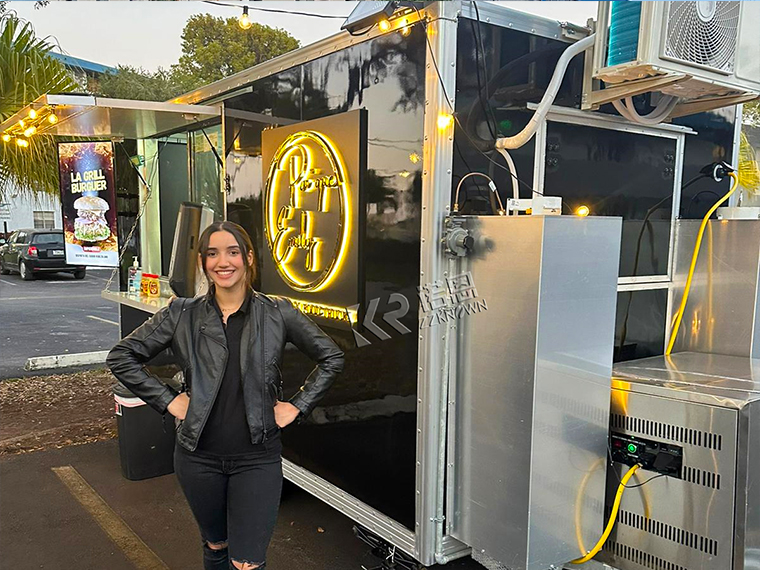
The ZZKNOWN KN-FS400 4-meter / 13-foot square food trailer project is a practical example because its published equipment list includes a 2-meter range hood, gas griddle, deep fryer, stove, air conditioner, dual-temperature refrigerator, workbench, and 3-meter serving window. The trailer is listed as 4 m × 2 m × 2.3 m (13 ft × 6.5 ft × 7.5 ft) with two axles.
That equipment list creates exactly the coordination puzzle discussed here: grease-producing cooking needs reliable capture; the hood exhaust removes a large amount of interior air; the AC is expected to improve comfort; and the long serving window changes the pressure boundary whenever it opens. The published page does not provide a final make-up-air CFM, and this article does not invent one. The final airflow schedule must be engineered for the selected hood and destination.
.jpg)
For related planning, see the food trailer fire-safety guide and the American-style food trailer chimney installation guide. Ventilation, grease ducting, fire suppression, fuel systems, and airflow are connected, but they remain separate approval questions.
Which make-up-air design mistakes cause the most trouble?
Can the serving window be used as the main air inlet?
Relying on the service window may appear inexpensive, but the airflow changes whenever the window opens, closes, faces wind, or is blocked by staff and customers. It can also pull hot, dusty, humid, or cold air across the service counter. Use it only as part of an explicitly reviewed design, not as an accidental solution.
Can a bigger exhaust fan solve smoke spillage?
Sometimes spillage comes from insufficient exhaust, but increasing fan speed without increasing replacement air can worsen negative pressure and energy use. Check filters, hood geometry, appliance position, cross drafts, duct resistance, fan performance, and make-up air as one system.
Can supply air be aimed directly at the hood?
A direct high-speed jet can push the cooking plume out from under the hood or short-circuit into the exhaust. Good distribution favors controlled, low-velocity delivery supported by the hood manufacturer's data and field testing.
Can the AC unit provide all required make-up air?
Many trailer air conditioners primarily recirculate indoor air. Unless the selected unit and duct design provide a documented outdoor-air quantity, do not count its nominal cooling airflow as make-up air.
Can the airflow plan wait until the trailer arrives?
Late changes can require new roof or wall openings, relocated lights, wiring, suppression piping, cabinets, or equipment. The best time to discuss make-up air is before the layout is approved and before stainless interior panels are installed.
What should be checked before ordering the trailer?
| Information to send | Why it affects airflow | What should come back |
|---|---|---|
| Menu and peak production | Defines cooking duty, heat, grease, steam, and simultaneous use | Cooking-duty review and appliance line |
| Exact appliance models, dimensions, fuel, and heat input | Determines plume, combustion, clearances, and hood coverage | Dimensioned equipment schedule |
| Hood manufacturer, type, listing, length, depth, and required exhaust | Provides the starting design airflow and installation limits | Hood and exhaust schedule |
| Destination, climate, and operating season | Controls heating, cooling, humidity, intake protection, and code pathway | Tempering recommendation and compliance questions |
| Door, serving window, and customer workflow | Openings affect pressure and cross drafts | Airflow-aware floor plan |
| Electrical service, generator, and gas availability | Limits fans, heaters, cooling, and controls | Utility-load schedule |
| Local inspector or plan-review comments | Identifies adopted code, certification, and test requirements | Revision list for local approval |
| Commissioning responsibility | Confirms who measures and adjusts the finished system | Test plan and records |
What do real buyers usually ask about food-truck make-up air?
1. Does every food trailer with an exhaust hood need make-up air?
The exhausted air must always be replaced. Whether local rules require a dedicated mechanical make-up-air unit, allow transfer air, or accept a combination depends on the hood, total exhaust, fuel-burning appliances, trailer construction, and jurisdiction. Ask the local mechanical and fire authorities before production.
2. Why is my food trailer door hard to open when the hood is on?
The exhaust fan may be lowering indoor pressure enough that outdoor pressure pushes the door closed. Hinge condition, seals, wind, and door hardware can also contribute. Compare the door force with the hood off and on, then have the airflow balance measured instead of guessing.
3. What percentage of exhaust should the make-up-air unit supply?
There is no safe universal percentage for every trailer. Some published guidance and hood strategies use target relationships, but the final value must account for all supply, transfer, exhaust, infiltration, desired pressure, combustion, hood performance, and local code. Ask for an air-balance schedule in CFM or L/s, not just a percentage.
4. Is make-up air the same as ventilation or air conditioning?
No. Exhaust ventilation removes contaminated air; make-up air replaces it; air conditioning changes temperature and humidity. A coordinated system can combine functions, but the plans and equipment data must show exactly how much outdoor air is delivered and how it is treated.
5. Can I use untempered outside air to save money?
Possibly in a mild climate or limited seasonal operation, if local rules permit and distribution does not disturb the hood. Compare the lower equipment cost with staff comfort, heating/cooling load, humidity, freeze risk, and energy use over the trailer's real schedule.
6. How do I know whether the hood is capturing properly?
Visible smoke or heat escaping the hood edge is a warning, but proper commissioning goes further. A qualified technician should verify exhaust and supply airflow, observe capture and containment under representative appliance operation, check controls and interlocks, and record the results.
7. Can a make-up-air grille go beside a fryer or gas burner?
Only when the engineered distribution and approved equipment arrangement allow it. Air velocity can cool food, disturb flames, affect pilots, or push grease vapor out of the hood. Send exact appliance and diffuser locations for review.
8. What does ZZKNOWN need to recommend a hood and make-up-air layout?
Send your menu, equipment list, model numbers, fuel type, heat inputs, desired trailer size, staff count, service-window plan, destination, climate, utility supply, and local inspector requirements. Photos or sketches help, but dimensions and nameplate data are essential.
Which official sources should your designer check?
- UK Health and Safety Executive — Ventilation of kitchens in catering establishments
- U.S. Department of Energy — Guidance on Demand-Controlled Kitchen Ventilation
- U.S. Department of Energy — Kitchen Equipment and Design
- ASHRAE Handbook — Kitchen Ventilation
- ICC Digital Codes — 2022 NYC Mechanical Code, Chapter 5
Use the editions adopted by your destination. A public guide helps you prepare the right questions; it does not replace sealed drawings, a hood listing, permits, inspection, or field commissioning.
Would you like a hood and make-up-air recommendation for your menu?
Send Your Cooking Equipment List → Get a Hood + Make-Up Air Recommendation
Include your destination, trailer size, appliance model numbers, fuel types, heat inputs, and preferred service-window position. ZZKNOWN will organize the information into a layout discussion for your local engineer and authority review.
Request a Food Trailer Airflow & Layout Review