
Food Trailer Refrigeration in Hot Weather: How Do Ambient Ratings and Airflow Protect Your Cold Food?
- Cabinet set temperature and ambient rating answer different questions: one is the target inside; the other is the room temperature the machine is designed to work in.
- “Commercial refrigerator” is not a universal high-heat rating. Current Hoshizaki models, for example, publish maximum ambient limits ranging from 90°F to 100°F depending on the model.
- A front-breathing refrigerator can be easier to integrate under a trailer counter, but its front intake and discharge grille still needs a clear path.
- Door openings, warm loading, dirty coils and recirculated condenser air can defeat an otherwise suitable model.
- FDA cold-holding guidance concerns food temperature; a refrigerator display or setpoint alone does not prove that food stayed within the required limit.
- Hot-climate design should coordinate refrigeration, air conditioning, make-up air, electrical capacity and cooking equipment before production.
Why can the same refrigerator work in a factory but struggle in a Texas summer?
Picture a new trailer on a mild factory day. The refrigerator is empty, the doors stay closed and no fryer is running beside it. The controller quickly reaches its setpoint. A few months later, that same cabinet is parked on sun-heated asphalt in Texas. The service window is open, a griddle and fryer are operating, staff open the refrigerator every minute, and warm boxes of ingredients arrive during the lunch rush. The machine is no longer solving the same heat-load problem.
A refrigeration system moves heat from the cabinet into the surrounding kitchen. As the air around the condenser gets hotter, the temperature difference available for rejecting heat shrinks. The compressor may run longer, cabinet recovery slows, energy use rises and the equipment has less margin for door openings or warm loading. If hot discharge air is trapped in a cabinet and pulled back into the intake, the refrigerator can create its own hotter microclimate.
That is why a factory “cooling test” is not enough. A buyer needs model-specific performance data and an installed-condition test. The ZZKNOWN food trailer temperature-monitoring guide explains how independent sensors and time-stamped trends can reveal slow recovery that a quick display check misses.
What is the difference between set temperature and ambient temperature rating?
The setpoint is the control target inside the refrigerator. The ambient range is the surrounding-air range in which the manufacturer says the equipment may operate. Neither number should be guessed from the other. A controller that can be set to 35°F does not guarantee that the cabinet will hold food safely when the surrounding kitchen reaches 105°F.
Real equipment makes the distinction clear. Hoshizaki currently lists its UR36B-D2 undercounter drawer refrigerator with a 32–52°F control setpoint range and a 45–100°F ambient range. The HR24A undercounter model is listed for 60–95°F ambient, while the compact HR15A publishes a 45–90°F ambient range. All are commercial products, but their limits are not interchangeable.
| Real model | Published ambient range | Published cabinet/control range | Layout lesson for a trailer buyer |
|---|---|---|---|
| Hoshizaki UR36B-D2 | 45–100°F (7–38°C) | 32–52°F setpoint range | Front-breathing, 36-inch undercounter format can suit a tight kitchen, but 100°F remains an operating limit—not unlimited heat tolerance. |
| Hoshizaki EUR48A | 45–100°F (7–38°C) | 33–39°F setpoint range | Two-section, 47.75-inch front-airflow cabinet offers more storage; verify circuit, aisle depth and service access. |
| Hoshizaki HR24A | 60–95°F (16–35°C) | 36–50°F setpoint range | A five-degree lower maximum ambient rating can matter inside an unconditioned trailer near cooking equipment. |
| Hoshizaki HR15A | 45–90°F (7–32°C) | 28–40°F setpoint range | Compact size does not automatically mean suitable for a hotter enclosed kitchen. |
Does NSF testing mean every refrigerator can handle a 100°F kitchen?
No. This is a place where a technically true sentence can become a misleading sales claim. In a 2023 commercial-refrigeration rulemaking document, the U.S. Department of Energy recorded industry comments that ANSI/NSF 7-2019 requires self-contained storage refrigerators to be tested for maintaining specified air temperature in 100°F ambient conditions. ENERGY STAR’s current commercial refrigerator criteria also cite ANSI/NSF 7-2019 and the applicable UL commercial-refrigeration safety standards.
But equipment categories and intended uses differ. Display refrigerators, beverage coolers, prep tables, open units and other configurations may be tested or classified differently. ENERGY STAR eligibility itself does not cover every refrigerator type used in foodservice. Most importantly, the installed model’s listing, manual and operating limits control. Do not buy from the sentence “NSF commercial refrigerator” alone; ask for the model number, certification record, data sheet and installation manual.
The safest buying question is simple: At what ambient temperature is this exact model designed and listed to maintain the required product condition, and what clearances and ventilation does that statement assume?
What does the FDA Food Code require—and what does it not prove?
The 2026 FDA Food Code is the latest U.S. model code available when this guide was updated. It is guidance for adoption by jurisdictions, not automatically the law in every state, county or city. Its cold-holding framework generally uses 41°F (5°C) or less for time/temperature control for safety food. Buyers must check the edition and amendments actually adopted where the trailer will operate.
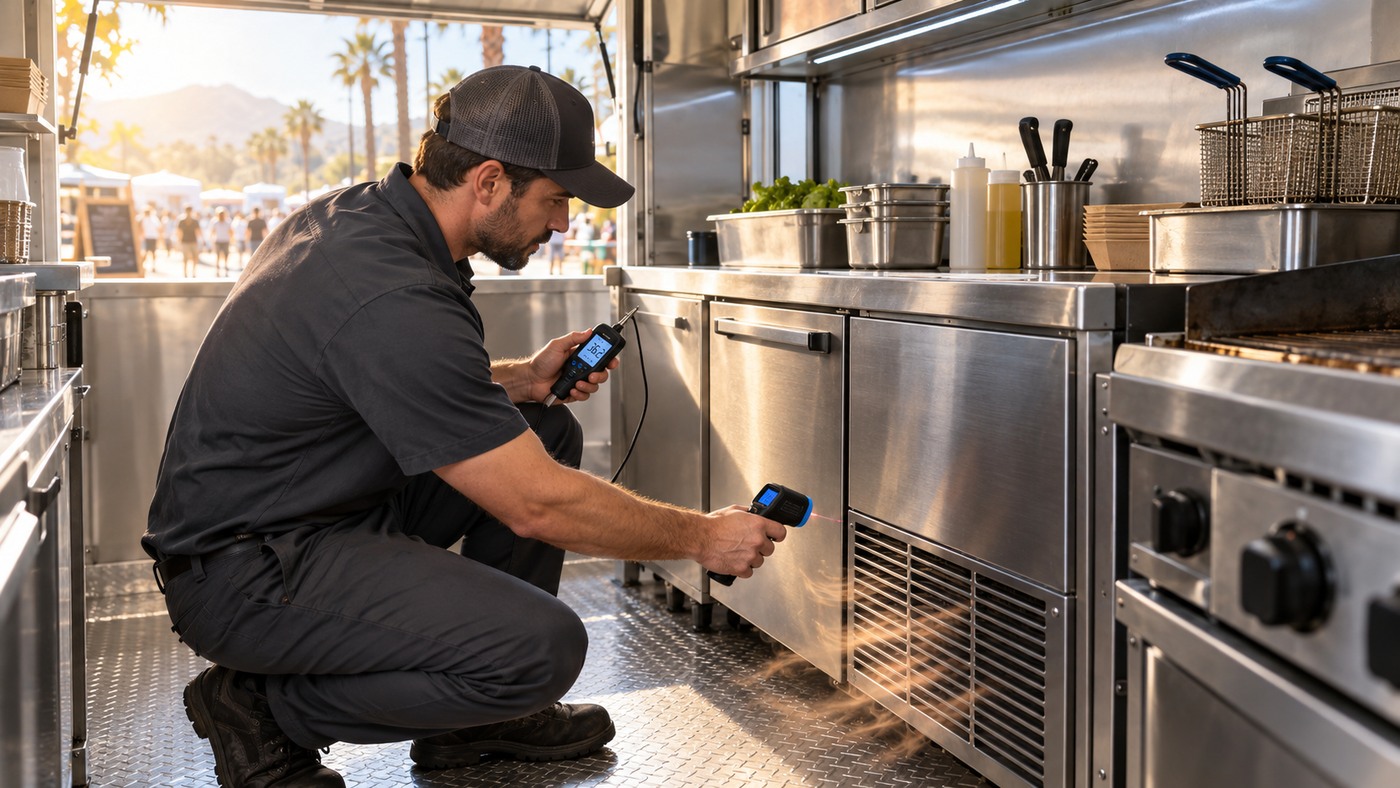
That limit applies to food holding, not merely to the thermostat display. Air warms quickly when a door opens; food warms more slowly. A sensor beside the evaporator may look reassuring while the warmest loaded zone recovers poorly. For safety decisions, operators need an approved monitoring plan and calibrated product checks. For design decisions, they need recovery data under realistic ambient, loading and door-use conditions.
Why does condenser airflow matter so much in a narrow trailer?
The condenser releases the heat removed from the food cabinet plus heat produced by the compressor. It needs a steady supply of cooler intake air and a clear route for warmer discharge air. In a building kitchen, the room volume may absorb and remove that heat. In a compact trailer, a refrigerator can sit inside a tight cabinet only inches from a fryer, wall panel, storage bin or decorative kickplate.
Front-breathing equipment is helpful because its engineered intake and discharge are at the front. That can reduce side and rear clearance demands on some models. It does not mean the grille can be covered. A menu board, floor mat, removable panel or stock box can block the same airflow the layout was designed to protect. Rear-venting and side-venting models need the manufacturer’s specified clearances and cannot be treated as built-in equipment unless approved for that installation.
- Keep condenser intake and discharge openings unobstructed.
- Prevent warm discharge air from looping directly back into the intake.
- Leave service access for coil cleaning, filter removal and refrigeration repairs.
- Do not share a sealed cabinet with another heat-rejecting appliance.
- Follow the manufacturer’s clearance, caster or leg, floor and enclosure instructions.
How much do fryers, griddles and sunlight change the refrigeration load?
Outdoor weather is only the first layer. Direct sun heats the roof and walls. A black exterior or unshaded service side can raise surface temperatures further. Fryers, griddles, ovens, water heaters and ice machines release sensible heat into the kitchen. Make-up air can bring outdoor heat inside, while an open service window allows repeated exchange. The air conditioner may cool the crew area, but its capacity and air path are not automatically coordinated with the refrigerator’s condenser zone.
Separation helps. Do not place a refrigerator condenser intake directly beside a fryer, under an uninsulated hot counter or in the exhaust path of another machine. Use the equipment manual and a scaled layout to protect airflow. Where the menu permits, a worktable, insulated partition or cool-prep zone can create distance between hot and cold equipment. The solution is not to blow grease-laden hood air across a condenser; ventilation systems must follow their own listed design.
According to ZZKNOWN’s production experience, buyers avoid expensive rework when the refrigeration models are frozen before counter fabrication. The engineering team can then reserve the correct opening, ventilation path, dedicated circuit, door swing, aisle clearance and service panel. The final installation and commissioning still need approval under the destination market’s requirements.
Why do frequent door openings and warm loading slow recovery?
Every door opening replaces cold cabinet air with warm, humid kitchen air. Moisture can condense or freeze on coils, products and doors. During a rush, the cabinet may never enjoy the long closed period used in a showroom demonstration. Loading warm drinks, sauces or freshly prepared ingredients adds a larger heat load because the system must cool the product, not just the air.
A refrigerator intended for holding is not necessarily a rapid chiller. Do not expect it to safely cool deep pans of hot food unless the equipment and food-safety process are specifically designed for that task. Organize ingredients by service frequency, use correctly sized containers, avoid overpacking, keep internal air passages open and restock in smaller planned batches. A self-closing door helps only if containers do not prevent it from sealing.
Recovery time is the useful performance metric: after a realistic door-opening pattern or approved warm-load test, how long does the warmest representative zone take to return to its normal operating band? Log that time on a mild day and a hot day. A lengthening trend can warn of coil fouling, gasket damage, restricted airflow or declining refrigeration performance.
How should you compare refrigeration options and project cost?
Do not compare only purchase price or cabinet liters. A cheaper refrigerator may require more cabinet modification, more airflow space, more energy, or earlier replacement if it is operated outside its limits. The table below uses relative cost impact because equipment prices and labor vary by country, voltage, certification and distributor.
| Design choice | Typical upfront impact | Hot-climate advantage | What to verify before ordering |
|---|---|---|---|
| Standard light-duty undercounter cabinet | $ | Lowest initial cost and compact footprint | Maximum ambient, duty classification, food-storage approval and warranty limits |
| High-ambient commercial holding refrigerator | $$–$$$ | More operating margin in a hot kitchen when installed correctly | Exact model rating, certification, power, refrigerant, clearance and local service |
| Front-breathing commercial undercounter model | $$–$$$ | Easier airflow planning beneath a counter | Front grille must remain open; confirm door/drawer extension and service access |
| Reach-in refrigerator away from cooking line | $$–$$$$ | More storage and potential separation from heat sources | Trailer height, axle load, restraint, aisle, door swing and electrical demand |
| Air-conditioning and insulated-envelope upgrade | $$–$$$$ | Reduces kitchen ambient load for people and equipment | Cooling calculation, make-up air, service window, generator/shore power and condensate |
| Independent monitoring and alarm package | $–$$$ | Shows recovery trends and warns of power or temperature loss | Probe placement, calibration, connectivity, alarm ownership and records |
Which real ZZKNOWN project shows the planning problem clearly?
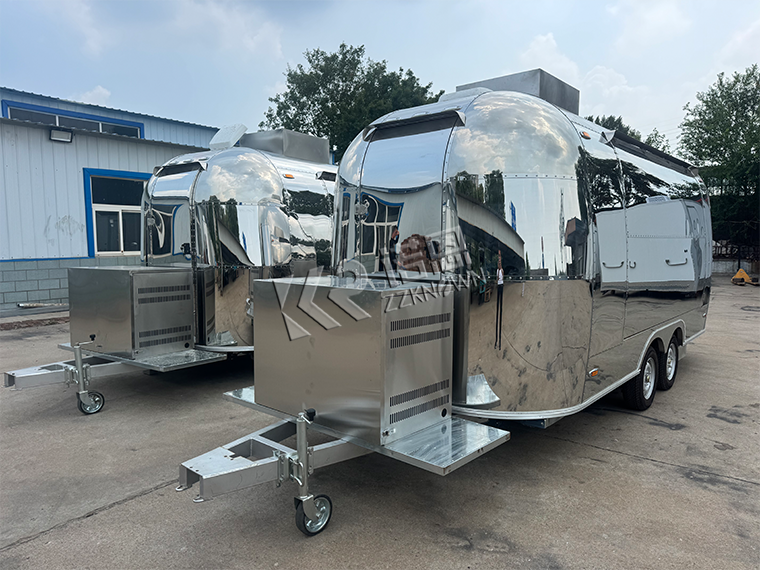
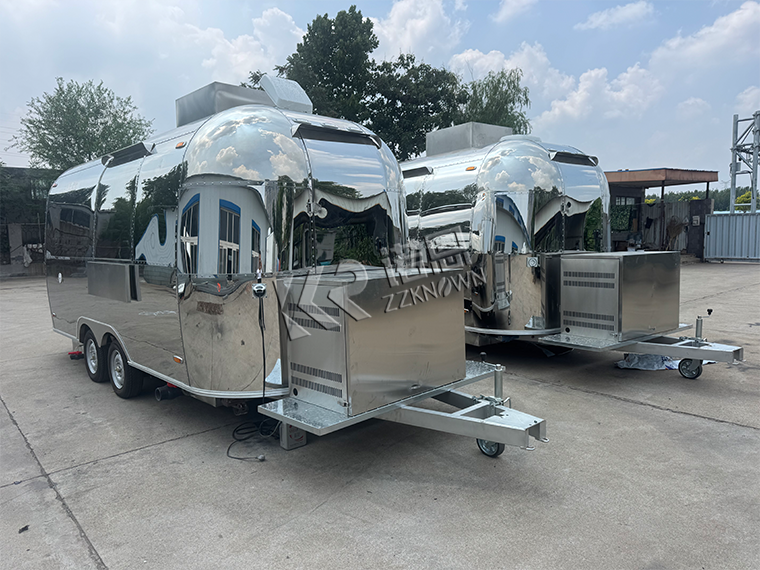
The real ZZKNOWN KN-QF500 Ice Cream & Bakery Food Truck is a useful example because its business depends on several cold zones, not one generic fridge. Its published configuration is a 5 m × 2 m × 2.3 m dual-axle trailer with a 2 m dual-temperature refrigerator, an ice cream display cabinet and a cake display refrigerator. The page also lists 110V/60Hz U.S.-standard power, ten sockets, an external power connection, ceiling air conditioning and a removable generator box.
Those verified specifications show the coordination challenge. Three refrigeration zones, air conditioning, lighting and other business loads must share a mobile electrical system and limited interior volume. The product page does not state that every cold cabinet is rated for every climate, so a new order should identify the destination climate and exact refrigeration models. The project is a planning reference, not a blanket high-ambient certification.
What should an engineer ask before approving the layout?
- Define the food duty. Is the cabinet holding pre-chilled ingredients, cooling prepared food, displaying packaged drinks, freezing product or serving as a prep table?
- Define the real ambient. Use expected trailer-interior conditions during operation, not only the city’s weather-app temperature.
- Collect exact data sheets. Record ambient range, temperature range, dimensions, airflow direction, clearances, amps, plug, refrigerant and certification.
- Map every heat source. Include cooking appliances, ice machines, compressors, sunlight and hot make-up air.
- Protect the electrical supply. Give refrigeration an appropriately designed circuit and account for compressor starting current and voltage limits.
- Plan cleaning and service. A condenser that cannot be reached will not stay clean.
- Commission under load. Test doors, realistic stock, cooking and ventilation together on the finished trailer.
How should the installed system be tested before opening?
Start with the equipment manual and local plan-review requirements. Confirm the trailer is level as required, the circuit voltage is correct, plugs and breakers are approved, door gaskets seal, condenser openings are clear and no transport damage is visible. Let the cabinet stabilize empty, then test it with a representative approved load. Do not block internal air passages with pans or boxes.
Run the trailer in a realistic service condition: cooking equipment on, hood and make-up air operating, service window in its normal position, air conditioning at the planned setpoint and staff opening the refrigerator on a repeatable schedule. Record kitchen ambient, refrigerator air trend and selected product-simulator or product temperatures using the approved method. Check recovery after restocking. The related pre-opening operational test guide can help organize a full-system rehearsal.
One successful hour is not lifetime proof. Keep the data as a commissioning baseline. Operators should clean condenser surfaces on the manufacturer’s schedule, inspect door gaskets, keep intake areas free, review temperature records and call qualified refrigeration service when recovery worsens. Refrigerant work and electrical repair are not do-it-yourself trailer maintenance.
How was the information in this guide collected?
Data collection method: On September 24, 2026, we reviewed the FDA Food Code 2026 landing page and publication, DOE commercial-refrigeration rulemaking material, current ENERGY STAR commercial refrigerator criteria, current Hoshizaki model pages for UR36B-D2, EUR48A, HR24A and HR15A, and the published ZZKNOWN KN-QF500 product page. We compared model-level ratings rather than treating “commercial refrigerator” as one performance class.
Evidence boundary: Manufacturer ratings apply only to the exact listed model, suffix, voltage and installation conditions. An ambient range is not a guarantee of performance with blocked airflow or excessive loading. FDA Food Code provisions are model rules until adopted locally. Cost symbols are comparative planning indicators, not quotations. Final food-safety, electrical, HVAC and equipment decisions require local professional review.
What do buyers ask about food trailer refrigerators in hot weather?
1. Is a refrigerator rated to 100°F enough for a trailer in 100°F outdoor weather?
Not automatically. The air at the condenser may be hotter than outdoor air because of solar gain, cooking appliances and recirculated discharge. Measure or calculate the expected installed ambient and keep design margin.
2. Does a 2–8°C specification prove the cabinet will hold food safely?
No. It describes a temperature range or control target, not necessarily the ambient conditions, loading pattern or recovery performance. Ask for the exact model’s data sheet and certification.
3. Is front-breathing refrigeration always zero-clearance?
Only follow the exact manufacturer’s installation instructions. Front breathing can reduce side and rear airflow requirements, but the front grille, leveling, service access and any stated clearances still matter.
4. Can I install a refrigerator directly beside a fryer?
Avoid exposing the condenser and cabinet to unnecessary radiant and convective heat. The final separation, barrier and appliance arrangement should be designed from the equipment manuals, hood plan and local requirements.
5. Why is my refrigerator cold overnight but warm during lunch?
Frequent door openings, warm restocking, blocked internal airflow, cooking heat or inadequate condenser ventilation may exceed the available recovery capacity. Temperature logging helps distinguish the pattern.
6. Should the air conditioner be sized to cool the refrigerator too?
Refrigerators reject heat into the trailer, so they contribute to the HVAC load. A qualified designer should coordinate the people load, solar gain, ventilation, cooking and all heat-rejecting equipment.
7. Can a domestic refrigerator be used in a food trailer?
Many jurisdictions require equipment that is approved for commercial foodservice, cleanability and intended duty. Domestic equipment may lack the rating, recovery, durability or certification needed. Ask the local authority before purchase.
8. What should I send ZZKNOWN for a hot-climate refrigeration review?
Send the destination city, operating season, menu, daily stock, refrigerator model/data sheet, cooking equipment, trailer color, service hours, voltage/frequency, shore-power limit, generator plan and desired trailer size.
Where can you verify the official and manufacturer information?
- U.S. FDA — Food Code 2026
- U.S. DOE — Commercial Refrigeration Equipment Test Procedure Rulemaking
- ENERGY STAR — Commercial Refrigerators and Freezers Key Product Criteria
- Hoshizaki — UR36B-D2 product data
- Hoshizaki — EUR48A product data
- Hoshizaki — HR24A product data
- Hoshizaki — HR15A product data
Do you want a refrigeration layout designed for your real climate?
Send ZZKNOWN your operating city, menu, refrigerator model, cooking-equipment list, voltage and service schedule. Our engineering team can prepare a hot-climate layout review covering heat-source separation, condenser airflow, circuits, access and monitoring—ready for final checking by your equipment supplier and local authority.
Request a Hot-Climate Layout ReviewExplore ZZKNOWN OEM/ODM