Direct answer: A smoothie food truck does not have one guaranteed profit margin. Calculate profitability from your actual selling price, recipe cost, packaging, waste, payment fees, labor, site fees, permits, insurance, utilities, towing, maintenance and marketing. Published percentages such as 10%–30% should be treated only as planning references unless the source, market and accounting method are clearly stated.
Data scope: United States planning example for 2026. Prices, wages, permits and operating costs vary by country, state and city.
People often quote one percentage without explaining what has been deducted. That makes comparisons unreliable. Start with three simple figures:
| Measure | Simple formula | What it tells you |
|---|---|---|
| Gross margin | (Sales − food and packaging cost) ÷ Sales | How much remains after direct product cost. |
| Contribution per order | Selling price − variable cost per order | How much one sale contributes to fixed costs and profit. |
| Operating margin | Operating profit ÷ Sales | What remains after normal operating expenses. |
For startup planning, the U.S. Small Business Administration recommends identifying one-time and monthly expenses and using a break-even analysis. See the SBA business planning resources.
Write a recipe card for every menu item. Record the usable quantity of fruit, liquid, yogurt or milk, protein powder, ice and toppings. Then add the cup, lid, straw, napkin, card fee and an allowance for waste. Update the worksheet whenever supplier prices or portion sizes change.
Ingredient prices move over time, so a copied percentage can become stale quickly. The USDA Food Price Outlook is one useful reference for U.S. food price trends, but your invoices are the source that matters for your own calculation.
The following example teaches the method. It is not a ZZKNOWN customer result, quotation or income guarantee.
| Illustrative input | Amount |
|---|---|
| Selling price per smoothie | $8.00 |
| Ingredients and ice | $2.20 |
| Packaging | $0.45 |
| Payment fee | $0.30 |
| Waste allowance | $0.25 |
| Total variable cost | $3.20 |
| Contribution per order | $4.80 |
If monthly fixed costs are $8,000, the break-even volume is approximately 1,667 orders per month ($8,000 ÷ $4.80), or about 64 orders per operating day across 26 days. Replace every number with your own local figures. Then run a lower-sales and higher-cost scenario before committing capital.
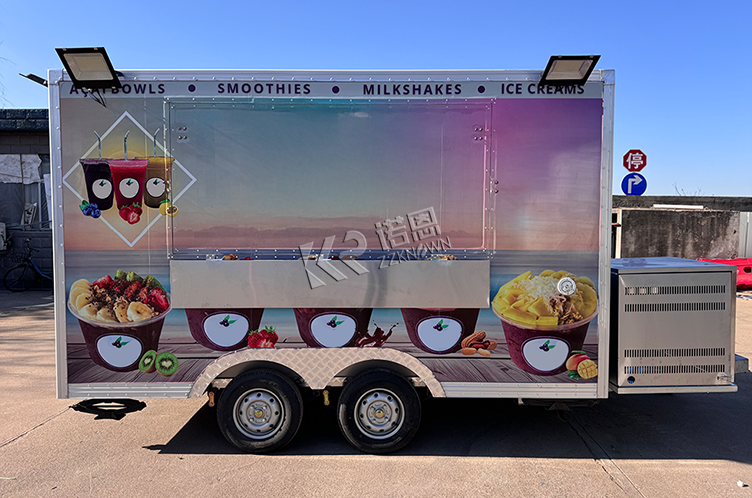
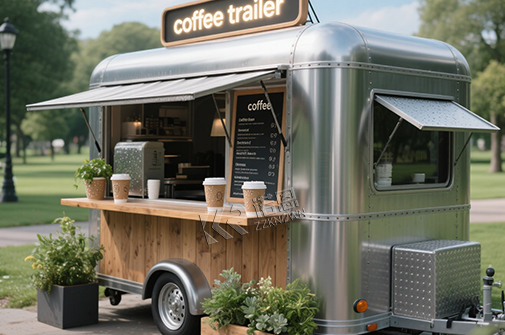
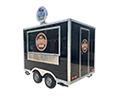
Documented 3.5 m smoothie trailer reference. Review the project details.
A cautious forecast includes more than ingredients. Check each item with the relevant supplier or authority:
Labor assumptions should be checked against current local wage data. For a U.S. benchmark, review the Bureau of Labor Statistics information for food preparation workers.
A short menu can reduce ingredient overlap, storage demand and preparation steps. However, the trailer still needs a safe flow from cold storage and washing to blending, finishing and service. When two people work inside, place high-use equipment so they do not repeatedly cross paths.
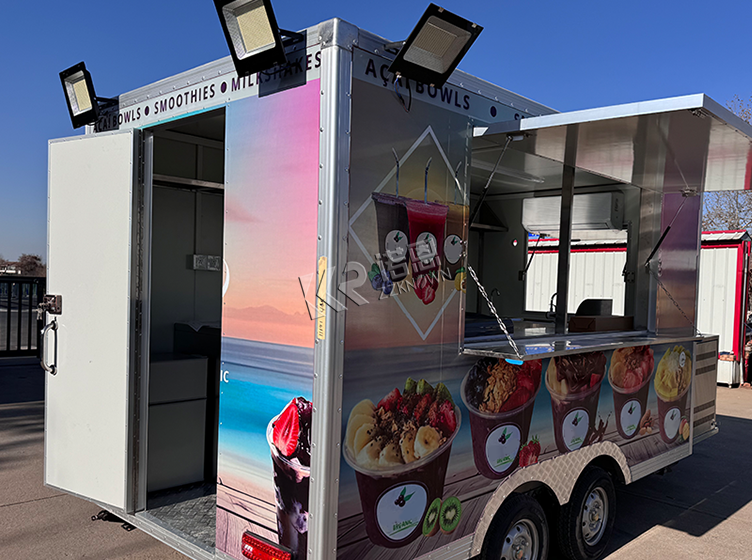
Plan operator movement, serving access and equipment clearance before production. See the food trailer layout guide.
According to ZZKNOWN’s production experience, buyers should confirm their menu, team size, destination, voltage and equipment list before approving a layout. A custom square food trailer can be configured around those requirements, but the equipment list and local approval requirements must be reviewed for the destination market.
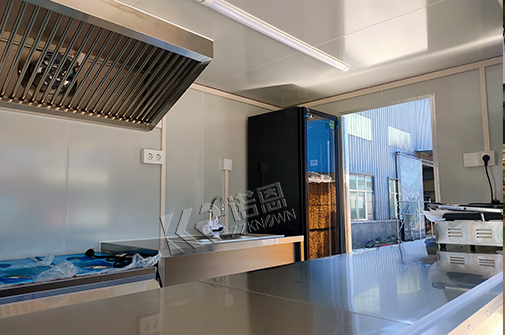
One published ZZKNOWN project documents a trailer measuring 3.5 × 2 × 2.35 m, used for smoothies and cold drinks. The recorded configuration includes 110V/60Hz sockets, refrigerator, freezer, blender space, sinks, counters and shelving. The project page does not state the destination, so no country claim is made here.

Equipment and workspace reference from the documented smoothie trailer page.
This configuration is evidence of a layout and equipment arrangement—not proof of sales, profit, payback period or approval in every market. Buyers can also browse real customer projects and review how ZZKNOWN handles factory production and quality control.
Food-service rules are local. Confirm plan review, sinks, handwashing, water and wastewater capacity, refrigeration, surface materials, ventilation, fire protection, gas or electrical inspection and mobile-unit permits with the relevant authorities before ordering. The FDA Food Code is a U.S. model code, not a permit. Check the FDA’s state retail and food-service code directory and then contact your city or county authority.
Before comparing overseas quotations, also calculate freight, import charges and destination costs with the shipping and landed cost guide.
No. Any percentage without a named market, time period, cost definition and source is only a broad planning reference. Your actual operating margin depends on real sales and all operating expenses.
Yes. Include a realistic wage or owner compensation so the calculation does not mistake unpaid labor for profit.
Divide monthly fixed costs by contribution per order. If either figure changes, the required order count changes too.
No. A smaller trailer may change purchase, towing or site costs, but capacity, storage and workflow may also be lower. Compare the complete operating model.
Provide the menu, expected team size, preferred body size, destination, voltage, cooking or refrigeration equipment, water needs, serving-window position and branding requirements.
No single factory document replaces destination-specific vehicle registration, health, fire, gas or electrical approval. Buyers should confirm local requirements before ordering.
Yes. Separate the factory price from inland transport, ocean freight, insurance, port charges, customs, tax and final delivery.
Share your menu, destination market, preferred size, team size and equipment list. ZZKNOWN can prepare a layout and quotation for your review before production.
Request a Layout & Quotation Contact ZZKNOWNEditorial note: The numerical example is illustrative and does not predict business performance. Product configurations, prices, freight and local approval requirements must be confirmed for each order and destination.