



Why Does Ice Build Up Around a Freezer Trailer Door? A Practical Seal and Frost Prevention Guide
What are the key takeaways?
- A large refrigeration unit cannot indefinitely compensate for a leaking or badly aligned door.
- The sealing system includes the gasket, panel joints, frame, hinges, latches, threshold and drainage.
- Frost location is a clue: one icy corner often points to alignment or compression; a full frosted perimeter suggests broader leakage or operating conditions.
- A thermal break reduces heat conduction through a structure. It is different from a rubber gasket, and a low-temperature design may need both.
- Frame heaters can help selected designs, but they add electrical load and never repair a gap.
- Inspect demanding-service doors daily and trend temperature, door events and recurring frost.
Why can the refrigeration unit look normal while the rear door keeps icing?
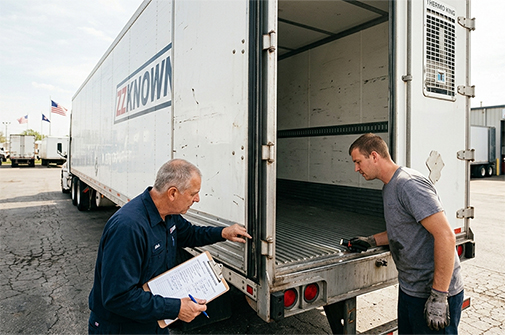
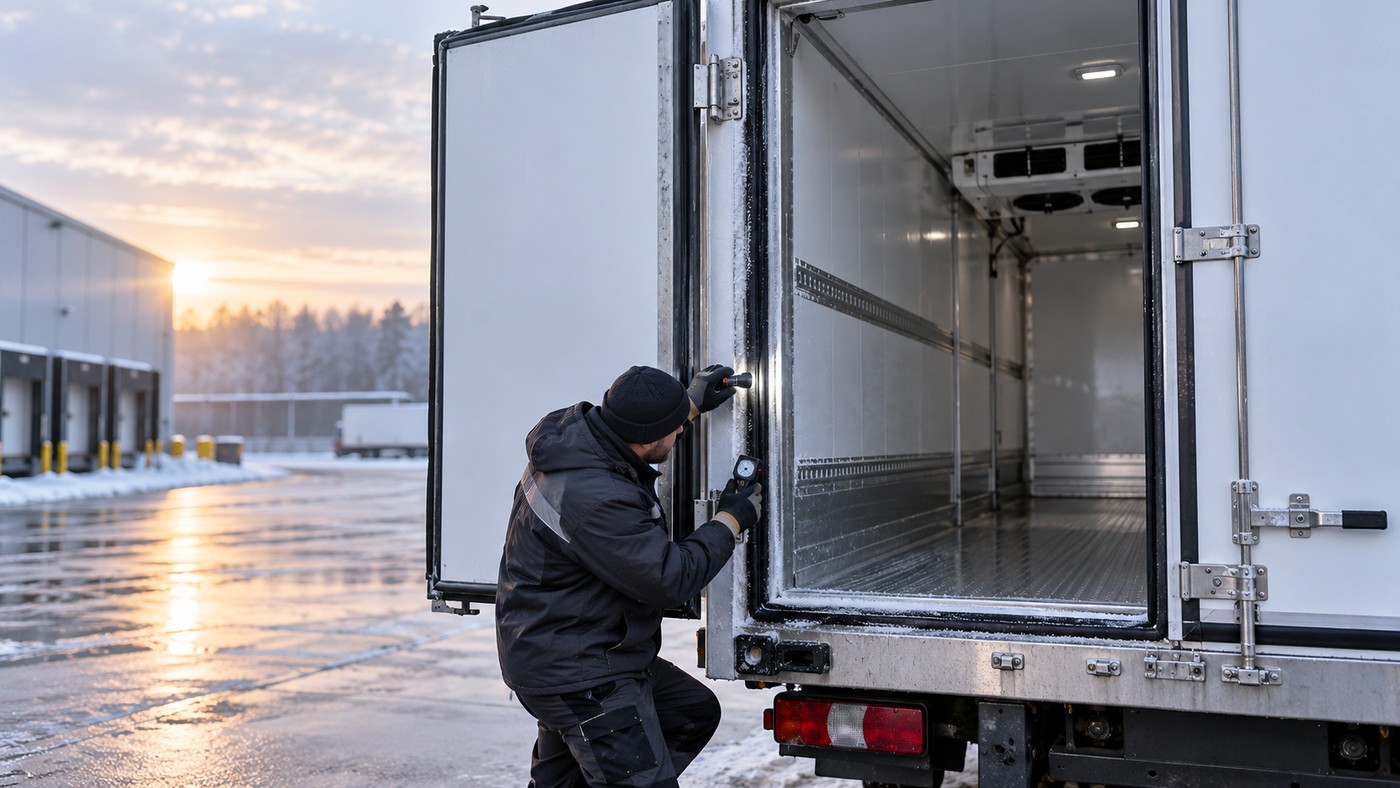
Picture a seafood distributor opening a freezer trailer before sunrise. The controller reads -20°C, the compressor sounds normal and the evaporator fans are running. Yet a white ridge of ice has returned along the lower latch-side corner. The operator removes it, loads the route and moves on. Two days later, the ridge is thicker.
The cooling unit may be doing exactly what it was designed to do. The door assembly is admitting moisture faster than the system and its defrost cycle can manage. Warm outdoor air carries water vapor. When that air reaches a cold frame, gasket or floor below its dew point, moisture condenses and freezes. Repeated openings add pulses of moisture, while a small permanent gap creates a continuous load.
This is why compressor capacity and panel thickness are only part of the specification. The rear opening is the largest planned break in the insulated envelope and one of the most mechanically stressed parts. It is opened, slammed, loaded against, vibrated on the road, washed, exposed to sun and rain, and sometimes parked out of level. The door must stay aligned and serviceable through all of that.
How does humid air get through a closed freezer trailer door?
A closed door is not automatically airtight. A compression gasket needs continuous contact around the perimeter. If the latch pulls the center firmly while one corner is bowed, the remaining gap may be almost invisible. Dust on the contact face, a torn gasket, a loose hinge, ice at the threshold or cargo trapped against the leaf can create the same result.
Pressure changes matter too. Evaporator fans, rapid pull-down and defrost can change compartment pressure. Do not improvise a vent through the insulated envelope. Ask how the approved door and pressure-management system works for the exact refrigeration design.
Door openings are the largest planned infiltration event. If the refrigeration package supports an approved door switch, ask the engineer how it signals an open door, coordinates fan operation and records door events. Confirm controller compatibility and wiring for the final unit; a generic add-on is not a substitute for an engineered control design.
What should a low-temperature gasket actually do?
The gasket fills the changing space between the moving door and fixed frame. It must remain flexible at the intended temperature, tolerate repeated compression and recover after opening. A seal that feels soft in a warm factory may stiffen in a freezer. A profile that fits the retainer but has the wrong bulb height may touch without compressing enough.
For a low-temperature opening, ask for the gasket material, continuous perimeter profile, compression range, replaceable corner and side details, corrosion-protected hardware, and an accessible spare-parts plan. For an insulated roll-up option, check panel joints, side seals, top closure, bottom channel and track alignment against the actual target temperature and duty cycle. A brochure label alone cannot show whether the complete opening seals under load.
A practical pre-use check is simple: verify that the doors close without forcing the latch, inspect for daylight or visible gaps around the gasket, remove debris from the threshold, and record any new frost pattern. Set inspection and replacement intervals using the final component manuals and observed operating duty.
What is the difference between a gasket and a thermal break?
A gasket reduces air exchange at a joint that must open. A thermal break interrupts a solid conductive path through the door or frame. Imagine a metal channel connecting the warm outside skin directly to the cold inside skin. Even without an air gap, that bridge conducts heat and can create a cold exterior surface where condensation or ice appears.
A thermal break uses a lower-conductivity section or separated construction to reduce that path. For any proposed door, ask the engineer to identify where through-metal bridges remain at the leaf, jamb, threshold and hardware penetrations. Request a section drawing; the phrase insulated door alone is not enough.
Why does ice often start at one corner or the threshold?
Location is diagnostic. Ice at an upper hinge corner can indicate door sag, hinge wear or frame movement. Ice near a latch can mean that the latch is not pulling the leaf evenly into the gasket. Frost at the threshold may come from a damaged bottom seal, debris, a distorted sill, standing wash water or a drain path that freezes. A vertical stripe may follow a panel joint or a damaged portion of gasket.
Road vibration magnifies small errors. Fasteners loosen, doors settle and a loaded chassis flexes differently from an empty one. Repeated pallet and cart impacts can deform skins or gasket retainers. Parking on an uneven surface may twist a compact trailer enough to change contact.
Based on ZZKNOWN's production experience, the useful question is not only, Does the door close? It is, Does it compress the specified seal continuously when the trailer is level, loaded as intended and latched under its normal operating condition?
Should you choose swing doors or an insulated roll-up door?
Neither layout wins automatically. Swing doors can provide thick leaves, broad access and comparatively simple perimeter seals. They need exterior clearance, secure holdbacks in wind, strong hinge support and careful alignment. An insulated roll-up door saves exterior swing space and can speed urban loading, but it adds panel joints, tracks, rollers, a top closure and side seals that require maintenance.
| Door option | Operational advantage | Leakage and frost watchpoints | Buyer questions |
|---|---|---|---|
| Double insulated swing doors | Broad opening; one or both leaves can open | Perimeter compression, center seal, hinge sag, latch adjustment, bottom sweep | Which gasket profile is used? How is compression adjusted? Are hinges and seals replaceable? |
| Insulated roll-up door | No exterior swing arc; useful at tight docks | Panel joints, side and top seals, bottom seal, tracks, rollers and cable balance | Is it rated for the target temperature? Which seals, rollers and cables are stocked? |
| Personnel access door | Smaller opening for frequent entry | High cycle count, closer function, threshold ice and gasket wear | Is it part of the tested envelope? How are safe exit and door-open alarms handled? |
Can a heated frame stop frost, and what are the limits?
Controlled heat can keep selected perimeter surfaces above the local dew point or prevent a freezer door from freezing shut. A U.S. Department of Energy walk-in cooler and freezer technical support document notes that non-display freezer doors may use heater wire and that controls can regulate anti-sweat heat. That source concerns walk-in equipment, not road trailers. We use it to explain the physics, not to declare a trailer requirement.
A mobile design faces vibration, washdown, flexible wiring, limited shore or generator power and different approvals. Any heater must be engineered into the frame, protected, controlled and included in the load calculation. It must not hide a torn gasket or misaligned latch. Extra heat also enters the cold space, so the refrigeration unit must remove part of it.
How do openings, cargo and climate affect frost?
Each opening replaces relatively dry cold air with warmer, wetter ambient air. The effect becomes severe at a humid port, summer market or washdown area. Twenty short delivery openings create a different profile from one long distribution-center opening. Buyers should state daily cycles, expected open time, ambient humidity, loading method and whether strip curtains or an approved air barrier are practical.
Warm cargo adds heat, while wet packaging and snow add moisture. A refrigeration unit designed to maintain frozen product is not automatically a blast freezer. Loading unfrozen cargo, blocking airflow or leaving doors open can keep the evaporator and threshold wet for long periods. Agree on cargo entry temperature, pre-cooling procedure, airflow clearance and temperature recovery test before production.
Which regulations should global buyers verify?
There is no single worldwide frost-proof approval. In the United States, the FDA FSMA Sanitary Transportation Rule may apply to covered food operations. FDA says covered equipment must be suitable, adequately cleanable and capable of maintaining temperatures needed for safe transport, and describes responsibilities for shippers, loaders, carriers and receivers. It does not prescribe one universal gasket or heater.
For relevant international road carriage of perishable foods, review the UNECE ATP Agreement text and status. As of this article's update, the UNECE page lists an ATP version valid from August 25, 2026. Applicability depends on route, countries, cargo and equipment classification. A door component or website temperature claim alone is not an ATP certificate.
Other markets may require local vehicle approval, electrical certification, refrigerant compliance, food-business licensing and documented temperature control. Confirm the exact destination and route with the authority, inspection body and logistics customer before production.
What does the real ZZKNOWN KN-FZ400 show buyers?
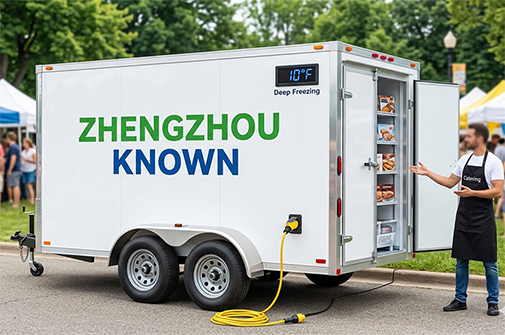
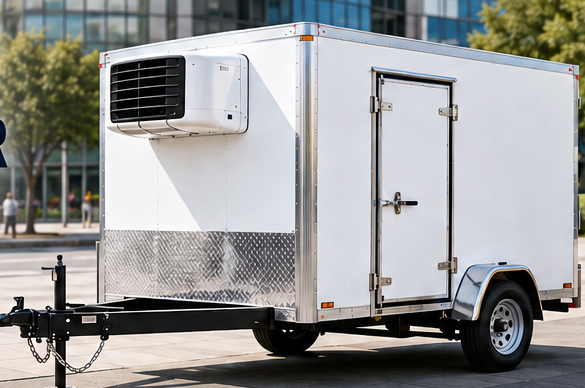
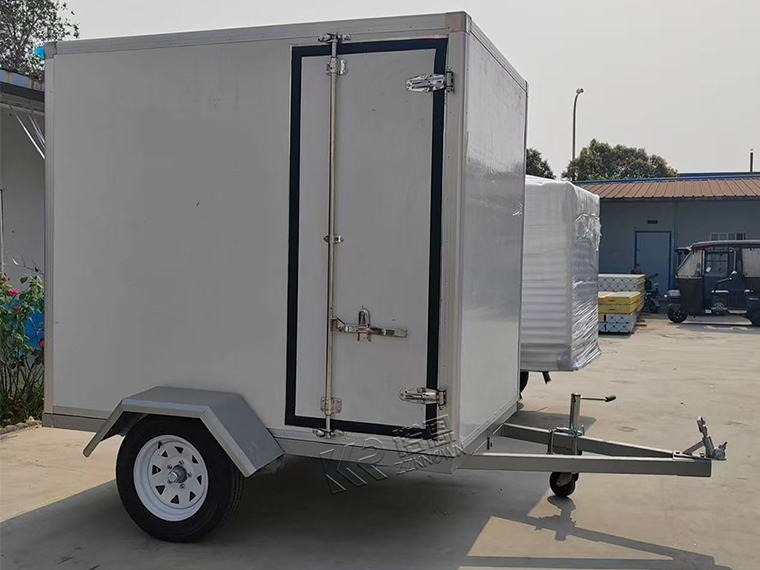
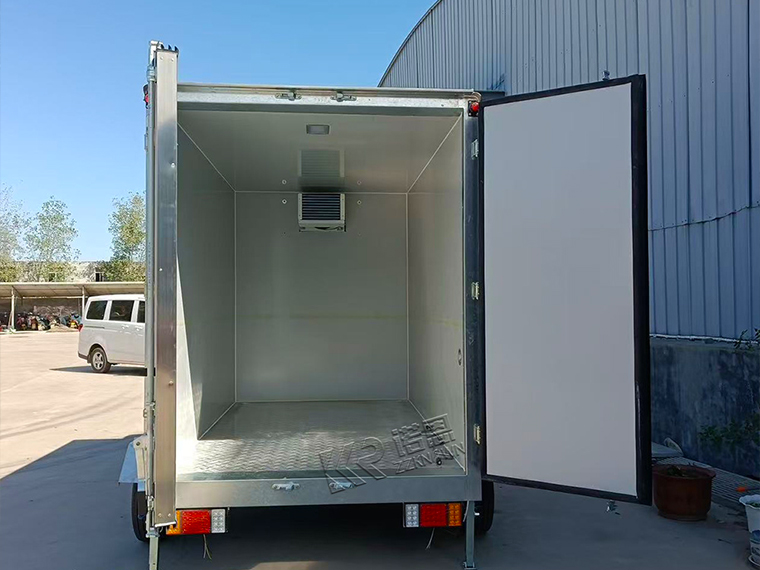
The real ZZKNOWN KN-FZ400 mobile refrigerated trailer is a planning reference. Its published page lists a 4000 × 2100 × 2550 mm external size, a -25°C to +10°C digital-control range, 110-240 V options, a 1,000-2,000 kg published payload range, polyurethane-foam sandwich panels with food-grade FRP lining, and dual-axle electric or mechanical brake options.
The page also describes rear double-swing doors with heavy-duty rubber seals. Those specifications show why the door must be settled with the full temperature, cargo, power and operating brief. They do not prove that every KN-FZ400 build has the same gasket compound, heater, certification or maintenance interval. Confirm all contract-specific details in the signed project schedule.
What should buyers compare before choosing a door package?
| Specification item | Lower upfront option | Higher-protection option | What changes total cost |
|---|---|---|---|
| Door construction | Standard insulated swing assembly | Verified low-temperature swing or insulated roll-up system | Opening size, panel thickness, hardware, rating and certification |
| Gasket | Replaceable standard compression seal | Verified low-temperature profile with documented spare | Material, perimeter, retainer, corners and spare quantity |
| Thermal bridge control | Basic insulated-frame details | Documented thermal-break sections at frame and threshold | Design, fabrication, testing and hardware penetrations |
| Frost management | Manual inspection and operating procedure | Approved door switch, alarm and controlled frame heat where justified | Controller compatibility, power, wiring, sensors and service |
| Monitoring | Local display and daily check | Door-event logging, alarms and temperature history | Gateway, subscription, probes, calibration and retention |
| Lifecycle support | Generic consumables where suitable | Documented part numbers and planned spare kit | Shipping distance, local stock, training and labor |
Fixed dollar figures would be misleading without the door opening, target temperature, voltage, destination, certification and duty cycle. Ask for line-item quotations using the same brief. A cheaper door can become the expensive choice if it leaks, damages cargo or requires overseas parts during peak season.
How should the door be inspected before delivery?
- Confirm documents: record door make or drawing, gasket profile, target temperature, wiring, control logic and parts list.
- Inspect geometry: check leaves, frame, center joint, threshold and retainers for damage or distortion.
- Verify closure: operate each hinge and latch and look for even gasket contact without forcing the handle.
- Test cold: pull down under the approved procedure and inspect for localized condensation, frost, gaps and abnormal hardware stiffness.
- Simulate use: follow an agreed opening schedule with representative load, ambient and humidity conditions, then record temperature recovery.
- Check defrost and drainage: verify drains remain open and water does not collect at the sill.
- Reinspect after transport: road vibration can change closure, so include the required road-test step.
- Create a baseline: save photos of gasket contact, hinge and latch positions, settings and accepted test results.
Thermal imaging and smoke or leakage methods can help when performed by trained personnel under an appropriate procedure. A colorful thermal image alone is not a pass/fail certificate; interpret it with surface materials, ambient conditions and the test method.
What maintenance routine helps prevent repeat icing?
Start with the exact trailer, door and refrigeration manuals. A practical routine normally includes a pre-use visual check, removal of debris from gasket and threshold, confirmation that latches operate normally, review of alarms and temperature history, and prompt documentation of any new frost pattern.
Clean rubber only with products approved by the gasket manufacturer. Harsh solvents, sharp scrapers and hot water on frozen parts can damage surfaces or create more ice. Never use a torch or open flame. If a door freezes shut, protect people and cargo, follow the approved thawing procedure and investigate the cause before returning the trailer to service.
Track repeated adjustments. A door that needs frequent tightening may have a deeper geometry, hardware or operating problem. Include gasket condition, hinge play, latch function, door-switch operation, heater current where applicable, drains and defrost performance in scheduled service.
For broader planning, see ZZKNOWN's small refrigerated trailer guide, portable freezer trailer guide, temperature-monitoring guide and refrigerated trailer resource center.
How was the information collected?
Data collection method: On October 14, 2026, we reviewed the live ZZKNOWN KN-FZ400 product page and its project images, the U.S. DOE walk-in cooler and freezer technical discussion, FDA sanitary-transportation resources, and the UNECE ATP text-and-status page. We used the official documents for regulatory or engineering context and the ZZKNOWN page for the product example.
Evidence boundary: DOE walk-in-door material explains relevant sealing and heater principles but does not automatically govern road trailers. FDA and ATP applicability depends on operation, route, cargo and jurisdiction. ZZKNOWN page figures describe the published model example, not every custom build. Final dimensions, materials, approvals, tests and maintenance instructions must be confirmed in the signed project specification.
What do real buyers ask about freezer trailer door seals?
1. Why does my freezer trailer door freeze shut overnight?
Moist air may be entering through a gap or may have entered during loading, then frozen during pull-down. Check gasket contact, hinge and latch alignment, threshold moisture, drains and the approved defrost routine. Do not assume the compressor is the cause.
2. Can I repair a torn gasket with tape or sealant?
A temporary patch may interfere with compression, hygiene and low-temperature flexibility. Follow the door manufacturer's repair or replacement method and record the exact profile and part number before removal.
3. Does a thicker door always prevent more frost?
No. More insulation can reduce conduction, but frost can still enter through a small air gap, misaligned joint or frequently opened door. Panel insulation, sealing, thermal breaks and operating practice must work together.
4. Should every -20°C trailer have a heated frame?
No universal rule makes that correct. Humidity, target temperature, door construction, opening frequency, power capacity and the tested design determine whether controlled heat is appropriate.
5. How often should a gasket be replaced?
There is no honest universal interval. Inspect at the frequency required by the manufacturer and duty. Replace after damage, hardening, permanent deformation or poor sealing that approved cleaning and adjustment cannot correct.
6. Is a roll-up door worse than swing doors for frozen cargo?
Not automatically. A low-temperature-rated roll-up system can work well when panels, joints, side and top seals, bottom channel, tracks and balance mechanism are designed and maintained for the duty.
7. What should I send ZZKNOWN for a door recommendation?
Send destination, cargo, required compartment temperature, ambient temperature and humidity, route, opening dimensions, daily door cycles, loading method, cleaning process, voltage, power limit, monitoring needs and certification requirements.
Where can you verify the main sources?
- U.S. FDA — FSMA Sanitary Transportation Rule
- UNECE — ATP text and status
- U.S. DOE — walk-in cooler/freezer technical support document
Do you want a freezer door package matched to your real route?
Send ZZKNOWN your cargo, target temperature, climate, door size, daily opening frequency, loading method, power standard and destination. Our engineering team can prepare a model-specific door and insulation review covering gasket type, thermal-break details, hardware, monitoring, frost controls, service access and spare parts, ready for confirmation by the component supplier and local authority.
Request a Freezer Door Configuration ReviewView the KN-FZ400 Refrigerated TrailerExplore ZZKNOWN OEM/ODM