If you've spent any time in Australia, you already know this truth:
Coffee here isn’t just a drink. It’s a standard.
Australians are famously picky about coffee—and that's exactly why a well-designed coffee trailer can thrive here… or fail fast if it's done wrong.
Over the years, I've worked closely with café owners, mobile coffee operators, and first-time buyers across Sydney, Melbourne, Brisbane, Perth, and regional Australia through ZZKNOWN. I've seen beautifully branded trailers that struggled to pass council approval, and simple, well-planned setups that paid themselves off in months.
This guide is for anyone seriously considering a coffee trailer in Australia—whether you're upgrading from a cart, launching your first mobile business, or expanding into events and festivals.
I'll walk you through:
What Australians actually expect from a coffee trailer
How design and layout affect speed, quality, and council approval
What works in the real world (and what doesn't)
Costs, common mistakes, and proven setups
Think of this as advice from a mate who's already been there.
Let's start with the big picture.
Australia consistently ranks among the top specialty coffee markets in the world. According to industry reports from IBISWorld and Deloitte:
Over 90% of Australian adults drink coffee regularly
Espresso-based drinks dominate (flat white, latte, long black)
Quality expectations are higher than in many other countries
At the same time:
Commercial rents are brutal
Staffing costs are rising
Councils are increasingly open to mobile food businesses
That combination has made coffee trailers one of the most attractive entry points into the market.
This is usually the first big decision.
| Option | Pros | Cons |
|---|---|---|
| Café | Strong branding, seating | High rent, long setup |
| Coffee Cart | Cheap, mobile | Limited equipment |
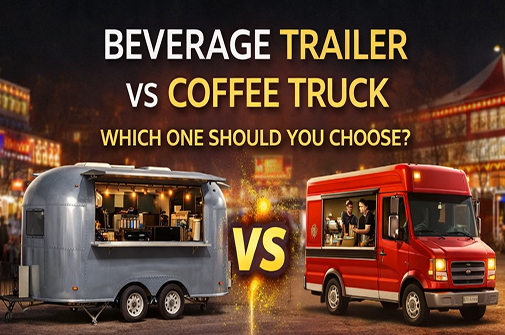
| Coffee Trailer | Best balance | Requires towing |
For most Australian buyers, a coffee trailer hits the sweet spot:
Professional setup
Council-friendly in many areas
Enough space for proper espresso equipment
This is where many imported trailers fail.
Coffee quality
Speed during peak times
Clean, professional presentation
A trailer that might work overseas often struggles in Australia because:
Layouts are inefficient
Power systems aren't compatible
Espresso machines are under-spec'd
At ZZKNOWN, we design specifically with Australian conditions in mind—not generic “global” layouts.
There's no one-size-fits-all answer, but trends are clear.
| Size | Best For | Notes |
|---|---|---|
| 6×8 ft | Solo operators | Tight but workable |
| 6×10 ft | Most popular | Great balance |
| 7×12 ft | Events & busy sites | Two baristas |
| 8×14 ft | High volume | Requires planning |
My honest advice:
If you're planning to serve espresso properly, 6×10 ft or larger is where life gets easier.
Short answer: Critical.
Long answer: It affects speed, quality, staff fatigue, and council approval.
A pivot layout means:
The barista stands in one main position
Espresso machine, grinder, milk fridge, and sink are all within arm's reach
No wasted steps during rush periods
In busy Australian morning trade, every second counts.
From experience:
Good layout = 30–40 seconds per cup
Poor layout = queues, complaints, lost sales
This is something councils and inspectors care about.
In most Australian councils:
Fixed, bolted-down equipment is seen as safer
Less movement during transport
Easier compliance inspections
At ZZKNOWN, we:
Reinforce benches
Secure espresso machines and grinders
Design for towing stability
This isn't just about compliance—it's about longevity.
Let's cut through the noise.
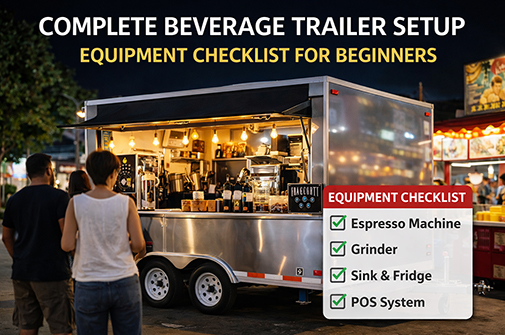
| Equipment | Why |
|---|---|
| Commercial espresso machine | Coffee quality |
| High-quality grinder | Consistency |
| Under-bench fridge | Milk temperature |
| Fresh & waste water tanks | Council rules |
| Handwash + sink | Health compliance |
| Hot water system | Cleaning |
| POS system | Speed |
Second grinder (decaf or single origin)
External fold-down counter
LED menu board
Canopy or awning for sun protection
Power is one of the most misunderstood topics.
15A / 20A mains power (most councils & sites)
Generator (events, remote locations)
Australian espresso machines often require:
Stable voltage
Sufficient amperage
Proper RCD protection
We design trailers at ZZKNOWN to match Australian electrical standards, which avoids painful (and expensive) retrofits later.
Australians won't wait long—especially weekday mornings.
Peak hours: under 45 seconds per cup
Events: consistency over complexity
Successful operators often:
Simplify menus during rush
Pre-steam workflows
Use efficient milk fridges
One Melbourne operator we worked with reduced average service time by 32% after redesigning layout alone.
This varies by state and council, but patterns exist.
Council inspection
Water and waste approval
Fire extinguisher & safety gear
Sometimes a commissary kitchen
Key tip:
Design your trailer for compliance first, branding second.
Let's be realistic.
Entry-level setup: AUD $25,000–$35,000
Fully equipped espresso trailer: AUD $40,000–$70,000
Return on investment depends heavily on:
Location
Operating hours
Speed & efficiency
Many operators break even within 6–12 months.
A Brisbane operator:
6×10 ft trailer
Simple menu
Busy weekday site
Result:
Broke even in 7 months
Expanded to events within a year
A beautifully designed trailer:
Too small
Poor workflow
Underpowered espresso machine
Result:
Long queues
Customer complaints
Costly rebuild
Looks don't pour coffee—design does.
Buyers work with ZZKNOWN because:
We understand Australian coffee standards
We design for workflow, not just appearance
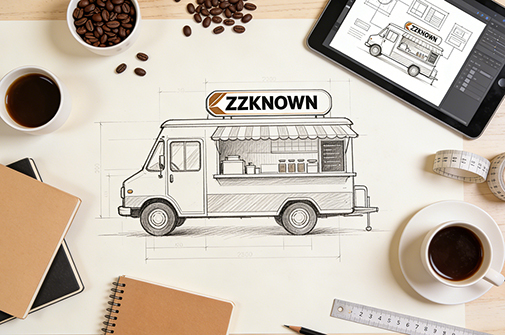
We provide 2D/3D layouts before production
We customise for council and power needs
We don't sell “copy-paste” trailers.
Most councils allow them, but rules vary—always check locally.
Some councils require it, some don't.
Yes, with a good layout and menu.
For espresso quality and volume—absolutely.
Usually 30–60 working days after design confirmation.
If you care about:
Coffee quality
Lower startup risk
Flexible locations
A coffee trailer in Australia is one of the smartest ways to enter the coffee business—if it's designed properly from day one.
And that's where experience matters.