Published: November 9, 2026 | Last updated: November 9, 2026 | Region: Global buyer guidance; U.S. regulatory examples identified below
Secure every heavy appliance to a load-bearing part of the trailer using a mounting method approved for that appliance and the vehicle; restrain doors, drawers, tanks, and loose stock separately. Leave access for cleaning and service, protect utility connections from movement, and inspect everything before and after each trip. Final details depend on the equipment, trailer structure, and local authority.
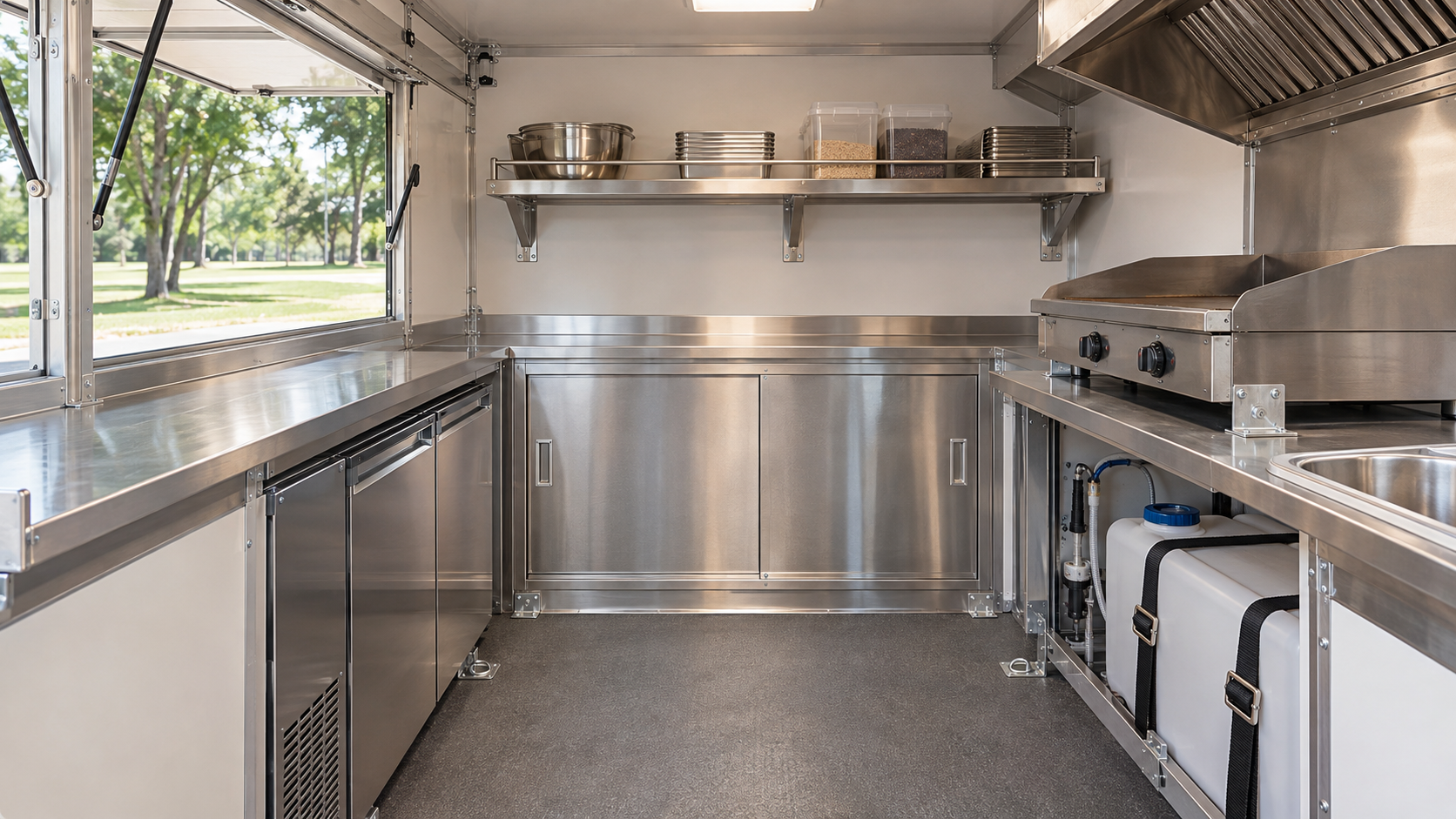
Imagine your first event is over. You have wiped down the griddle, counted the remaining stock, and closed the service window. The trailer looks organized. Then the driver brakes for a light. A refrigerator that was merely pushed against a bench shifts forward, a drawer slides out, and a stack of pans lands on the floor. Nothing about that scenario requires a dramatic crash; ordinary driving is enough to reveal a weak restraint plan.
According to ZZKNOWN’s production experience, buyers often begin with the cooking line: What size fryer? How many burners? Where should the refrigerator go? Those are good questions, but a trailer adds another one: What holds each item in place between one service location and the next? The answer affects floor structure, wall reinforcement, bench design, utility routing, door hardware, cleaning access, and where heavy mass sits relative to the axle. It is therefore a layout decision, not just a bag of bolts added at the end.
Think about three motions. Braking encourages equipment and contents to move forward. Cornering encourages side-to-side movement. Uneven pavement creates repeated vibration that can loosen poorly chosen hardware over time. A restraint must address all three while letting a technician reach the appliance for cleaning and maintenance. A flexible gas hose, power cord, or water line is never an acceptable substitute for a mechanical restraint.
Fixed equipment is intended to stay in its assigned position during service and travel: a built-in bench, undercounter refrigerator, cooking appliance, or tank assembly, for example. Movable equipment may be pulled out for cleaning or reconfigured for a different menu, but it still needs a defined transport position and a positive restraint before the trailer moves. Loose items include pans, utensils, ingredient tubs, POS hardware, and removable countertop appliances. A strong appliance mount does nothing for the contents that can fly out of an open cabinet.
For a buyer, the useful question is not “Is it bolted down?” It is “What is the travel state of this item, what prevents motion in each direction, and how do we inspect that restraint?” If the answer depends on friction, a rubber mat, the weight of the appliance, or a door that happens to stay shut, ask for a better design.
| Approach | Best use | Main advantage | What to verify |
|---|---|---|---|
| Engineered brackets to reinforced floor or frame | Heavy fixed appliances and benches | Clear, inspectable load path | Manufacturer mounting points, substrate, corrosion protection, service access |
| Purpose-designed cabinet bay with stops | Undercounter units and contained equipment | Integrated into kitchen layout | Positive restraint, ventilation clearance, removal path |
| Rated straps at designed anchor points | Equipment intentionally removable for transport | Flexible for changing menus | Anchor capacity, strap condition, repeatable operator procedure |
| Door latches, drawer catches, bin lips | Cabinets and stored supplies | Keeps contents contained | Positive engagement and load when full |
This is a method comparison, not a universal hardware specification or load rating. Quote and approve the actual mounting details for your trailer, destination, and equipment model.
Start with the equipment’s actual installation instructions. A refrigerator might have approved anchoring locations or require an installation kit; another might not allow drilling through its base at all. Ask for the exact make, model, operating weight, service clearance, and door swing before the builder finalizes the bench. Then locate it where the trailer structure can support a real restraint without puncturing refrigeration components or blocking airflow.
An undercounter unit can look beautifully flush in a rendering and still be impossible to remove for repair. Ask: Can a technician reach the condenser and clean the surrounding area? Is there a route to slide the unit out after power and plumbing are safely disconnected? Does the door have a transport latch, or must the operator empty and secure it by a separate method? For refrigerated food, transport temperature control is a separate food-safety issue; a strong mount does not replace temperature monitoring.
If you are evaluating cold storage capacity as well as securing, see ZZKNOWN’s refrigeration monitoring guide. Verify the exact page and available controls for your configuration with the sales and engineering team.
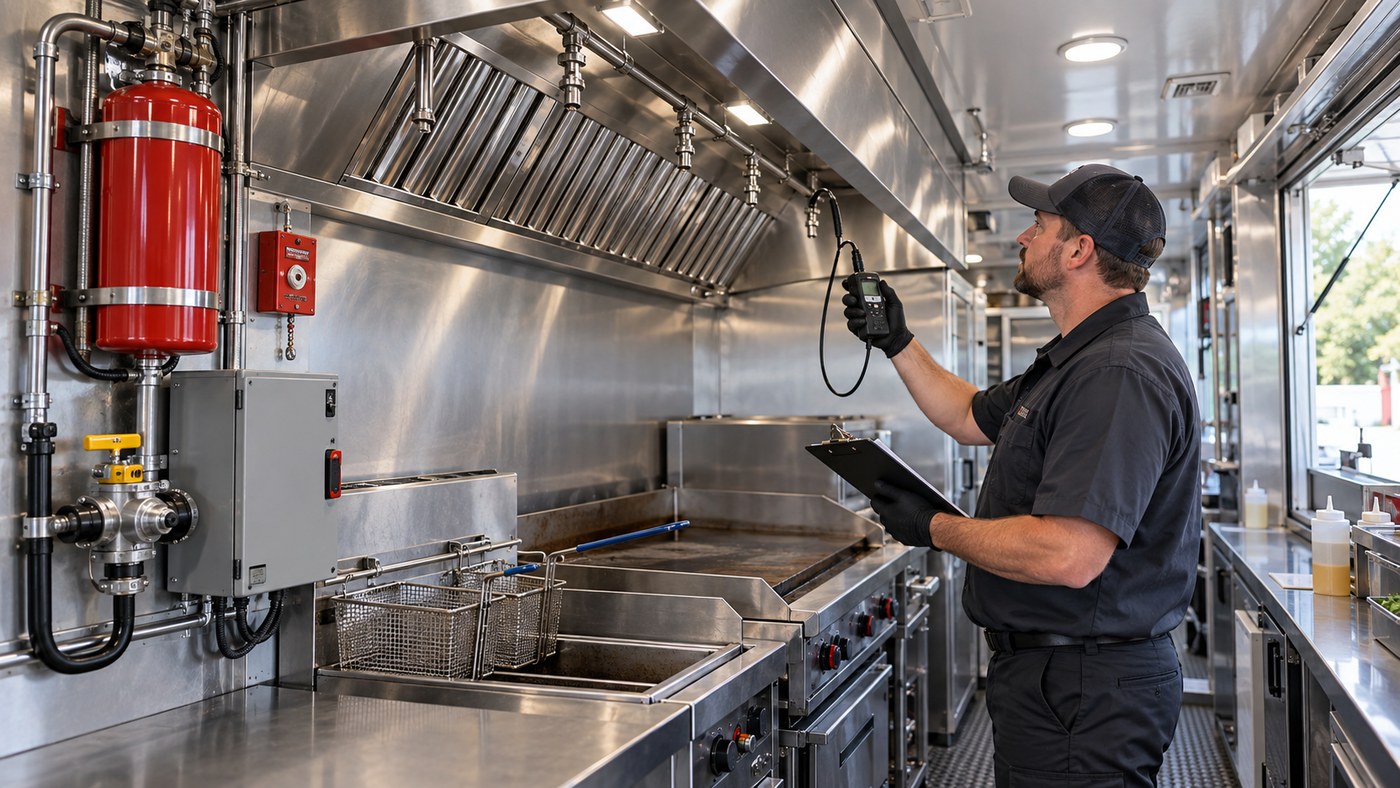
Cooking equipment needs more than a convenient counter position. The counter or equipment stand must have a defined connection to the trailer structure; the appliance must have a restraint appropriate to its approved mounting points; and heat, cleaning, ventilation, fire protection, and utility disconnects must still work as designed. Do not improvise by driving screws through a fryer body or clamping across a removable service panel.
Ask the builder to show two drawings: the working layout and the travel layout. In the working layout, staff need safe access to controls, drains, and service areas. In the travel layout, lids and removable components are secured, grease and oil are handled according to the appliance instructions and local rules, and no hose or cord is carrying the appliance load. A countertop griddle that is easy to reposition at an event still needs a documented place to ride.
Gas-fired equipment calls for a qualified installer and destination-specific review. Bottle storage, regulators, shutoffs, ventilation, leak testing, and transport procedures vary by jurisdiction. The ZZKNOWN LPG system guide is a useful planning companion, but a local licensed professional and authority having jurisdiction must approve the finished system.
A stainless workbench may be one of the largest objects in a compact kitchen. The legs, floor interface, backsplash, and any wall connection should be designed together so the bench does not become a lever on a thin wall panel. A good drawing identifies the structural attachment, the fasteners and backing, and how the floor and wall joint will remain cleanable. Avoid dead gaps where food debris and wash water can collect.
Shelves need more than strong-looking brackets. Consider the shelf itself, its supports, the wall reinforcement behind them, and the pans or bins placed on top. Heavy stock belongs low. Upper shelves should have lips or other containment suited to their contents, but do not assume a lip alone will hold tall bottles or dense ingredients during a sharp maneuver. Every cabinet and drawer also needs a latch that stays positively closed during travel. In practice, people forget the small things: a cash drawer, a magnetic knife rack, a bottle rail, or a display warmer that was added after the original plan.
ZZKNOWN’s storage and shelving design guide explains how to separate daily-use items from reserve stock. Read it alongside the securing plan: good storage placement reduces the amount of heavy material that must be kept high above the work zone.
Fresh-water and wastewater tanks change mass as they fill and empty. That means their supports, straps, saddles, or cradle must be planned for the tank in its relevant operating states, not just when it is empty in the factory. The builder should identify the tank volume, location, support points, fill and drain access, hose routing, and how an operator can inspect for leaks or movement. Protect valves and pipes from being used as accidental handholds or tie-down points. A drain line should not be the thing that keeps the tank from sliding.
A generator, whether carried in a dedicated exterior enclosure or transported separately, has its own manufacturer instructions for mounting, ventilation, exhaust, fueling, and service. An enclosure that merely fits the box dimensions is not enough. Ask where it is restrained, where hot exhaust goes, and how the operator removes it if required. Never run a generator in an unventilated compartment or assume a general appliance strap solves exhaust safety.
For tank cleaning and seasonal start-up after transport or storage, see ZZKNOWN’s fresh-water tank guide. Tank hygiene and tank restraint are different checks, and both belong in the handover.
ZZKNOWN’s published Australian 250W customer project provides a real example of how a compact trailer uses fitted stainless workbenches and undercounter cabinets. The project page identifies a 250 × 200 × 230 cm single-axle trailer, Australian-style electrical fittings, and a tailored service window. The photograph below is from that project, not from the generated concept image above.
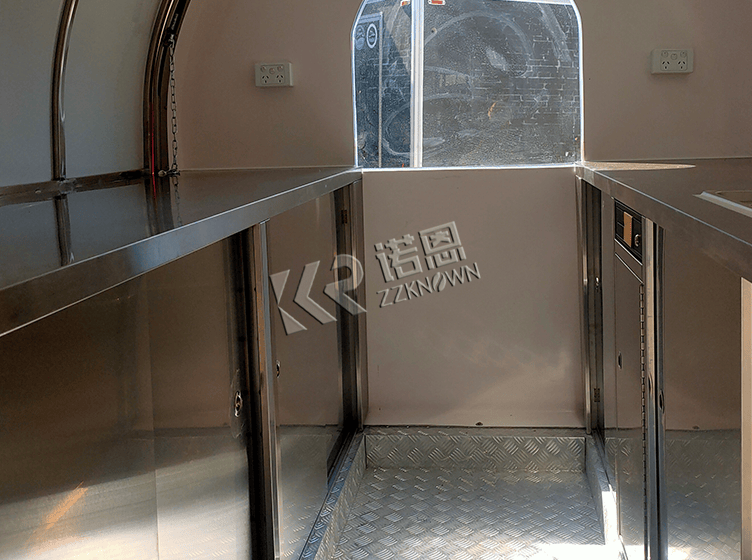
For a larger starting point, the published KN-FS400 product page lists a 4 m × 2 m × 2.3 m double-axle food trailer. That is a real model reference, not a promise that the photographed Australian project or every KN-FS400 unit shares the same mounting hardware. Ask for the build-specific drawing before approving a quote.
Based on ZZKNOWN’s production workflow, a responsible review begins with the equipment schedule and weight, manufacturer-approved mounting locations, trailer floor and wall construction, expected full and empty tank conditions, utility connection paths, access for cleaning, and the destination’s inspection requirements. Only then can the builder choose anchors, backing plates, brackets, latches, and installation details. No named ZZKNOWN engineer has been represented as having personally reviewed this article or a particular customer build.
That last distinction matters. A blog can explain the questions to ask, but it cannot validate an individual installation from a photograph. Request a drawing that marks each appliance’s location, the intended attachment to a structural member or reinforced panel, the travel latch for doors and drawers, and the clearance needed to reach drains, filters, and shutoffs. For a removable appliance, request a written packing and restraint procedure instead of leaving it to the driver’s judgment.
There is no single global food-trailer fastening rule. In the United States, the FDA Food Code 2026 is a model for jurisdictions to adopt, not a nationwide building approval for a specific trailer. Its sections 4-402.11 and 4-402.12 address how fixed equipment is spaced, sealed, or elevated to allow cleaning; section 4-501.11 says doors, hinges, fasteners, and similar components should remain intact and adjusted to manufacturer specifications. These food-safety provisions help prevent a careless restraint design from making the kitchen uncleanable. They do not prescribe a universal bracket or bolt size for road travel.
As one local U.S. example, Northern Nevada Public Health’s mobile-unit program directs applicants to its construction guidance and Food Establishment Regulations, and asks for design plans of the mobile-unit layout. Its guidance document says the intended menu, construction, and available equipment affect permitting, and that inspectors expect equipment in good repair and surfaces that can be cleaned. That guidance applies to Washoe County; it should not be copied into a quote for another country as if it were universal law.
Wherever you operate, confirm the current vehicle, gas, electrical, fire, and food-premises requirements with the authorities and qualified installers in that destination. A manufacturer’s statement of “U.S. ready” or “EU ready” is not a substitute for the permits, inspection, and final approvals you will actually need.
At arrival, inspect again before opening for service. A new rattle, shifted appliance, wet floor under a tank, or cabinet that no longer closes is information, not an inconvenience to ignore. Stop and correct the cause before operating. For frequent routes, the same short inspection repeated consistently is more useful than an elaborate checklist nobody follows.
This article was prepared from publicly accessible ZZKNOWN product and customer-project pages, the FDA’s 2026 Food Code page and text, and Northern Nevada Public Health’s current mobile-unit program and guidance as checked on November 9, 2026. The comparison table is a qualitative engineering-planning framework; it is not a lab test, price survey, crash-test result, or certification schedule. No measured pull-out loads, vibration tests, customer failure rates, or universal installation costs were supplied, so none are claimed. Product specifications are those stated on the linked pages and must be reconfirmed for a new order.
Author: ZZKNOWN Editorial Team. Technical review: No named engineer or signed technical review was supplied for this article. Build-specific restraints should be reviewed by ZZKNOWN’s engineering team and qualified local installers before fabrication and use.
No. Floor skins are not automatically structural, and drilling an appliance can damage it or void its installation requirements. Identify approved appliance mounting points and a reinforced load path in the trailer, then check sealing and cleaning access.
Not as the sole travel restraint. A mat can help with ordinary use, but it does not create a positive mechanical connection when the trailer brakes or turns. Give removable machines a designated transport bay and approved tie-down method.
That depends on your cold-chain procedure, power availability, trip duration, product, and local rules. A secured refrigerator does not guarantee safe food temperature. Validate temperature control separately and restrain what is inside so it cannot damage the door.
They can help contain supplies, but only if the doors and their latches remain closed under the expected load. Dense stock should still be placed low and packed so it cannot slam into the door. Ask how the latch is tested and replaced.
Often yes, but not by assuming the old anchor locations will fit the new load. Send the replacement appliance’s dimensions, operating weight, utilities, and installation instructions to the builder or a qualified local professional for review.
It needs a designed mount and enclosure, correct tongue-load assessment, and compliance with the generator maker’s ventilation, exhaust, fueling, and maintenance requirements. Treat its location and mass as part of the complete towing design.
Send your menu, destination, proposed trailer size, exact appliance models or dimensions, operating weights, tank volumes, generator details, route frequency, and any local inspector notes. Ask for both an operating layout and a travel-state equipment schedule.
Send ZZKNOWN your equipment list and destination. Ask us to mark the proposed appliance positions, cabinet and door restraints, tank and generator locations, service clearances, and items that will need local installer review. We can then discuss a build-specific layout and quotation—not a generic promise that any trailer fits every market.
Request a secure equipment layout and quote