What Size Water Heater Does a Food Trailer Really Need?
Direct answer: Size a food trailer water heater from peak hot-water demand, not tank gallons alone. Add the usable volume needed for the wash sink, handwashing and other simultaneous draws, then confirm that the heater can recover before the next cleaning cycle. Check the required outlet temperature, incoming-water temperature, power or gas capacity, freshwater supply and wastewater storage with the local reviewer.
What should a buyer remember first?
- A legal minimum tank size is a starting point, not proof that the trailer will have enough hot water during a busy shift.
- Tank capacity tells you what is stored; recovery rate tells you how quickly the next batch becomes available.
- The largest warewashing compartment, its real fill line and the required water temperature usually drive the first large draw.
- Incoming water at 40°F requires much more energy than incoming water at 70°F to reach the same faucet temperature.
- An electric heater is also an electrical-load decision. The breaker, cable, plug, generator or shore-power service must support the heater and the rest of the kitchen.
- A larger heater and higher flow also affect freshwater and wastewater capacity, weight, service access and layout.
- Ask the plan reviewer and equipment manufacturer to approve the final specification before production.
Where do the data and examples in this guide apply?
This guide is for global buyers comparing food trailers, food trucks, coffee trailers, burger trailers and mobile kitchens. The engineering formulas are general planning tools. The regulatory examples come from the United States and were checked on September 23, 2026. The 2026 FDA Food Code is the latest FDA model code, but it is not automatically the enforceable rule in every state, county or city. Local authorities may use an earlier edition, add stricter provisions or apply a different plumbing and plan-review standard.
The most specific mobile example in this article is the Los Angeles County Mobile Food Facility Plan Check Guideline. It says a mobile facility conducting warewashing needs hot water at 120°F, lists a minimum four-gallon storage heater or an instantaneous heater, and states that the heater must be large enough to fill the first compartment of the three-compartment sink, support at least ten seconds of handwashing and maintain 120°F. That is a Los Angeles County example, not a worldwide product certificate.
Why can two four-gallon heaters perform completely differently?
Imagine two buyers ordering trailers that both list a four-gallon heater. One sells espresso, packaged pastries and bottled drinks. The other fries chicken, mixes sauces and cleans pans throughout the day. The coffee operator may use hot water mainly for handwashing and light utensil cleaning. The fried-food operator may need to fill a large wash compartment, replace greasy wash water and keep the hand sink ready at the same time. The label says “four gallons” on both quotations, but the work behind the label is not the same.
A storage tank is like a small battery for heat. Once the stored hot water is used, the heating element or burner must recharge it. A low-input unit can have the same tank volume as a high-input unit and take much longer to recover. Long pipe runs, heat loss, a low inlet-water temperature and back-to-back sink fills make the difference even larger.
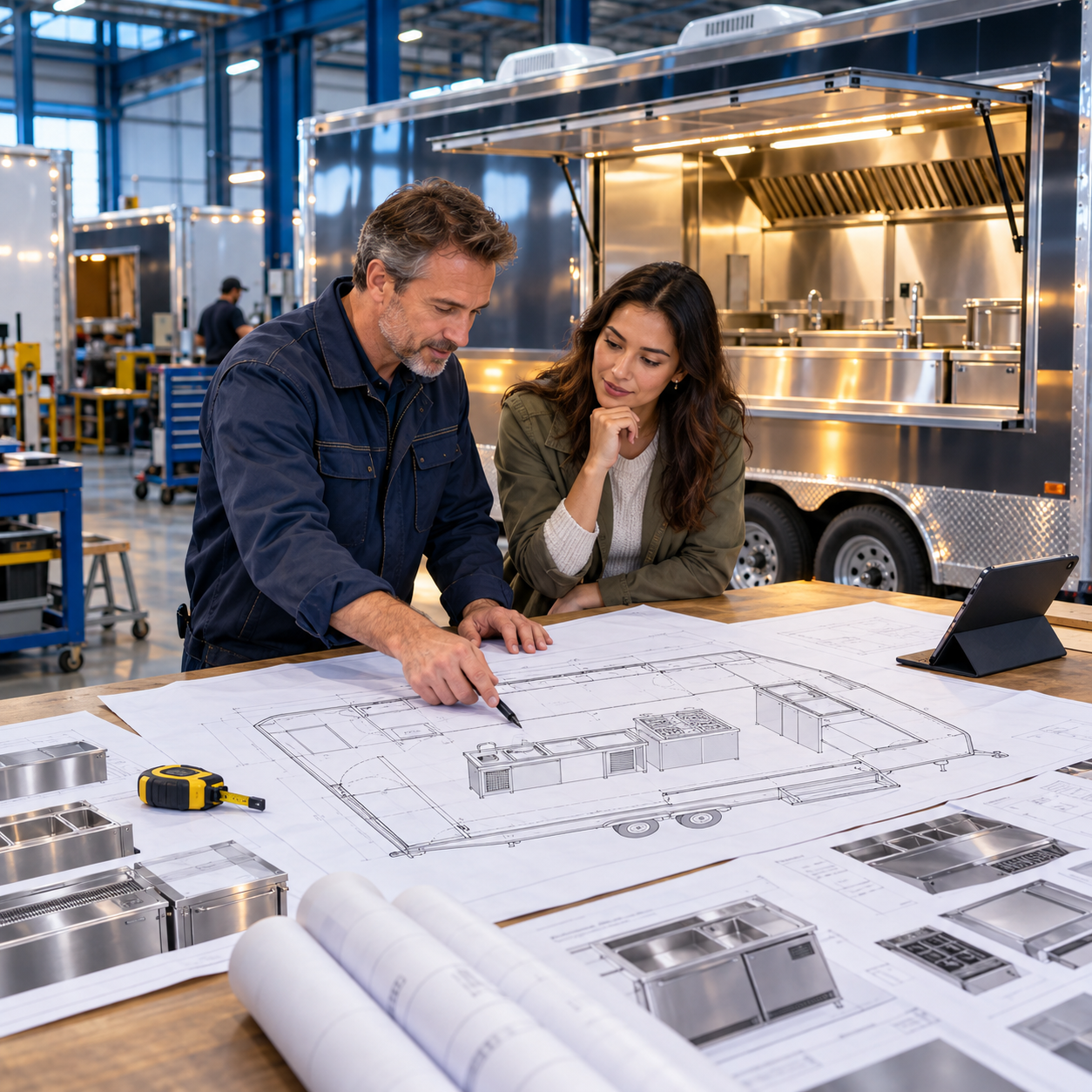
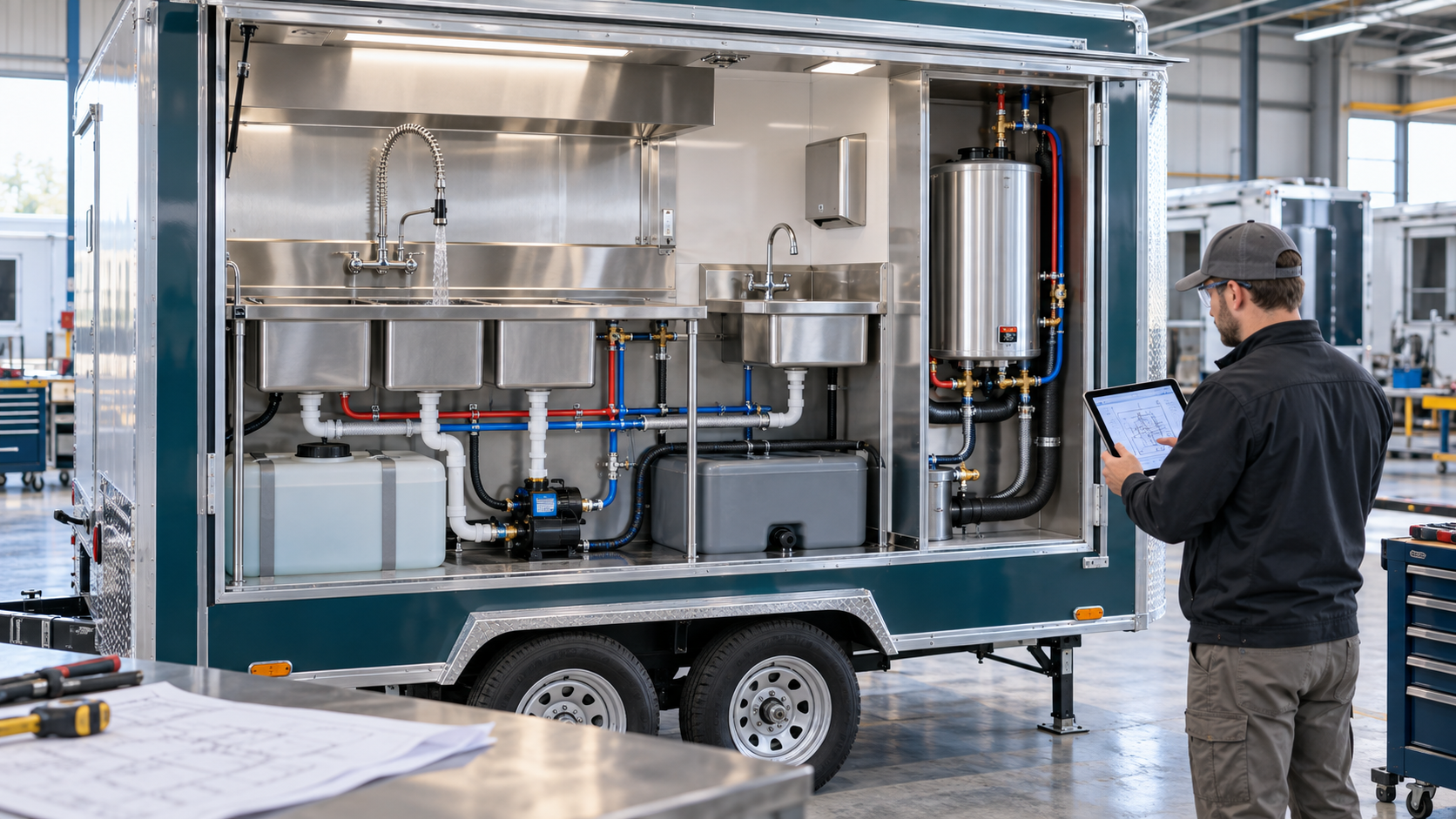
According to ZZKNOWN’s production experience, the best time to solve this problem is during the layout and equipment-schedule stage. The engineer should know the sink dimensions, fill depth, inlet-water assumption, heater model, energy source, other simultaneous loads and local plan-review target before the electrical panel, plumbing cabinet and tank supports are finalized.
What do capacity, recovery rate and first-hour delivery mean?
What is storage capacity?
Storage capacity is the nominal volume held in the heater tank. Usable hot water can be different because of thermostat setting, mixing, inlet-water dilution, draw pattern and the heater’s internal design.
What is recovery rate?
Recovery rate is how much water the heater can raise through a stated temperature increase in a stated time. A gallons-per-hour figure is incomplete unless the temperature rise and test conditions are also known.
What is first-hour rating?
ENERGY STAR defines First Hour Rating as an estimate of the maximum gallons a storage heater can supply in an hour that starts with the heater fully heated. It combines stored volume and recovery under a standard test, but many compact commercial or point-of-use units may publish different data.
What is temperature rise?
Temperature rise is outlet temperature minus inlet temperature. Heating 50°F water to 120°F is a 70°F rise. Heating 30°F water to 120°F is a 90°F rise and requires about 29 percent more heat for the same volume.
How can you calculate the water held in a sink compartment?
Use the internal length, width and actual working fill depth, not the outside dimensions and not automatically the full bowl depth. One U.S. gallon equals 231 cubic inches.
For example, a compartment with internal dimensions of 12 × 12 inches filled to an 8-inch working depth holds about 4.99 gallons. If it were filled to the full 10-inch depth, it would hold about 6.23 gallons. The correct working fill line depends on the utensils, displacement, detergent procedure, splash control and local reviewer. The sink also needs to accommodate the largest utensil when that is required by the applicable rule.
| Example compartment | Working fill depth | Calculated water volume | Why it matters |
|---|---|---|---|
| 10 × 14 in bowl | 8 in | About 4.85 gal | A nominal four-gallon heater cannot supply a full 4.85-gallon draw at the target temperature without recovery or mixing assumptions. |
| 12 × 12 in bowl | 8 in | About 4.99 gal | The first wash compartment alone can consume roughly five gallons before handwashing is added. |
| 14 × 16 in bowl | 8 in | About 7.76 gal | Larger cookware can move the design beyond common compact point-of-use tanks. |
| 18 × 18 in bowl | 8 in | About 11.22 gal | Large catering utensils can create a major peak draw and require a different heater and tank strategy. |
These are geometry examples, not recommended sink sizes and not a statement of code compliance. Measure the proposed sink and use the reviewer-approved working assumption.
How should you estimate peak hot-water demand?
How can you estimate electric water-heater recovery?
A useful planning formula comes from the heat required to raise one gallon of water by one degree Fahrenheit. It is not a substitute for the manufacturer’s certified performance data.
The table below assumes a 98 percent conversion factor for a simple immersed electric element, consistent with the assumption used in a U.S. Department of Energy water-heater test-procedure document. Real performance can be lower because of standby loss, cycling, voltage, scale, plumbing loss, controls and installation conditions.
| Electric input | Approx. recovery at 70°F rise | Approx. recovery at 90°F rise | Ideal current reference |
|---|---|---|---|
| 1.5 kW | 8.6 gal/hour | 6.7 gal/hour | 12.5 A at 120 V before design allowances |
| 3.0 kW | 17.2 gal/hour | 13.4 gal/hour | 25 A at 120 V or 12.5 A at 240 V before design allowances |
| 4.5 kW | 25.8 gal/hour | 20.0 gal/hour | 18.75 A at 240 V before design allowances |
| 6.0 kW | 34.5 gal/hour | 26.7 gal/hour | 25 A at 240 V before design allowances |
Planning estimates only. Circuit sizing, continuous-load treatment, conductor size, overcurrent protection, disconnects, grounding, plug type and installation must be designed by qualified people to the destination’s rules and the appliance instructions.
Why does cold inlet water change the answer so much?
Suppose a 3 kW heater must deliver water at 120°F. With 70°F inlet water, the rise is 50°F and the theoretical recovery is much faster than with 40°F inlet water, which creates an 80°F rise. The same heater, tank and trailer can feel adequate in a warm commissioning bay and slow during a cold outdoor event.
This is why a buyer should send ZZKNOWN the operating city or climate, season, water source and expected inlet range. If the trailer will work in Canada in winter, Arizona in summer and indoor exhibition halls, the utility plan needs more than one ambient assumption. Insulated hot-water lines can reduce distribution loss, but insulation cannot replace inadequate heater input.
Should you choose a tank or tankless water heater?
| Decision point | Storage heater | Tankless / instantaneous heater |
|---|---|---|
| Peak draw | Stored hot water helps meet a short large draw even when the heating input is modest. | Must have enough input to heat the required flow continuously at the design temperature rise. |
| Electrical demand | Often lower instantaneous input, but recovery may be slower. | Electric tankless models can require very high current, which may not suit a small generator or 30/32 A connection. |
| Gas option | Gas storage adds combustion, flue, gas-train and ventilation decisions. | Gas tankless can provide strong recovery but still needs approved installation, venting, freeze protection and adequate gas supply. |
| Space | Tank occupies cabinet volume and needs secure mounting for road travel. | Compact body can save space, but clearances, service access and utility hardware remain. |
| Low-flow behavior | Usually supplies low flows without a minimum activation threshold. | Some units need a minimum flow to fire or energize; verify compatibility with the hand-sink faucet. |
| Plan review | Published volume and recovery data can be easy to explain. | The reviewer may request flow, temperature-rise and listing data. “Endless hot water” is not a calculation. |
There is no universal winner. A compact coffee trailer with limited heavy warewashing may benefit from a small approved system. A high-volume burger trailer may need a larger storage and recovery combination. A tankless heater that works on a building’s utility service can overwhelm a trailer’s generator. A storage heater that fits the electrical service can still run out during back-to-back cleaning. Match the technology to the actual load.
How does the water heater affect the generator and electrical panel?
A heater is often one of the largest continuous or repeated electrical loads in a mobile kitchen. Add it to refrigeration, air conditioning, espresso equipment, fryers, hood fans, pumps, lighting and point-of-sale equipment, then account for starting currents and applicable design margins. Do not simply add nameplate watts and buy the closest generator size. The electrician or system designer must check voltage, phase, frequency, branch circuits, simultaneous demand, protective devices and the connection allowed at the operating site.
A 3 kW heater on 120 V draws an ideal 25 A before design allowances. That single appliance can consume most of a 30 A, 120 V service. Moving the heater to 240 V may reduce current on each conductor, but only if the destination, appliance and panel are designed for it. A gas heater may reduce electrical demand but introduces gas storage, combustion, ventilation and approval requirements. The correct answer is a utility balance, not a sales slogan.
How do freshwater and wastewater tanks change the design?
Hot water starts as freshwater and ends as wastewater. A heater sized for repeated sink fills is useless if the freshwater tank empties after one cycle or the wastewater tank reaches capacity before lunch. Tank volume also adds weight: one U.S. gallon of water weighs about 8.34 pounds, or roughly one kilogram per liter. The chassis, tank brackets, axle loads and tow balance must be checked with tanks in realistic travel and operating conditions.
Los Angeles County’s guideline provides a useful example of this systems approach. For enclosed mobile food facilities, it identifies at least 25 gallons for food preparation and warewashing, plus dedicated handwashing provisions, and specifies wastewater capacity at least 50 percent greater than the potable-water tanks supplying the hand and warewashing sinks. Other jurisdictions use different numbers. The lesson for a global buyer is not to copy the Los Angeles values; it is to size heater, water supply and wastewater storage together.
What would three practical trailer scenarios look like?
| Illustrative scenario | Likely demand pattern | Questions before selecting the heater |
|---|---|---|
| Compact coffee trailer | Frequent handwashing, pitchers and small tools; espresso machine may have its own boiler; moderate cleanup peak. | Is there a warewashing sink? What is the largest pitcher? Is the cup washer connected? Does the espresso machine use product water from a separate approved line? |
| 4 m burger and fries trailer | Greasy utensils, tongs, pans and prep tools; handwashing overlaps service; heavy end-of-shift wash. | What is the first-compartment working volume? How often is wash water replaced? Is the heater electric or gas? Can the generator and panel support the recovery target? |
| Event catering trailer | Large cookware, batch production and intense cleanup periods; multiple staff may draw water at once. | Can the largest utensil fit? Is a larger storage/recovery package needed? Are shore water and power reliable? Will tank weight and wastewater capacity remain within the trailer design? |
These are planning stories, not measured customer results. ZZKNOWN should calculate the real configuration from the buyer’s menu, sink, heater data and destination review.
What does a real ZZKNOWN model show?

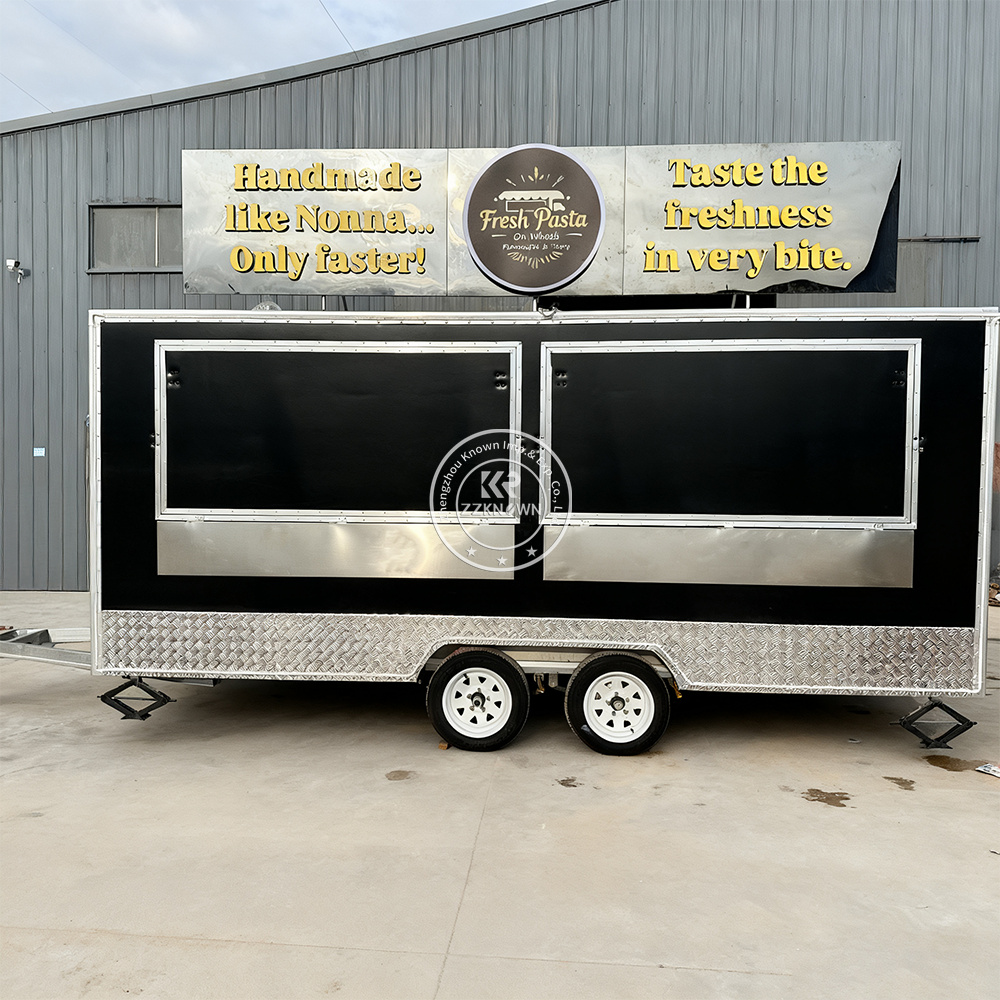
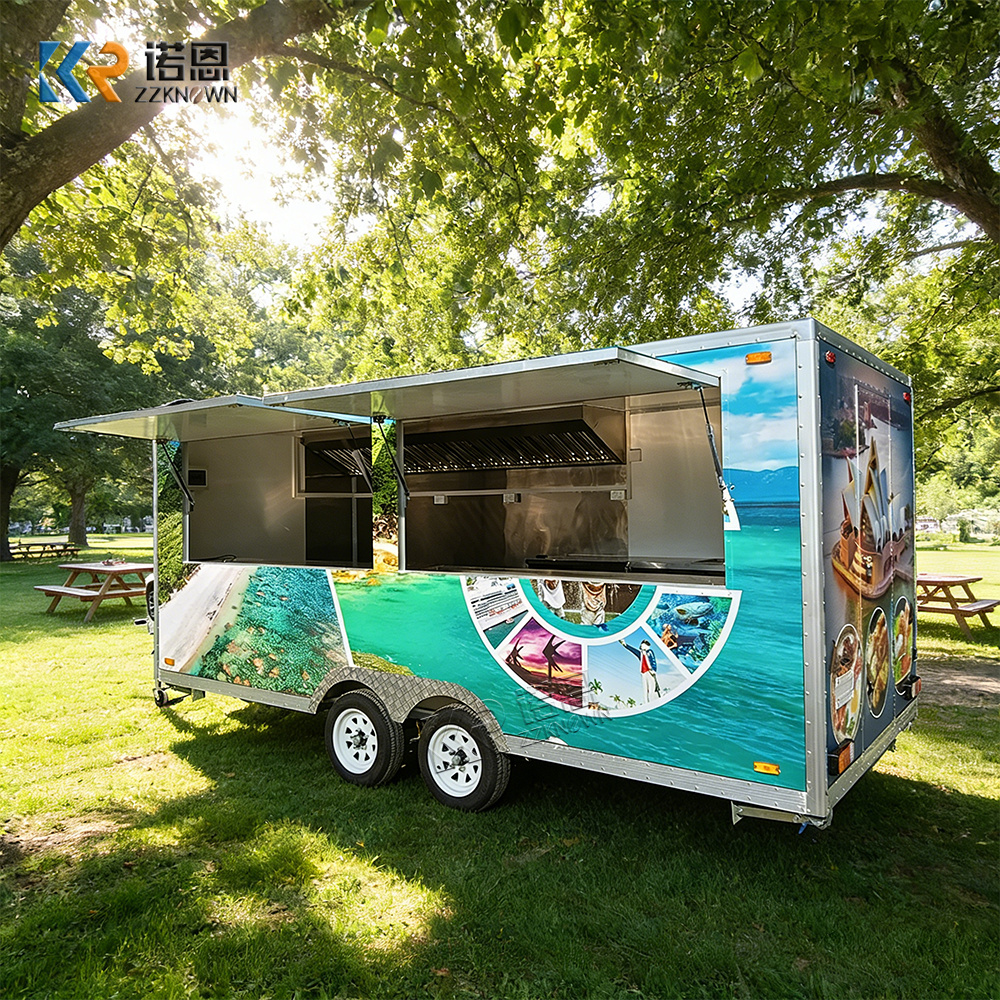
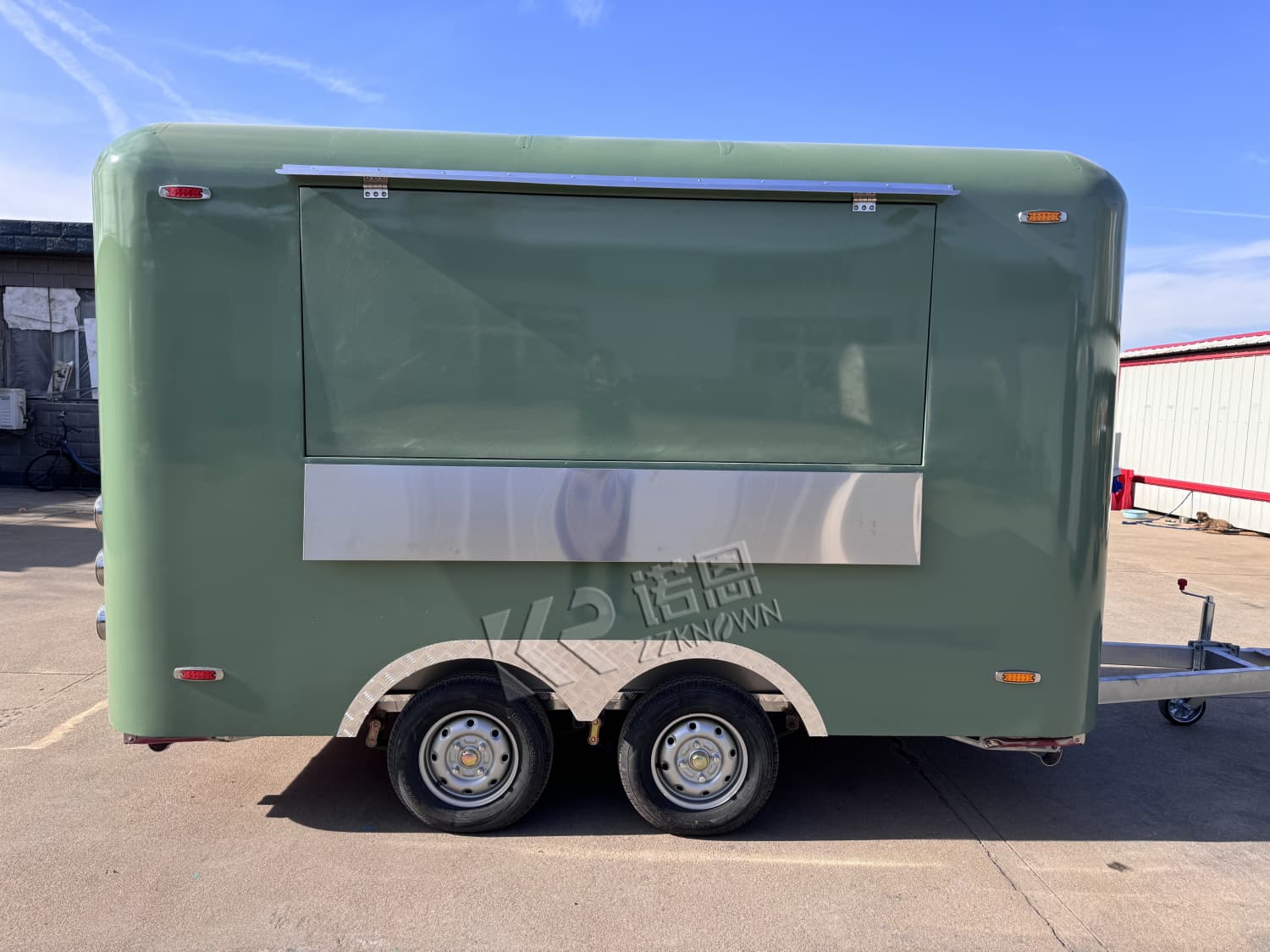
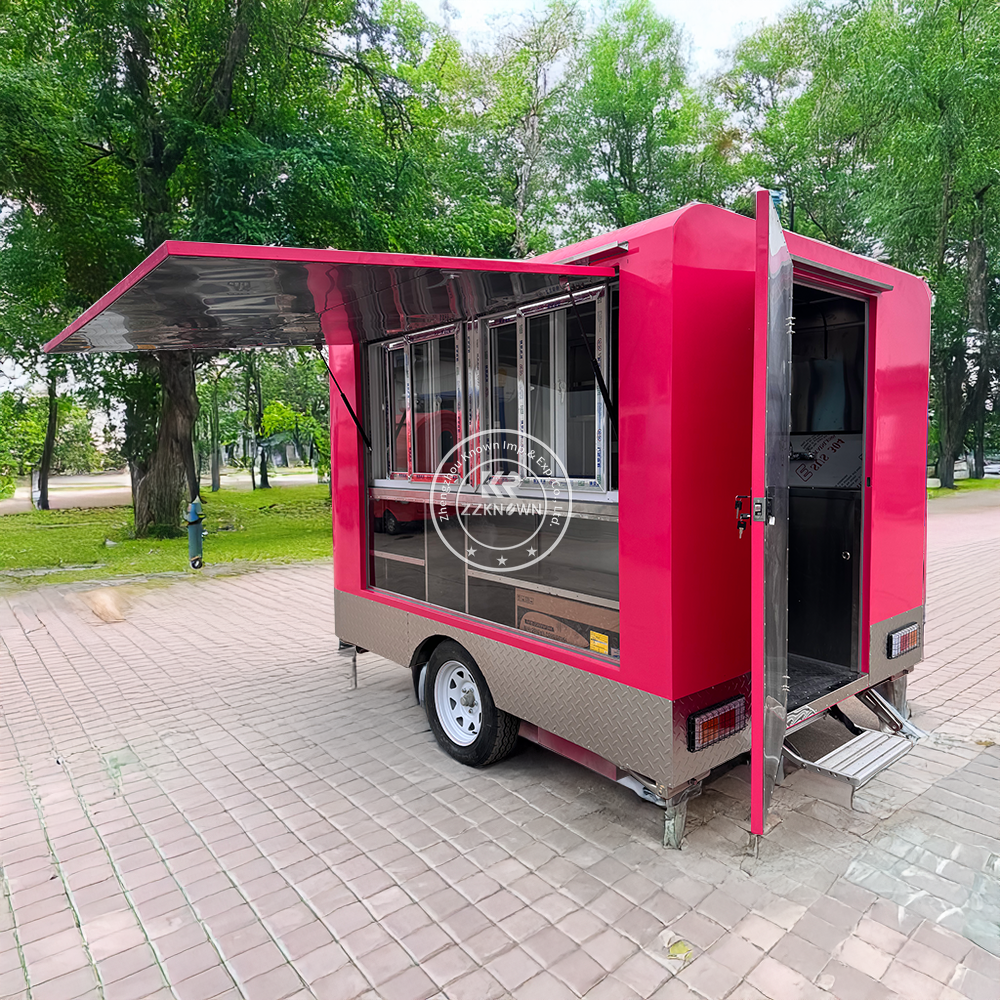
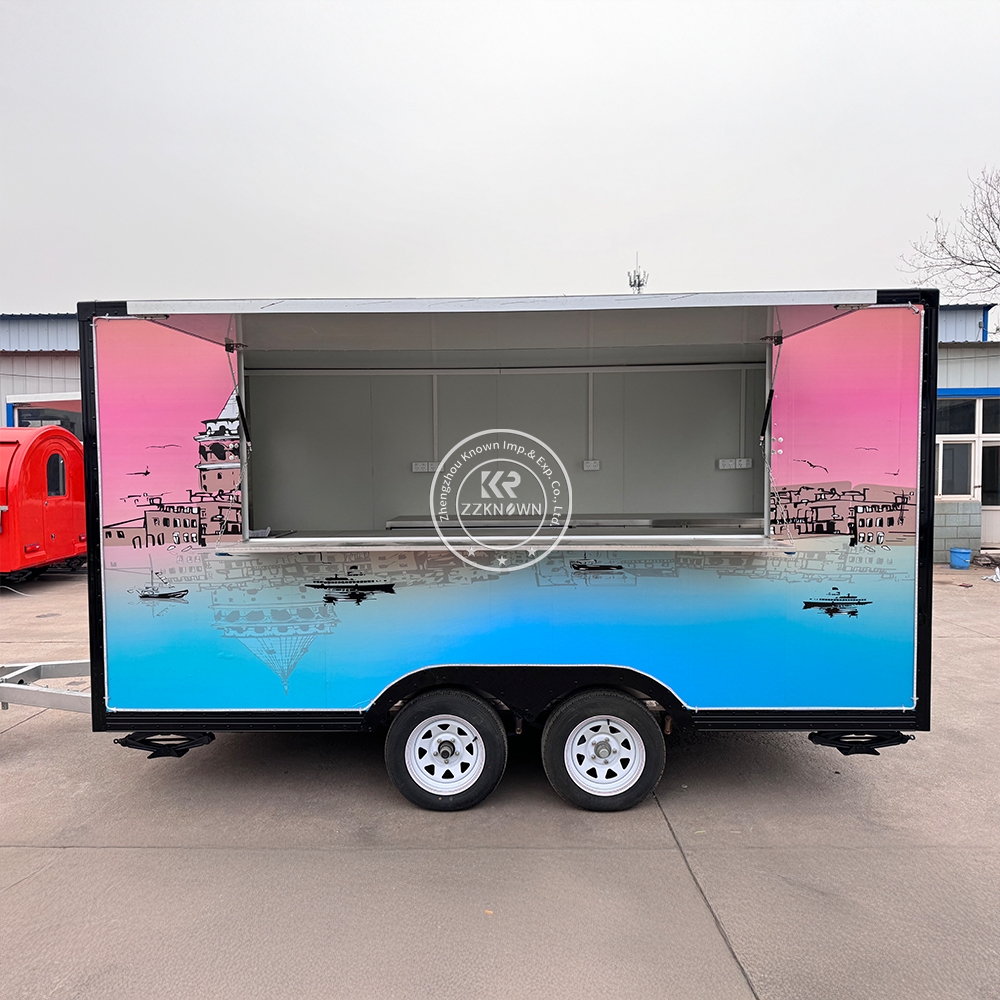
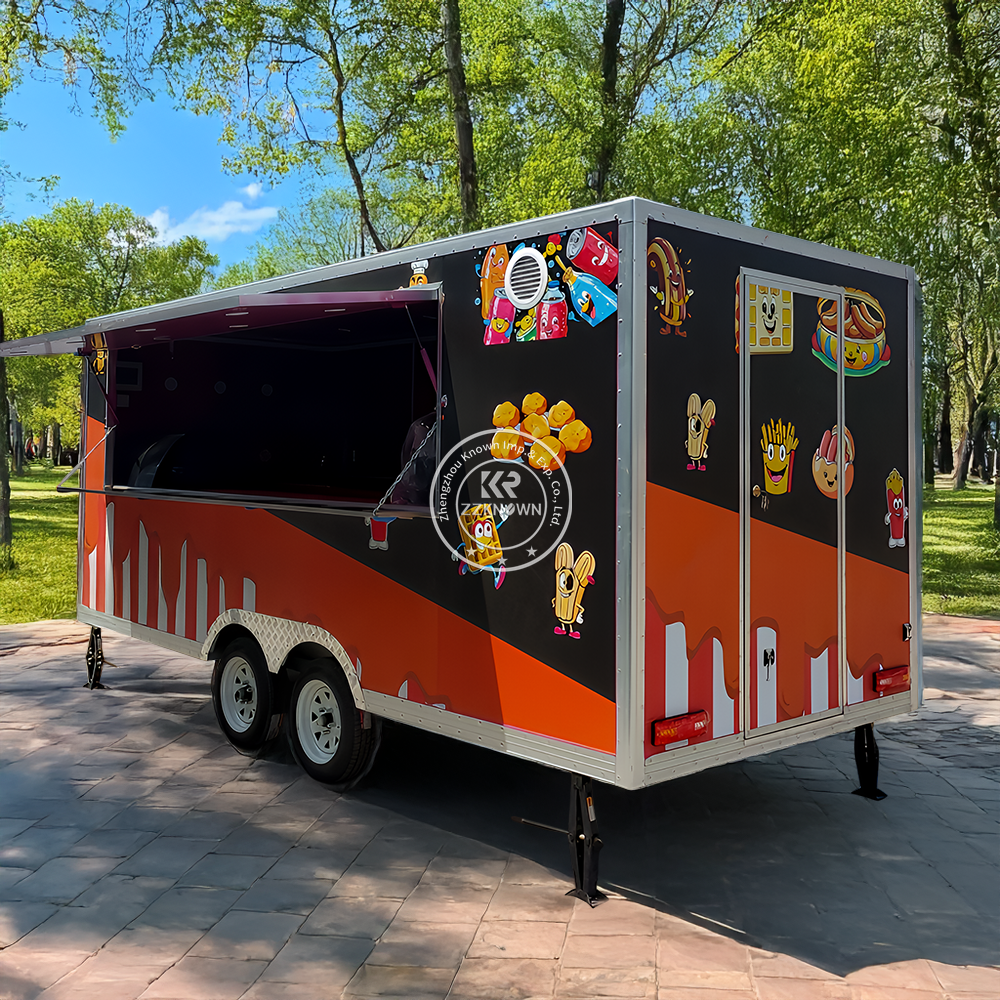
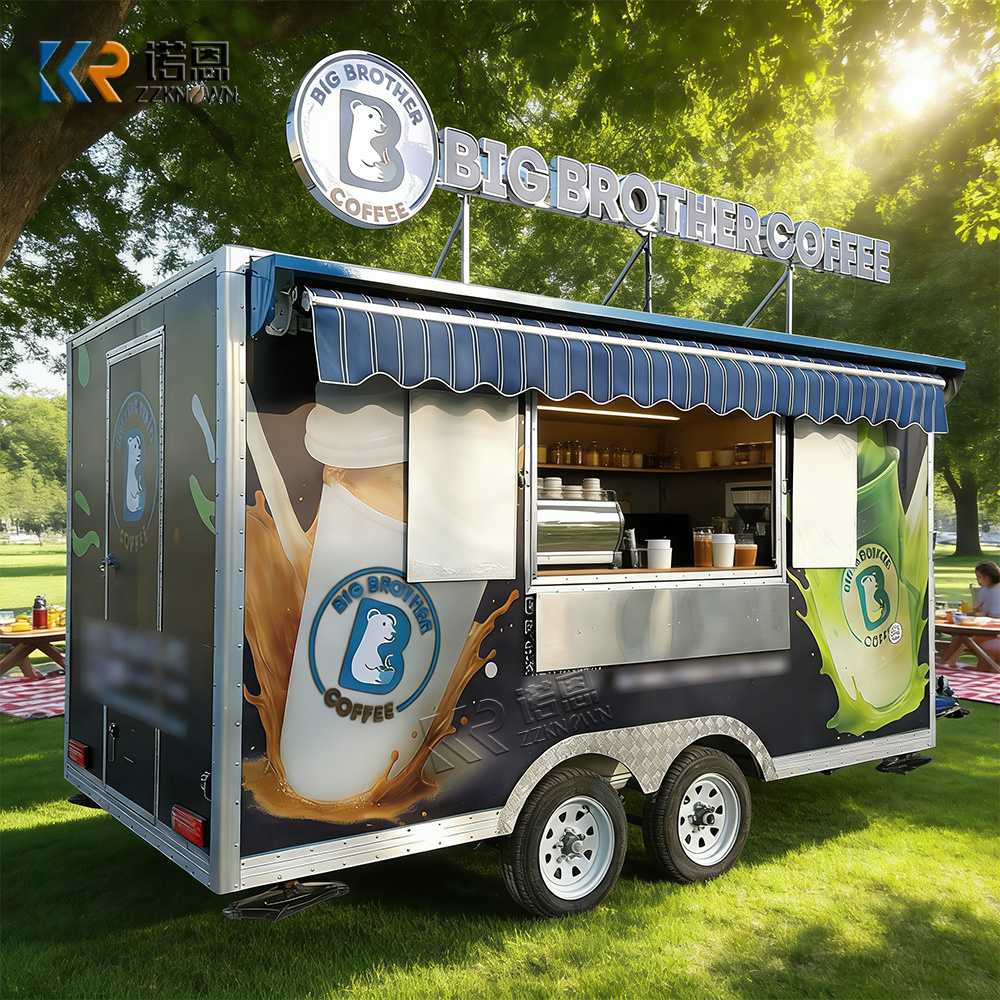
The published ZZKNOWN KN-FS410 4.1 m custom square food trailer is a useful real reference. Its product page lists a 4.1 × 2.15 × 2.35 m body, 110 V/60 Hz electrical system, hot-and-cold faucets, a 120 L clean-water tank and a 180 L wastewater tank in the shown configuration. Those numbers describe that published project, not a universal specification for every KN-FS410.

A buyer could use this platform for coffee, burgers or mixed menus, but the heater cannot be chosen from trailer length alone. During engineering review, the team should record the sink’s internal dimensions, working fill level, heater model and input, faucet flow, inlet-temperature assumption, electrical schedule and tank capacities. If any of those change, the hot-water calculation should be checked again.
What does the ZZKNOWN engineer want before approving the layout?
How did we collect and calculate the data?
We used four data groups. First, we checked the newly issued FDA Food Code 2026 page to confirm that it is a model offered for jurisdictional adoption. Second, we reviewed the Los Angeles County mobile-food plan-check guidance for its stated sink, temperature, heater and tank examples. Third, we used ENERGY STAR water-heater definitions for First Hour Rating and gallons per minute at a stated rise. Fourth, we checked the current ZZKNOWN KN-FS410 product page and its real project images.
The sink-volume table uses geometric volume divided by 231 cubic inches per U.S. gallon. The electric-recovery table uses the thermal relationship among watts, Btu, water mass and temperature rise, with a 98 percent electric-element efficiency assumption for the planning calculation. We did not test a named heater, collect field data from a customer shift or claim a guaranteed recovery rate. Final figures must come from the selected heater’s manufacturer data and the approved installation.
What mistakes cause hot-water complaints after delivery?
- Buying by gallons only: the quotation lists tank volume but no recovery rate, element input or temperature-rise condition.
- Measuring the sink outside: external bowl dimensions exaggerate usable water volume or hide the real fill line.
- Using warm inlet water in the calculation: the design works in a factory test but slows in winter service.
- Ignoring simultaneous use: the hand sink, wash sink and other equipment compete for one small heater.
- Overloading the power system: an electric tankless heater is added after the generator and panel are already selected.
- Forgetting wastewater: extra hot-water capacity increases drainage demand and tank weight.
- Blocking service access: a refrigerator or cabinet prevents inspection, draining or heater replacement.
- Assuming factory documentation equals local approval: the destination reviewer has not accepted the appliance, plumbing or final plan.
What do real buyers usually ask?
Is a four-gallon water heater enough for a food trailer?
Sometimes, but the number alone cannot answer the question. Calculate the first sink fill, simultaneous handwashing and the time until the next draw. Then compare those loads with usable storage and the manufacturer’s recovery data under the expected inlet temperature.
How long will a small electric heater take to recover?
It depends on wattage, temperature rise, tank design and losses. As a planning example, a 1.5 kW element at a 70°F rise recovers roughly 8.6 gallons per hour under the assumptions in this guide. Use the selected model’s published data for the final decision.
Can I use an electric tankless heater on a generator?
Only if the heater’s voltage, current, starting/control behavior and required temperature rise fit the generator and distribution design. High-output electric tankless units can demand more current than a small mobile service can provide.
Does the FDA Food Code tell me the required tank size?
The FDA Food Code is a model for adoption and is not a universal mobile-trailer plan sheet. Your state or local authority decides the enforceable requirements. Ask the relevant health, plumbing, electrical and fire reviewers.
Should the heater be set hotter and mixed down?
Only if the heater, mixing valve, plumbing, scald protection and local rules allow that design. A higher storage temperature can increase effective mixed-water availability, but it also changes safety, energy and component requirements. Do not improvise the setting.
Do I need a separate heater for the hand sink?
Not always. One correctly designed system may serve both sinks, but the layout must maintain required temperature and availability at each fixture. Some operations or jurisdictions may prefer or require a different arrangement.
Can ZZKNOWN guarantee that a selected heater will pass inspection anywhere?
No responsible manufacturer can guarantee approval in every jurisdiction without destination-specific review. ZZKNOWN can prepare the layout, utility schedule and equipment information for the buyer’s local reviewer and revise the specification before production.
What information should I send for a recommendation?
Send the operating country and city, menu, staff count, largest utensil, sink dimensions, heater preference, water source, lowest expected inlet temperature, peak cleaning schedule, electrical service or generator and any official plan-check comments.
Which related ZZKNOWN guides should you read next?
- Food Trailer Drainboard and Air-Drying Guide
- HACCP Guide for Food Trailer Kitchens
- Battery-Powered Food Trailer vs. Generator Guide
- Food Trailer Workflow and Layout Guide
- Sanitizer Test Strips and Warewashing Guide
- Global Food Trailer Certification Guide
- Explore real ZZKNOWN trailer models
Which official sources should a buyer verify?
- U.S. FDA Food Code 2026 — the current federal model code, offered for adoption by jurisdictions.
- Los Angeles County Mobile Food Facility Plan Check Guideline — an official local example covering hot-water temperature, minimum heater capacity and system sizing.
- ENERGY STAR Water Heater Key Product Criteria — definitions for First Hour Rating, gallons per minute and temperature rise under standardized conditions.
Would you like a water-heater recommendation based on your real sink and menu?
Send ZZKNOWN your sink internal dimensions, largest utensil, menu, operating city, inlet-water assumption, peak wash schedule, voltage, generator or shore-power limit, preferred gas system and freshwater/wastewater targets. Our team can prepare a menu-based hot-water review and a practical CAD layout for local technical approval.
Request a Hot-Water & Layout ReviewCompare Real ZZKNOWN Food Trailers
Editorial and technical note: This article is educational planning guidance. It does not replace manufacturer instructions, professional plumbing or electrical design, scald protection, gas and combustion requirements, local health-department plan review, permits, inspection, warranty conditions or the authority having jurisdiction. Confirm the final heater, sink, power, gas, water and wastewater system before production.